
The soft corals are spawning at St John's Island!!!
Well, not all of them, but at least this species above. I have no idea what soft coral this is though. When I took the photo, I was actually rather doubtful if those were egg/sperm packages. It was only after I did a search online just now that I confirmed my suspicion. Seriously, this was something that I never expect to witness on an intertidal trip! I have heard from other friends who went diving to see the hard corals spawning, but today, I actually got to see a soft coral spawning without having to dive! This really made my day!
Today, we were actually on a recce trip to check out the shores for a field camp in Jun, and apart from the spawning soft corals, we saw a number of other interesting stuff.
As usual, I managed to find a few tiny Fan Seaweed Slugs (Costasiella spp.) on the Fan Seaweeds.
There were a few really tiny Land Hermit Crabs (Coenobita sp.) too, and each was just a few mm wide. They were bright red in colour. I suspect they were juvenile hermit crabs.
And here's a huge Land Hermit Crab nearby, using an African Land Snail's shell to protect its soft abdomen.
Talking about shells, we saw interesting living shells too, including this Giant Top Shell (Trochus niloticus).
I found a Dolphin Shell (Angaria delphinus) too! It got its common name from the shape of the shell, which resembles a jumping dolphin (with some imagination).
The Funeral Nudibranch (Jorunna funebris) appears to rather abundant on most of our shores these few weeks.
There was this little Pustulose Phyllid Nudibranch (Phyllidiella pustulosa) on a small rock. This nudibranch is said to be able to excrete toxic chemicals to deter predators.
There were lots of Bryopsis seaweed, and hence I wasn't surprised to find a few Leaf Slugs (Elysia ornata) which feed on the seaweed. Leaf Slugs are able to retain the chloroplast of the algae and use them for photosynthesis to make food, making them effective solar-powered!
I found the same Giant Chiton (Acanthopleura gemmata) that I had been seeing during my past few trips on the same rock! This time round it was busy trying to squeeze into a small crack though.
Another giant was this long and slim Giant Reef Worm (Eunice aphroditois), which appeared to be somewhat common on this shore
Another somewhat long and slim animal would be this pipefish. Not sure what species this is though.
There were quite a few Tiger Beetles (Subfamily Cicindelinae) near the coastal forest.
And what looks like a juvenile Brown Shrike (Lanius cristatus). Not sure if it's the same one, but I had saw one last November around the same area as well, and JH who's working in TMSI had told me that she regularly saw this bird in the same area.
Frankly speaking, the diversity on St John's Island's intertidal areas appeared to be decreasing every time I went. Many of the corals have died ever since they joined St John's Island with Lazarus Island with a rock bund, probably due to the changes in the currents. Will things start coming back when the situation stabilises, I wonder? Hmm...
Thursday, March 24, 2011
Soft Coral Spawning at St John's Island!

Tuesday, February 15, 2011
Dead Sea Turtle on St John's Island
In late December last year, I saw one of the Xylocarpus rumphii flowering, and hence decided to go back to take a look today to see if the fruits had matured. After getting some photos, I decided to explore further, when I suddenly heard lots of buzzing sound. It turned out to be a dead sea turtle! It was decomposing rather badly with lots of flies and maggots on it, and was lying on its back. Since I couldn't identify the species with it lying on its back, I decided to turn it over.
From the scutes, it should be an Olive Ridley Turtle (Lepidochelys olivacea)! I had never seen this species before in Singapore, either dead or alive! Correction: Have found out from our local vertebrate expert that the structures on the back are not the scutes, but par tof the skeleton. The scutes had fallen off. This could be a Green Turtle or Hawksbill Turtle.
Here's its original position before I turned it over. The head appeared to be badly damaged. Could it be killed by boat propellers? Seeing this is certainly very, very sad...
Another interesting animal I saw was a Chiton (Acanthopleura gemmata). Interestingly, this appeared to be the same individual I saw in December last year, as it had a little barnacle growing on the left side of its middle plate.
And this was the fruit of the Xylocarpus rumphii, and the main reason I was here today. So far I have seen 4 of these locally critically endangered plant on St John's Island. Not sure if there are more of them.
And one of the them was flowering! So I guess in about 2 months time, it may start fruiting also.
Right on top of the cliff, I saw a wild Kemunting (Rhodomyrtus tomentosa).
I also saw this plant with little flowers growing on the cliff which I had no idea what it was.
It was a small tree with alternate leaves. The leaves were rather glossy and leathery, meaning it could be a coastal plant. Perhaps any of the plant experts can shed some light on its ID? Update: Thanks for Prof Hugh Tan, this is Chrysobalanus icaco, an exotic plant which has been naturalised here.
It started raining cats and dogs soon and I had to cut short the trip. Did not see a lot of things due to the rain, but it was still a rather memorable trip, though in a rather sad way.
Sunday, November 07, 2010
Huge Chiton at St John's Island
I went to St John's Island with a group of volunteers for an intertidal exploration trip. And finally, I saw an intertidal animal that I had always wanted to see!
This is a Chiton (Acanthopleura gemmata). While this animal may be rather common in some countries, we hardly see them these days in Singapore. This one here was about 8-10cm long. Chitons are molluscs from the Class Polyplacophora, and are characterised by having 8 overlapping plates on their back. Before this, I had only seen the smaller chiton species (less than 3cm long) in Singapore.
The moment I spotted it felt so magically. Just a few seconds before I spotted it, I was just telling another volunteer that I was really hoping to find it one day, though chances were slim. And then, it was there on a huge boulder!
Other molluscan highlights we found include this Galeommatid clam, likely to be a Scintilla philippinensis. In fact, several of these were found under a rock. They are able to move around by pushing using their muscular "foot".
Here's another species of Galeommatid clam. Should also be a Scintilla sp., though it was not as active as the previous one.
Another nice find would be this Gualtieri's Moon Snail (Natica gualtieriana), which I seldom see on my trips. This fierce snail feeds on other shelled molluscs, such as smaller clams and snails.
There was also a Dolphin Snail (Angaria Delphinus) at the rocky shore. It got its name from the shape of its shell, which resembled a dolphin jumping out of water (with a bit of imagination).
I could usually find Giant Top Shells (Trochus niloticus) here too. These huge shells are over-collected in some places to be made into buttons or for food.
On some of the Fan Seaweeds (Avrainvillea sp.), I found a few Fan Seaweed Slugs (Costasiella spp.). Not exactly sure of the IDs of these slugs though. They certainly look somewhat different from the ones I have seen at Semakau. My guess is that the one on top is a Costasiella kuroshimae, while the one below is a Costasiella usagi. And it appeared that some of these slugs might have laid some egg capsules already, looking at the circular egg ribbon nearby!
There was a tiny Sap-sucking Slug (Thuridilla ratna) which I almost missed due to the currents.
The only flatworm I saw was this one, a Pseudoceros sp. There was just to much sargassum to really properly find things.
This Giant Reef Worm (Eunice aphroditois) suddenly appeared in front of me, grabbed a mouthful of seaweed, and then quickly retracted back into its burrow.
This animal may look like a worm to some people, but it's actually a fish. This is pipefish, and it's closely related to seahorses. Like the latter, the females deposit the eggs into a pouch on the males' bellies, and hence the males are the ones carrying the eggs until they hatch instead of the females.
I was really glad that I brought the volunteers to see this locally critically endangered plant - Xylocarpus rumphii. There were 3 of them on this part of the shore. It was flowering, but the flowers were way to high up for me to take any decent shots.
And why was I glad that I brought them to see this tree? It was because on the way back from this tree, I had to walk pass a huge boulder which had the chiton on it! That means if I had not brought the volunteers to see this tree, I could have just missed the chiton altogether!
This was certainly my lucky day!
P.S. Pai seh Martina. Did not blog about the Black Sea Cucumber (Holothuria leucospilota) as the only photo I took today was horrible.
Saturday, May 22, 2010
Highlights of the TMSI Touch Pool
I went to the Tropical Marine Science Institute on St John's Island last Monday and Tuesday for the ascidian workshop conducted by Dr Gretchen Lambert. There's a touch pool in the compound, and I always like to check it out for any new organism that they added to the pool.
The newest addition was this little nudibranch - a Bornella stellifer. It was in fact only added when I was there on Tuesday! This nudibranch was unfortunately collected with some of the ascidians used for the workshop, and I noticed it only when some of the participants were about to preserve the ascidians back in the lab.
There were a few little Fluted Giant Clams (Tridacna squamosa) in the pool - results of the research programme under TMSI.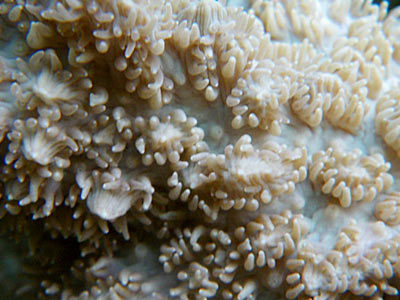
The hard corals appear to be doing rather well. The above is a Hydnophora sp. You can tell from the little bumps (hydnophores) on the surface.
There were at least 2 types of corallimorphs (Order Corallimorpharia) in the pool. This group of animals is very under-studied in Singapore, and we have no idea what species we have here at all.
Here's another type of corallimorph.
There were a few colonies of zoanthids (Order Zoantharia) as well. The ones above are probably Zoanthus sp. They resemble lots of little sea anemones living together, but they are not, though they are somewhat closely related from the same class.
This is probably a Zoanthus sp. too.
At one corner was a colony of zoanthids with larger oral disc. These should be Palythoa mutuki.
There were many of this tiny translucent unidentified sea anemones in the pool too.
Yet another unidentified sea anemone...
There were so many of them at some places, that they appeared like a furry carpet.
There were a few black sea cucumbers, Holothuria leucospilota, too.
There were patches of Paddle Weed (Halophila ovalis) in the pool. These are seagrasses - the only flowering plants that live fully sudmerged in sea water!
There were a few species of seaweed too. The above is a Halimeda sp.
This Ghost Crab (Ocypode ceratophthalmus), obviously, was not found in the touch pool. We spotted it among the grass near the jetty, harassed by a cat. We chased away the cat eventually. It was really cute, and I just decided to add it into this blog. Haha... :P
