
Why does the snake cross the road? And why must it cross when I was cycling on the very same road?
I had to jam brake and even hurt my toes so as not to run over it. And what did it do after I stopped.? It gave me that "what the xxxx" look, then continued sliding across the road. I managed to get a photo of this reckless Oriental Whip Snake (Ahaetulla prasina) when it was safely on a plant on the other side of the road.
Anyway, I went to Pulau Ubin with Kwan Siong yesterday as I had not visited Noordin Beach, and thought of checking out the mangrove plants there.
My main objective was to check out the Berus Mata Buaya (Bruguiera hainesii), which happened to be flowering like nobody's business!
And some of the flowers were on rather low branches, and hence I managed to get some close-up shots of them.
Here's another flower. This plant is critically endangered not just in Singapore, but internationally as well.
There were a number of seedlings too.
Along the way, we saw a number of other plants flowering, including this Dalbergia candenatensis, a mangrove climber., which has lots of pretty little white flowers.
And the flowers attracted several pollinators, including this Blue Glassy Tiger (Ideopsis vulgaris macrina).
The Nyireh Batu (Xylocarpus moluccensis) was also flowering, and the pollinated ones will eventually develop into cannonball-like fruits.
I only found a lonely flower on this Teruntum Putih (Lumnitzera racemosa).
The Latherleaf (Colubrina asiatica) was both flowering and fruiting. This coastal plant is so-named due to its ability to produce a lather in water.
So was the Chengam (Scyphiphora hydrophyllacea), which bloomed in bunches of little white flowers.
The Gymnanthera oblonga which I saw was flowering about a month ago was not flowering this time round, but I could see a few flower buds developing.
I also saw several Bakau (Rhizophora stylosa) flowering, fruiting, and developing seedlings.
Several animals were spotted, apart from the snake, though I only took a few photos.
I found a few Thespesia Firebugs (Dysdercus simon) on a Portia Tree (Thespesia populnea). Unlike the more common Cotton Stainer Bugs (Dysdercus decussatus) found on Sea Hibiscus (Talipariti tiliaceum).
This Stink Bug (Pycanum sp.) appeared from no where and decided to land on Kwan Siong's bag.
In the mangrove area, we saw lots of Blue Striped Hermit Crabs (Clibanarius longitarsus).
But we also saw these smaller striped hermit crabs, which are also Clibanarius species, but the obvious blue stripes were replaced by brownish stripes instead. Not sure if they were variations or a different species.
We also saw many little mudskippers, possibly some kind of Periophthalmus species.
It was great to be back on Ubin. Do hope to find time to go back more often! :)
Sunday, March 13, 2011
A Visit to Noordin Beach on 12 Mar 2011

Sunday, February 13, 2011
Pleasant Walk at Ubin with Fellow Volunteers
It's been a while since I had a walk at Pulau Ubin, and hence when Alan organised a walk for Ubin volunteers, I decided to take part.
And during the walk, surprise surprise! The Gymnanthera oblonga was flowering!!! I had been hoping to get photos of the flowers for years! This back mangrove plant is critically endangered in Singapore, though it is rather wide spread on Ubin. I have seen it once on Semakau as well.
There were even some opened seed pods, with the feathery seeds that are dispersed by wind. This was also my first time seeing the seeds of Gymnanthera oblonga!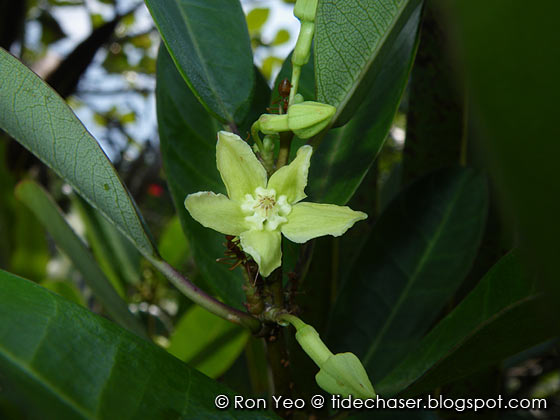
Here's another look at the flower again with some flower buds. There were lots of Weaver Ants on the plant though. Guess I will go Ubin again another day to properly check if the other Gymnanthera oblonga on the other parts of the island are flowering or fruiting, just to get more photos.
Another blooming plant I saw was the Lenggadai (Bruguiera parviflora).
The Teruntum merah (Lumnitzera littorea) has pretty little red flowers in bunches.
The catkin of the Buta-buta (Excoecaria agallocha), otherwise known as 'Blind-your-eyes" due to its toxic sap.
The female flower of the Nipah Palm (Nypa fruticans) is like a yellow ball.
Fruiting plants include the Seashore Nutmeg (Knema globularia), with its yellow fruits that split open to reveal the red flesh when they are ripe.
And the Berembang (Sonneratia caseolaris), which also had lots of Weaver Ants on its fruits.
I did not take many photos of animals this time round, as it was really hot and many animals were just hiding from the heat.
The Black Carpenter Bee (Xylocopa latipes) is one of the biggest bees in the world.
Not sure what bee or wasp is this (the lazy me will once again wait for the kind-hearted souls to help me), but it's really pretty with the metallic greenish blue exoskeleton. Update: Thanks James for the info. After checking the various actual size photos for the details, it should be a cuckoo wasp (family Chrysididae) :)
A moth which looked really weak - not sure if it just emerged from its cocoon not too long ago, or was it attacked by some predator before this.
A very pretty and colourful caterpillar which I saw near the mangrove area.
Two species of monitor lizards can be found on Pulau Ubin, and this was the smaller Clouded Monitor (Varanus nebulosus).
And here's a juvenile Malayan Water Monitor (Varanus salvator) hiding in a burrow. To distinguish between the two species just look at the nostrils - for the Malayan Water Monitor, they are located nearer to the tip of the snout.
And lastly, a swallow - not sure which species is this as well.
Monday, December 06, 2010
Exploring Chek Jawa on Nparks Volunteer Appreciation Day
Initially, I was hoping to reach Ubin earlier and explore a bit, but the queue for the bumboat was surprisingly long, and I ended up reaching just half an hour before the meeting time, and hence only had time to look around the volunteers' hub.

As usual, the Kemunting (Rhodomyrtus tomentosa) planted near the volunteers' hub was blooming with pretty pink flowers. This shrub is rather uncommon in Singapore, but interesting is an invasive species in some countries where it was introduced.

Here are the fruits.

After the award presentation and lunch, we moved on to Chek Jawa for a walk. At the entrance, we were greeted by a rather tamed Wild Boar (Sus scrofa). Guess the visitors were really feeding it too much, and it was obviously sniffing around us for food!

I managed to take a look at the Pemphis (Pemphis acidula). There were lots of fruits.

Most of the flowers looked like they were withering though.

I also took a look at the Lenggadai (Bruguiera parviflora) near the mangrove boardwalk, which I noticed was flowering when I was guiding here two weeks back, but didn't have the time to take photos.

There was even a crab spider which climbed onto one of the flowers.

And I also spotted an interesting-looking caterpillar.

Also near mangrove boardwalk, I noticed a Dungun (Heritiera littoralis) fruiting! Wow! My first time having decent photos of the fruits! Previously when I saw them fruiting, they were always too high up, or I did not have my camera with me. Some of my friends call it the ultraman fruit, as the fruit has this ridge-like structure running across the middle of the fruit, making it appear like the head of the TV character, Ultraman.

The Sea Almond (Terminalia catappa) trees appeared to have just shed their leaves and were growing ones.

When we reached the intertidal area, many volunteers were already down on the sandflat!

The top find of the day must be this Honeycomb Stingray (Himantura uarnak). Adults are reported to be able to grow to more than 2m long! The one we found was probably just about 1m long.

There were lots of Noble Volutes (Cymbiola nobilis) laying eggs that day! I saw at least 15 of them, and at one spot, 3 of them within a 1m radius!

There were lots of Glassy Bubble Shells (Haminoea sp.) on the soft sand. Like other headshield slugs (Order Cephalaspidea), they have well-developed headshield, which is a broadening at the head used to plow beneath the sand surface and help prevents the sand entering the mantle cavity.

We also found another headshield slug, a Philinopsis sp. Members from this genus generally feed on other headshield slugs, such as the Glassy Bubble Shells!

There were several Sandfish Sea Cucumbers (Holothuria scabra). These sea cucumbers are the same species that are usually served in restaurants, but must be treated to remove toxins in them before they can be eaten.

There were also several of this smooth and slimy sea cucumber which I am not sure of the exact ID.

Our hunter-seekers also found us a few Sand-sifting Sea Stars (Archaster typicus)! They feed on tiny organic particles among the sand, and digestion is done externally. And to do that, they have to push out their stomachs through their mouths located on their undersides, and lay the stomachs over the sand to digest the edible bits.

The Sand Star (Astropecten sp.), on the other hand, swallows its food and digest it internally. It feeds on small snails and clams.

We saw a Pencil Sea Urchin (Prionocidaris sp.) too! Unlike most other sea urchins, the spines of this sea urchin were thick like pencils (with some imagination), hence giving it its common name.

The animal above is a Pygmy Squid (Idiosepius sp.), and is only about 1cm long!

Several juvenile Mangrove Horseshoe Crabs (Carcinoscorpius rotundicauda) were spotted too, burrowing just beneath the sand surface, probably searching for little worms to feed on?
All too soon, tide was rising and we had to end the walk. We were really luck that the weather was fine throughout the entire event. Thanks to NParks for organising this! :)
