
It was a bright and sunny day at Semakau last Sunday!
We had a total of 21 participants. Danwei had the biggest group (Clownfish) and he had Lahiru to help him, while Helen (Sea Star) and I (Turtle) got smaller groups. Samson, Robert and of course Luan Keng were the hunter-seekers for the day. We gathered at West Coast Pier before taking a 30 minute boat ride to Semakau Landfill.
After the video presentation by NEA, Samson was arrowed to do the landfill tour, and he did a really good job too :)
This walk was yet another spectacular and fruitful one. We saw the usual hermit crabs and mangrove trees at the mangrove area, and when we reached the sandy area just before entering the seagrass lagoon, a sprinkle of stars greeted us.
They were the common sea stars (Archaster typicus). Not only did we find many of the usual ones with five arms, we found one with four arms, and another with six arms (see below) as well.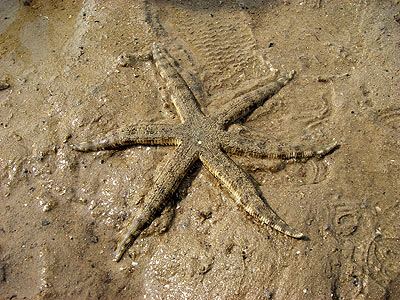
While crossing the seagrass lagoon, we saw the "resident" humongous synaptid sea cucumber (Family Synaptidae) again! We usually found it around the same spot in the seagrass lagoon.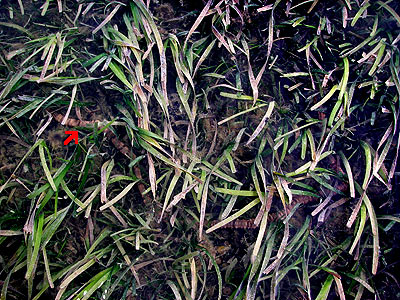
Just look at where the red arrow is pointing above. Just compare it to the tape seagarss (Enhalus acoroides)! This sea cucumber was easily more than two metres long! And below, we have a close up of its front end and feeding tentacles. Synaptid sea cucumber are deposit feeders which lash their tentacles around to collect edible particles.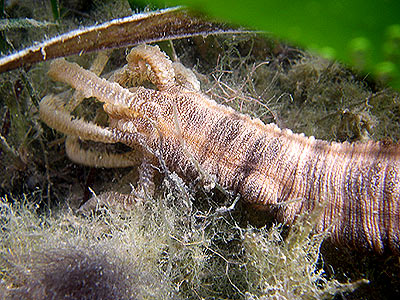
We saw several other species of sea cucumbers, including the sandfish sea cucumber below (Holothuria scabra).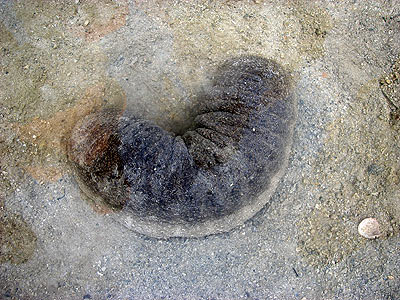
We have seen a number of warty sea cucumbers on several of our trips, but were not really sure if they were of the same species. Some of those we had seen appeared more thorny than warty, and the colours were different. Hopefully some sea cucumber experts can advise on the species below if he/she read this :)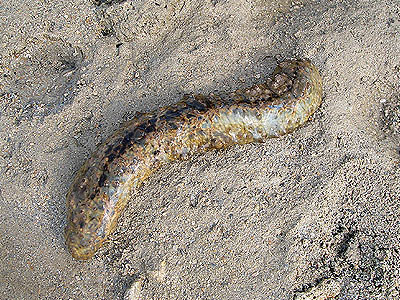
We also found a few stonefish sea cucumber (Actinopyga lecanora).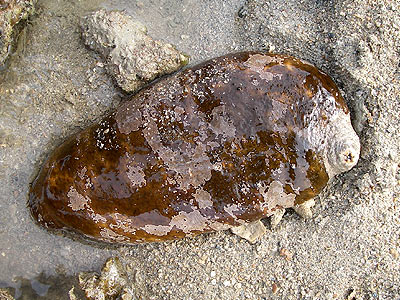
We also found several species of nudibranchs, including the Ceratosoma sinuata on below left and the Discodoris boholensis on the right.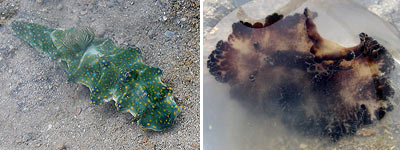
"Nudibranch" actually means "naked gills". For the two species above, you can see the flowery gills on their backs. To protect themselves, some nudibranchs secrete distasteful substances and even toxins.
We also found a cute little hermit crab. Looks like a striped hermit crab (Clibanarius sp.) to me.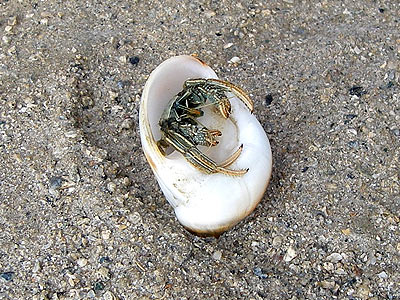
We have been seeing a number of long-spine sea urchins (Diadema setosum) recently. This sea urchin species has an orange rim on its anal cone.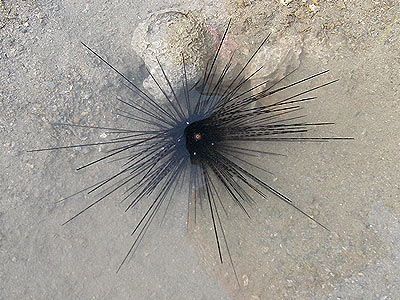
For the past few walks, we had several sightings of the upside-down jellyfish (Cassiopea sp.) as well. However, the one we saw this time round has a different colour - its kind of brownish orange rather than dark green. The shape of the tentacles and the patterns on its top looked the same though. This jellyfish usually remains in an upside-down position as it has symbiotic algae, mostly in its tentacles, which photosynthesises better with it being upside-down.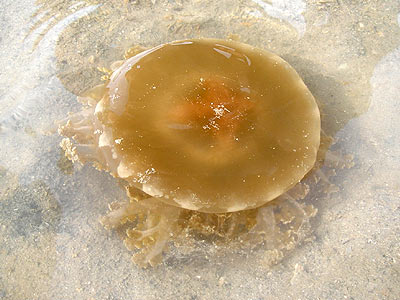
We also saw several lovely fanworms (Family Sabellidae).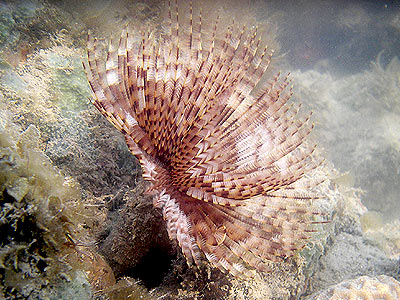
These worms live in flexible, leathery tubes. The feathery fan that we see is stuck on the top of the worm's head.
Other worms we saw include the five-striped ribbon worm (Baseodiscus quinquelineatus).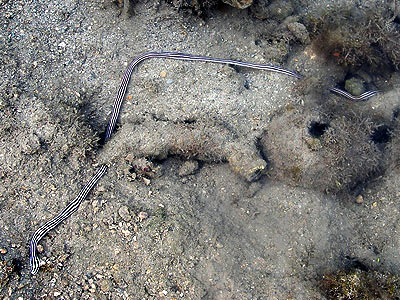
While they appear soft and defenceless, in actual fact they are fierce predators. Studies also suggest that many ribbon worms harbour bacteria that produce powerful toxins that may make them toxic to eat.
We also found a noble volute (Cymbiola nobilis).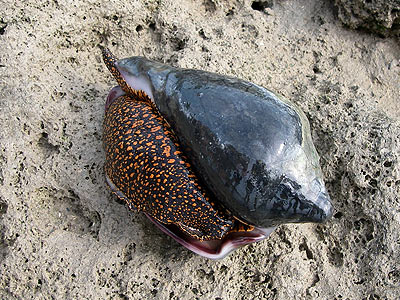
Just look at its beautiful foot with the bright orange spots!
We also found a few spider conches (Lambis lambis).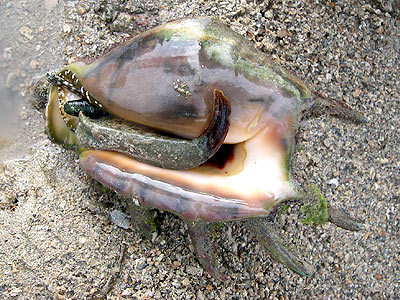
And once again, we found a heart cockle (Corculum cardissa).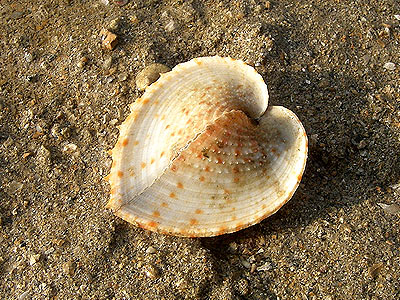
Unlike most other clams which have their valves flatten like plates, this clam has its opening of the valves cutting across the centre of the 'heart'.
We also found a living scallop!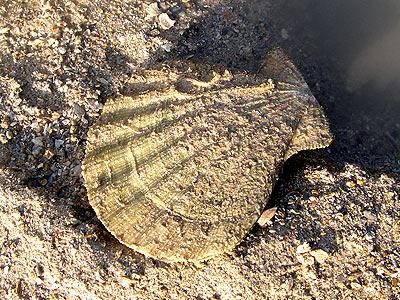
Scallops can 'swim' by flapping their valves.
We also saw lots of soft corals and hard corals, inlcuding this sunflower mushroom coral (Heliofungia actiniformis) below.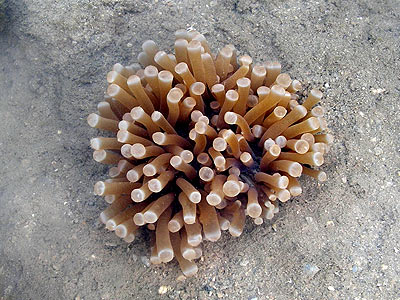
And for the third time during the intertidal walks, we found this huge cushion star (Culcita novaeguineae)! Cushion stars feed on corals.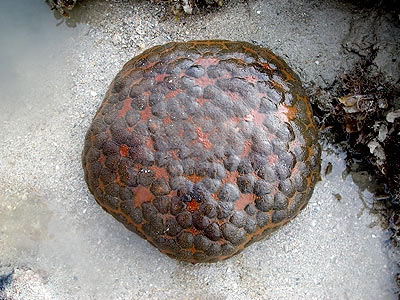
And of course, a Semakau trip will be incomplete without having a group shot with the knobbly sea star (Protoreaster nodosus).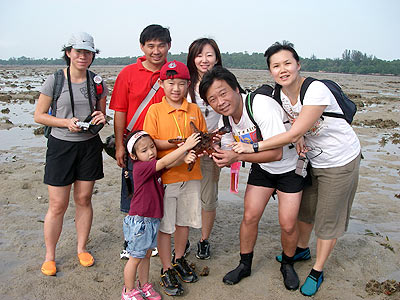
This is my group - the Turtles!
See also:
Samson's account of the trip with more photos!
Tuesday, March 20, 2007
Semakau Walk on 18 March 2007

Sunday, March 18, 2007
Sentosa!
I never knew the cliffs at Sentosa were so beautiful.
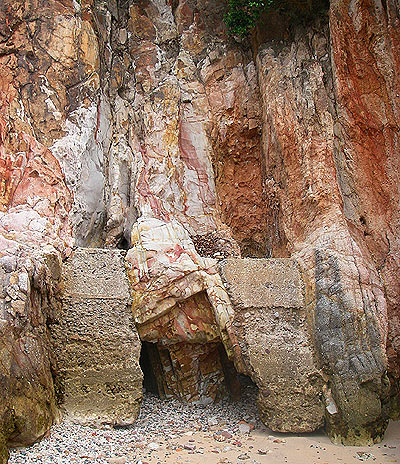
I went with a few volunteers and beachfleas to Sentosa last Saturday to check out the intertidal area. While I've visit the area before, this was the first time I went via what I called the longer "adventure" trail. And good thing that we decided to recce this trail, as I finally got to see the beautiful pink cliffs with my own eyes! England may have its White Cliffs of Dover, but we have our very own Pink Cliffs of Sentosa!
The trail, though much longer than the usual one we took, was certainly more interesting.
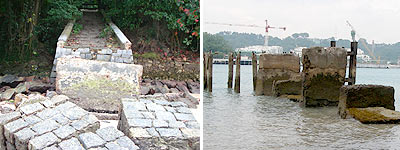
The above was a collapsed stairway leading to a broken jetty. Wonder if this jetty harbours any interesting stories, waiting to be uncovered...
There are lots of caves along the cliff. And here's one with a "stranded" beach volleyball.

There were also hundreds and thousands of cute little onch slugs (Onchidium sp.).

These slugs often blend in very well with the rocks. So do remember to keep a look out for them to avoid stepping onto them when you are out on rocky shores. Onchs graze on algae on the rocks at low tide. They have gills on their backsides to breathe air.
We also found some pitcher plants creeping over a tree.

And there was a lovely tidal pool among the rocks with carpets of beautiful zoanthids (aka colonial anemones) and fanworms.

Some zoanthids are known to contain toxins to protect themselves from predators, so avoid touching them, especially if you have wounds on your hand. And if you accidentally touched them, don't touch your eyes and mouth after that.
There were lots of barnacles on the rocks too. The ones below are star barnacles (Chthamalus sp.).

Although many people thought that they were shells, barnacles are actually crustaceans like prawns and crabs.
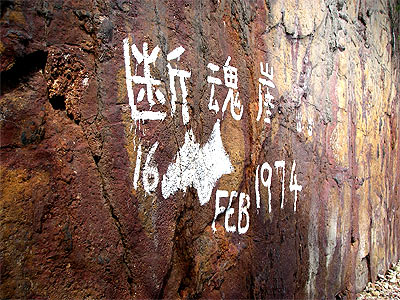
Finally, we reached the intertidal area that we usually visit. Below is the so-called 断魂崖 (i.e. Broken Soul Cliff).
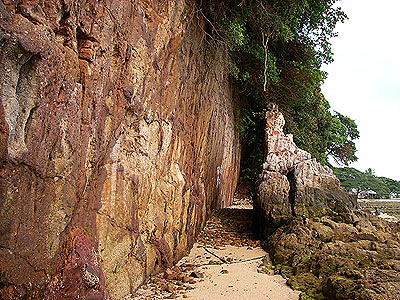
Someone painted these words on the cliff.
On reaching the lagoon, we had a pleasant surprise waiting for us. It's tape seagrass (Enhalus acoroides) flowering season!
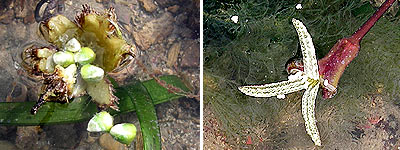
The picture on the left shows an "exploded" fruit, and the one on the left is the female flower with the male pollen floating around like styrofoam bits. Check out the Wildfilms blog and the annotated budak for more details.
We also found a few cute polka dot nudibranchs (Jorunna funebris).
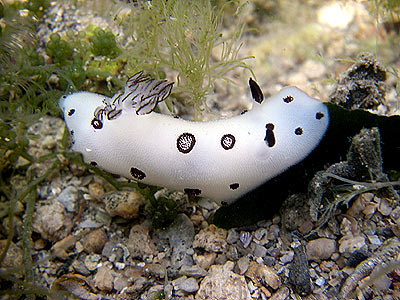
Nudibranchs are slugs - snails without shells. These polka dot nudibranchs feed on sponges.
We also saw lot's of beautiful corals and anemones.

The top two were hard corals (not sure about the species though), while the bottom left is a soft coral (Sacrophyton sp.) and the bottom right is a branched anemone (Phymanthus sp.).
And while the Chinese New Year was already over for a while, Andy found a plastic container full of kueh balu! The strange things you can find on our shores sometimes...

We also saw several crabs. Below is a brown egg crab (Atergatis floridus).
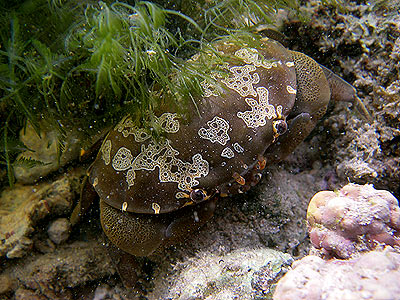
Egg crabs are poisonous, so don't eat them! And that also include the red egg crab (Atergatis integerrimus) below.

Some how, the red egg crab always reminds me of the crab-like invid scouts from the Mospeada series of the anime Robotech. Those of you from my generation will know what I mean. Just compare the photo above with the one below...
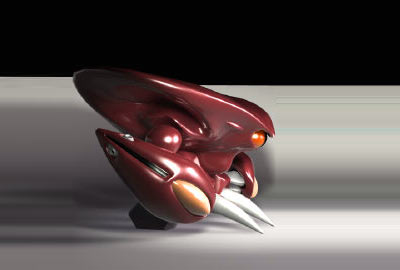
Brings back good old memories... Don't you think so?
:)
Subscribe to:
Posts (Atom)
