
Labrador Nature Reserve, otherwise known as Labrador Park, covers an area of 10 hectares, and contains the only rocky sea-cliff on the mainland accessible to the public. The area was previously designated as a nature reserve under the Nature Reserve Ordinance in 1951 to protect the habitat of the primitive fern, Dipteris conjugata. However, it was downgraded to a nature park in 1973. In the year 2002, it was re-gazetted as a nature reserve after calls from the public to preserve the rich history and nature of the area.

The reserve has a secondary forest which contains the old Pasir Panjang Fort with several World War 2 relics, a rocky sea-cliff with interesting coastal vegetation, and a rocky shore with various types of marine life.
Dos & Don'ts
Getting Started
Labrador Nature Reserve has a few trails which brings you through some of the historical sights under the shade of the secondary forest.

That includes several war relics from World War 2, including several military bunkers which was part of Fort Pasir Panjang, one of the 11 coastal forts which defended Singapore's waters. Fort Pasir Panjang was built in 1878 to protect the western approach to Keppel harbour.
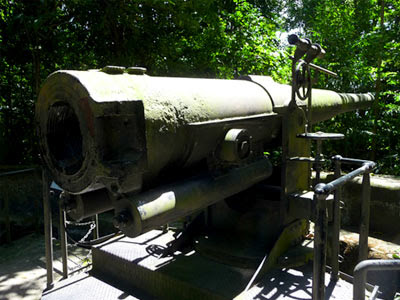
An old British gun can also be found in the reserve. This old 6-inch rifled barrel was found at the old Beach Road camp in March 2001, and was brought over and installed at Labrador since it's similar to the 6-inch guns deployed at Labrador Battery.

Walking along the trail also allows you to see many interesting plants, though many of them, such as the silver fern above which had whitish spores, are planted by the park management. Other planted plants include several tongkat alli, elephant ferns and fishtail palms.

The nibong palm (Oncosperma tigillarium) is sometimes found in our coastal areas. Its tall trunk is used to construct the stilts for kelongs and stilt houses, since it is very resistant to salt water.
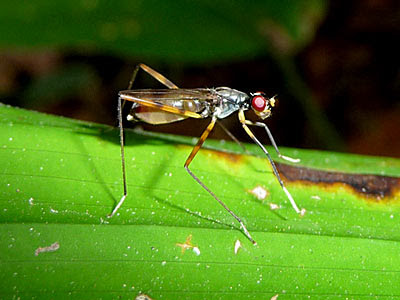
Several insects can be seen in Labrador Nature Reserve, including many butterflies, dragonflies, beetles, bugs and flies, such as the white-handed fly (Mimegralla albimana) above.

Crickets (Family Gryllidae) are also commonly sighted. The males of these little insects can make a loud chirp by rubbing their left forewing which has lots of ridges against the upper hind edge of the right forewing which has a thick scraper.

The most visible spider should be the golden web spider (Nephila pilipes), which builds one of the biggest spider webs in the world.

Following the trail to the cliff edge, there's a viewing point by the side of the cliff, which give you a bird's eye view of the surrounding.

There used to be a aerial staircase right next to the cliff which has many secondary forest plants, but that has been removed for safety reasons. There is still a stairway down the cliff to the beach area though. The palm tree in the middle of the photo above is a fishtail palm (Caryota mitis), a native secondary forest palm. Interestingly, this palm starts fruiting near the top of the tree, and then subsequently fruits lower down. Eventually, it will start fruiting near the base of the tree, after which it will die. Most parts of the palm contain toxic calcium oxalate crystals though, and can cause severe swelling.

This white leaf fig (Ficus grossularioides), which the leaves have whitish undersides, is very commonly found in our secondary forests. Like other figs, it fruits regularly, thus providing a steady food source for many animals living in the forest.

Yet another very common secondary forest tree will be the tiup tiup (Adinandra dumosa), a sun-loving tree which can also be found in the edges of our primary forests. It is yet another important tree as the flower provide nectar for many insects, and the fruits feed many little animals.

Down the staircase nearer to the shore area in Labrador Park, more coastal plants such as this penaga laut (Calophyllum inophyllum) can be seen. Plants from this genus are also called beauty leaf, as it have very pretty leathery leaves with fine parallel veins. This is a very useful tree, and the timber has been used to make into furniture, while the oil extracted from the dry seeds was used for massage and applied to wounds to promote the growth of new tissues. The sap of this plant, however, is said to be mildly poisonous.

Another coastal plant, mata ayam (Ardisia elliptica), can also be found here. Mata means eye, while ayam means chicken, refering to the fruits which are about the size of a chicken eye. Like many other coastal plants, the mata ayam has thick leathery leaves to retain water, since the coastal environment is usually very dry, being exposed to the land and sea breezes which increase the rate of evaporation.

Many mangrove trumpet trees (Dolichandrone spathacea) were planted in the reserve, though a number of them were probably natural. This tree got its name from its huge trumpet-like flowers. Unfortunately, none of them were blooming the few times I was there. This tree has very smooth and reflective leaf surfaces, which enable the leaves to reflect the heat from the sun better. When salt sprays evaporate to form salt crystals on the leaf surfaces, the smooth surfaces allow them to be easily carried away by the wind.
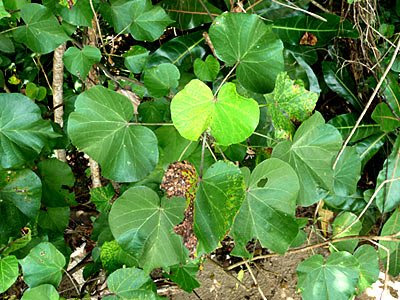
Nearer to the edge of the cliff, there were many sea hibiscus trees (Talipariti tiliaceum) with their distinctive heart-shaped leaves. Traditionally, the bark from this tree is used to make ropes or even clothing.

Among the various heart-shaped leaves, you may sometimes find a few that was thinner with clearer veins - they are from the portia tree (Thespesia populnea). The timber from this tree has pretty patterns with several shades of colour, which makes it popular with craftsmen, making beautiful woodcraft from it.
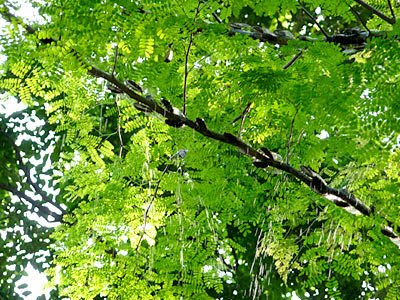
In the park at the end of the stairs, the lucky ones sometimes get to witness this spectacular sight which happens once every few years in Labrador Park- the cicada rain. Most cicadas go through a life cycle that lasts from 2-5 years, when towards the end of their life cycle, the nymph will emerge from the ground to metamorphose into adults. Thousands may emerge together and they will feed on the sap of trees. Since the sap consists mostly of water with little nutrients, the cicadas need to constantly expel the water while absorbing the nutrients so that they can suck in more sap. This resulted in the cicada rain, when there are hundreds, if not thousands of cicadas on the same tree expelling jets of water, making it looks like it's raining under the tree!

In the park at the edge of the forest, it's quite common to see skinks such as this common sun skink (Mabuya multifasciata) sunning on the pavement or by the sides of the drain.
One interesting characteristic of Labrador Nature Reserve is that it comprises both terrestrial and marine components.

The seashore and jetty area are currently closed though to allow the marine life to regenerate due to the negative impact from various nearby development works. Previously, by walking along the trails in the park and heading towards the west, one can enter the jetty area and the rocky shore. The jetty was renovated from an oil jetty - part of the facilities of an oil refinery that was previously in the area. At high tide, the area below the jetty is covered with water, and on a good day, the sea water can be brilliantly clear.

During low tide, however, the rocky shore is exposed, and a wide variety of marine life was unveiled.

It was also during low tide when many schools used to bring scores of students to visit the shores of Labrador Nature Reserve as part of their ecology course last time. Unfortunately, at that time, most schools do not hire experienced guides, and neither were the teachers experienced enough to manage their students to minimise damage to the ecosystem.
While it was good that students could get closer to nature to appreciate the little bit of nature that Singapore had left, their appreciation often meant annihilation for the marine life. More often than not, students were left running amok on the shores, trampling on seagrass, sponges, shells, crabs and other marine life, overturning rocks and baking organisms to death under the hot sun, and leaving marine life they caught on the high shore instead of returning them to their habitats.
A herd of elephant will probably cause less damage. I am really glad that the seashore is now closed to the public and these school groups. In any case, in my opinion, schools should always ensure that they hire experienced guides for such field trips to minimise the damage that could be caused by the students. Not just for Labrador, but other nature areas as well.

On the western side of the shore, there were nearby development works which left lots of sediment, clay and litter on the beach, burying much of the sessile marine life there.
It's a wonder that any marine life actually managed to survive the ordeal, but our shore organisms always amaze me.

The sickle seagrass (Thalassia hemprichii) appeared to have survived, though they were certainly not as abundant as before. Seagrasses are flowering plants, and they provide food and hiding places for many marine animals, including many edible species. The loss of seagrass habitats will severely affect our seafood sources as well.

This patch of Montipora coral which used to be found near the jetty a few years ago was not so fortunate though. It was already reduced to a rubble of dead corals at the point of writing.

A few huge colonies of Psammocora corals can still be seen at very low tide. This is a colonial hard coral, and every colony like the one above may have thousands of coral animals (also known as a polyp). The colony is like our HDB flat with lots of occupants. The corals are such amazing animals, that they build their own "flat" with calcium carbonate!

A few colony of branching soft corals (Family Nephtheidae) can still be found here, but they are far and few. Soft coral polyps are joined together and supported by a fleshy tissue instead of a hard skeleton.
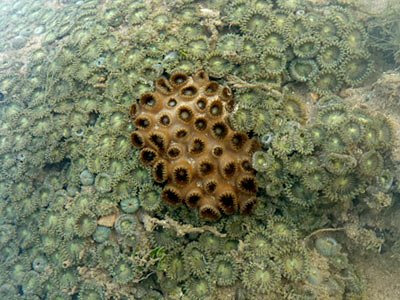
Zoanthids, however, are still quite abundant, and sometimes, the competition for space can get rather apparent. The above shows a Palythoa tuberculosa colony among a Zoanthus sp. colony. Related to sea anemones and corals, zoanthids also has lots of tentacles with stinging cells. To protect themselves against predator, some species are very poisonous, and in fact, the most toxic marine poison discovered so far, palytoxin, was found in a zoanthid.

On the higher shore, marine pulmonate slugs (Family Onchididae) are still commonly seen when the tide goes down. These slugs are more closely related to land snails, and breathe air with simple lungs, though some species are known to be able to survive for short periods under water by breathing through their skin or gill-like papillae.
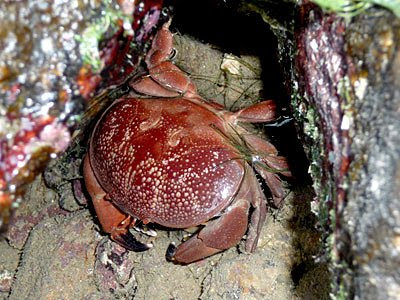
The red egg crab (Atergatis integerrimus) is also regularly spotted. It is poisonous, and advertise that with its bright colour.
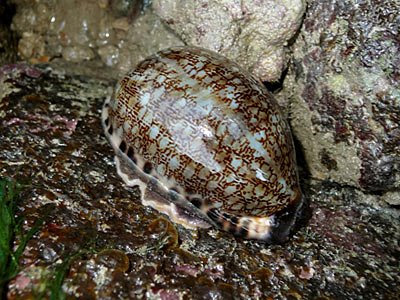
The Arabian cowrie (Cypraea arabica) is one of the biggest cowrie in Singapore waters. It can also be found on many of our southern islands. Cowries feed on algae. In ancient time, they were used in China, Africa and some other ancient civilisations as a currency.

The tigertail seahorse (Hippocampus comes) used to be regularly spotted in the shallow waters of Labrador Nature Reserve, but is much less common now with the destruction of much of its habitat. While a seahorse is a bony fish, it doesn't have scales, but instead has a thin skin stretched over a series of bony plates arranged in rings over its body.

The pygmy squid (Idiosepius sp.) are hardly over 1 or 2 cm long, and feeds on small crustaceans. They are often mistaken to be juvenile squids.

A tropical rocky shore often has its fair share of octopuses, and the rocky shore of Labrador Nature Reserve is no exception. This master of camouflage can change its body colour to blend into its surrounding. The one above had gone one step further by flattening itself close to the substrate, but unfortunately the dangling arm gave it away.

Nudibranchs, such as the above Glossodoris atromarginata, are seasonally common on Labrador's rocky shores. These sea slugs got their common name from the flower-like gills on the back of many species. Nudi means naked, while branch means gills. Many nudibranchs are poisonous or possess chemicals to make them distasteful, and their bright colours warn predators of this fact.
Conserving Labrador Nature Reserve
The situation in Labrador Nature Reserve clearly demonstrates that preserving a nature area takes a lot more than just giving it the status of a nature reserve.
Schools and other users of the reserve should be properly educated to ensure that they minimise damage to the ecosystem while using it for educational or leisure purposes. Otherwise, the trampling from these users will do more harm than good. Guidelines should be given to schools on how to manage educational trips.
Development work near the reserve should be carefully managed. For example, a silt screen can be erected around the development area to minimise the impact on the surrounding areas. Regulations can be established to enforce how such projects can be managed.
More collaborations between the various stakeholders will be very useful to understand the various concerns. In many developed nations, nature lovers are often regarded as a weird breed, and the diversity of ideologies among them are often ignored. On the other hand, developers are often seen as the capitalists with a $ sign on their forehead. Meanwhile, the various authorities involved each has its own agenda.
Generally, there should be a better appreciation how human fit into the overall ecosystem. A lot of times, the capitalists, developers, major decision-makers and even many members of the public tend to forget that we as living organisms are part of the bigger ecosystem. We need the plants to convert carbon dioxide to oxygen for us to breathe; a lot of things we eat come from the sea; answers to many health problems have been found in marine organisms; and the pollution we have done to the environment may end up in our body one day through the food chain, or through direct contact for beach-goers.
From a nation building perspective, our natural heritage is something that is naturally ours, and not imported from other places nor artificially created. Shouldn't we be proud that being such a tiny place like Singapore still has lots to offer in terms of biodiversity and natural history?
These are things that money can't buy, and we can proudly say they are ours. And Labrador Nature Reserve, being a unique reserve which holds both our natural and human history within such a tiny area, is certainly a place worth preserving and protecting.

The reserve has a secondary forest which contains the old Pasir Panjang Fort with several World War 2 relics, a rocky sea-cliff with interesting coastal vegetation, and a rocky shore with various types of marine life.
Dos & Don'ts
- Stay on the trail! Wandering off the trail may result in trampling of the flora and fauna.
- Bring water and some light snacks, but avoid eating or drinking when there are monkeys around.
- Do not feed any animals, as they may become very dependent on human to feed them, and forget how to find food on their own.
- Keep your volume down, or you may disturb the very animals you want to see, and they may hide away from you.
- Take nothing but photos, leave nothing but foot prints. Bring your litter out with you, and never take anything from the forest. Poaching has resulted in severe reduction in the population of much wildlife in many places.
- You may want to consider wearing long pants, e.g. light track pants etc. There could be mosquitoes.
- Please bring insect repellent. Mosquito pads are usually not very useful for such outdoor activities as the mosquitoes can be quite aggressive.
- Please bring a cap/hat in case of sunny weather, and raincoat/poncho in case of wet weather. I would also recommend bringing a few plastic bags to keep your electronic products in case it rains.
- Bring a camera along, but remember to have a plastic bag to keep it dry in case it rains.
- The rocky shore is currently closed to allow the shore life to recover from the impact from the surrounding development work. Please do not try to venture down the sea wall to the shore on your own, as you could be causing damage to the already weakened ecosystem.
Getting Started
Labrador Nature Reserve has a few trails which brings you through some of the historical sights under the shade of the secondary forest.

That includes several war relics from World War 2, including several military bunkers which was part of Fort Pasir Panjang, one of the 11 coastal forts which defended Singapore's waters. Fort Pasir Panjang was built in 1878 to protect the western approach to Keppel harbour.

An old British gun can also be found in the reserve. This old 6-inch rifled barrel was found at the old Beach Road camp in March 2001, and was brought over and installed at Labrador since it's similar to the 6-inch guns deployed at Labrador Battery.

Walking along the trail also allows you to see many interesting plants, though many of them, such as the silver fern above which had whitish spores, are planted by the park management. Other planted plants include several tongkat alli, elephant ferns and fishtail palms.

The nibong palm (Oncosperma tigillarium) is sometimes found in our coastal areas. Its tall trunk is used to construct the stilts for kelongs and stilt houses, since it is very resistant to salt water.

Several insects can be seen in Labrador Nature Reserve, including many butterflies, dragonflies, beetles, bugs and flies, such as the white-handed fly (Mimegralla albimana) above.

Crickets (Family Gryllidae) are also commonly sighted. The males of these little insects can make a loud chirp by rubbing their left forewing which has lots of ridges against the upper hind edge of the right forewing which has a thick scraper.

The most visible spider should be the golden web spider (Nephila pilipes), which builds one of the biggest spider webs in the world.

Following the trail to the cliff edge, there's a viewing point by the side of the cliff, which give you a bird's eye view of the surrounding.

There used to be a aerial staircase right next to the cliff which has many secondary forest plants, but that has been removed for safety reasons. There is still a stairway down the cliff to the beach area though. The palm tree in the middle of the photo above is a fishtail palm (Caryota mitis), a native secondary forest palm. Interestingly, this palm starts fruiting near the top of the tree, and then subsequently fruits lower down. Eventually, it will start fruiting near the base of the tree, after which it will die. Most parts of the palm contain toxic calcium oxalate crystals though, and can cause severe swelling.

This white leaf fig (Ficus grossularioides), which the leaves have whitish undersides, is very commonly found in our secondary forests. Like other figs, it fruits regularly, thus providing a steady food source for many animals living in the forest.

Yet another very common secondary forest tree will be the tiup tiup (Adinandra dumosa), a sun-loving tree which can also be found in the edges of our primary forests. It is yet another important tree as the flower provide nectar for many insects, and the fruits feed many little animals.

Down the staircase nearer to the shore area in Labrador Park, more coastal plants such as this penaga laut (Calophyllum inophyllum) can be seen. Plants from this genus are also called beauty leaf, as it have very pretty leathery leaves with fine parallel veins. This is a very useful tree, and the timber has been used to make into furniture, while the oil extracted from the dry seeds was used for massage and applied to wounds to promote the growth of new tissues. The sap of this plant, however, is said to be mildly poisonous.

Another coastal plant, mata ayam (Ardisia elliptica), can also be found here. Mata means eye, while ayam means chicken, refering to the fruits which are about the size of a chicken eye. Like many other coastal plants, the mata ayam has thick leathery leaves to retain water, since the coastal environment is usually very dry, being exposed to the land and sea breezes which increase the rate of evaporation.

Many mangrove trumpet trees (Dolichandrone spathacea) were planted in the reserve, though a number of them were probably natural. This tree got its name from its huge trumpet-like flowers. Unfortunately, none of them were blooming the few times I was there. This tree has very smooth and reflective leaf surfaces, which enable the leaves to reflect the heat from the sun better. When salt sprays evaporate to form salt crystals on the leaf surfaces, the smooth surfaces allow them to be easily carried away by the wind.

Nearer to the edge of the cliff, there were many sea hibiscus trees (Talipariti tiliaceum) with their distinctive heart-shaped leaves. Traditionally, the bark from this tree is used to make ropes or even clothing.

Among the various heart-shaped leaves, you may sometimes find a few that was thinner with clearer veins - they are from the portia tree (Thespesia populnea). The timber from this tree has pretty patterns with several shades of colour, which makes it popular with craftsmen, making beautiful woodcraft from it.

In the park at the end of the stairs, the lucky ones sometimes get to witness this spectacular sight which happens once every few years in Labrador Park- the cicada rain. Most cicadas go through a life cycle that lasts from 2-5 years, when towards the end of their life cycle, the nymph will emerge from the ground to metamorphose into adults. Thousands may emerge together and they will feed on the sap of trees. Since the sap consists mostly of water with little nutrients, the cicadas need to constantly expel the water while absorbing the nutrients so that they can suck in more sap. This resulted in the cicada rain, when there are hundreds, if not thousands of cicadas on the same tree expelling jets of water, making it looks like it's raining under the tree!

In the park at the edge of the forest, it's quite common to see skinks such as this common sun skink (Mabuya multifasciata) sunning on the pavement or by the sides of the drain.
One interesting characteristic of Labrador Nature Reserve is that it comprises both terrestrial and marine components.

The seashore and jetty area are currently closed though to allow the marine life to regenerate due to the negative impact from various nearby development works. Previously, by walking along the trails in the park and heading towards the west, one can enter the jetty area and the rocky shore. The jetty was renovated from an oil jetty - part of the facilities of an oil refinery that was previously in the area. At high tide, the area below the jetty is covered with water, and on a good day, the sea water can be brilliantly clear.

During low tide, however, the rocky shore is exposed, and a wide variety of marine life was unveiled.

It was also during low tide when many schools used to bring scores of students to visit the shores of Labrador Nature Reserve as part of their ecology course last time. Unfortunately, at that time, most schools do not hire experienced guides, and neither were the teachers experienced enough to manage their students to minimise damage to the ecosystem.
While it was good that students could get closer to nature to appreciate the little bit of nature that Singapore had left, their appreciation often meant annihilation for the marine life. More often than not, students were left running amok on the shores, trampling on seagrass, sponges, shells, crabs and other marine life, overturning rocks and baking organisms to death under the hot sun, and leaving marine life they caught on the high shore instead of returning them to their habitats.
A herd of elephant will probably cause less damage. I am really glad that the seashore is now closed to the public and these school groups. In any case, in my opinion, schools should always ensure that they hire experienced guides for such field trips to minimise the damage that could be caused by the students. Not just for Labrador, but other nature areas as well.

On the western side of the shore, there were nearby development works which left lots of sediment, clay and litter on the beach, burying much of the sessile marine life there.
It's a wonder that any marine life actually managed to survive the ordeal, but our shore organisms always amaze me.

The sickle seagrass (Thalassia hemprichii) appeared to have survived, though they were certainly not as abundant as before. Seagrasses are flowering plants, and they provide food and hiding places for many marine animals, including many edible species. The loss of seagrass habitats will severely affect our seafood sources as well.

This patch of Montipora coral which used to be found near the jetty a few years ago was not so fortunate though. It was already reduced to a rubble of dead corals at the point of writing.

A few huge colonies of Psammocora corals can still be seen at very low tide. This is a colonial hard coral, and every colony like the one above may have thousands of coral animals (also known as a polyp). The colony is like our HDB flat with lots of occupants. The corals are such amazing animals, that they build their own "flat" with calcium carbonate!

A few colony of branching soft corals (Family Nephtheidae) can still be found here, but they are far and few. Soft coral polyps are joined together and supported by a fleshy tissue instead of a hard skeleton.

Zoanthids, however, are still quite abundant, and sometimes, the competition for space can get rather apparent. The above shows a Palythoa tuberculosa colony among a Zoanthus sp. colony. Related to sea anemones and corals, zoanthids also has lots of tentacles with stinging cells. To protect themselves against predator, some species are very poisonous, and in fact, the most toxic marine poison discovered so far, palytoxin, was found in a zoanthid.

On the higher shore, marine pulmonate slugs (Family Onchididae) are still commonly seen when the tide goes down. These slugs are more closely related to land snails, and breathe air with simple lungs, though some species are known to be able to survive for short periods under water by breathing through their skin or gill-like papillae.

The red egg crab (Atergatis integerrimus) is also regularly spotted. It is poisonous, and advertise that with its bright colour.

The Arabian cowrie (Cypraea arabica) is one of the biggest cowrie in Singapore waters. It can also be found on many of our southern islands. Cowries feed on algae. In ancient time, they were used in China, Africa and some other ancient civilisations as a currency.

The tigertail seahorse (Hippocampus comes) used to be regularly spotted in the shallow waters of Labrador Nature Reserve, but is much less common now with the destruction of much of its habitat. While a seahorse is a bony fish, it doesn't have scales, but instead has a thin skin stretched over a series of bony plates arranged in rings over its body.

The pygmy squid (Idiosepius sp.) are hardly over 1 or 2 cm long, and feeds on small crustaceans. They are often mistaken to be juvenile squids.

A tropical rocky shore often has its fair share of octopuses, and the rocky shore of Labrador Nature Reserve is no exception. This master of camouflage can change its body colour to blend into its surrounding. The one above had gone one step further by flattening itself close to the substrate, but unfortunately the dangling arm gave it away.

Nudibranchs, such as the above Glossodoris atromarginata, are seasonally common on Labrador's rocky shores. These sea slugs got their common name from the flower-like gills on the back of many species. Nudi means naked, while branch means gills. Many nudibranchs are poisonous or possess chemicals to make them distasteful, and their bright colours warn predators of this fact.
Conserving Labrador Nature Reserve
The situation in Labrador Nature Reserve clearly demonstrates that preserving a nature area takes a lot more than just giving it the status of a nature reserve.
Schools and other users of the reserve should be properly educated to ensure that they minimise damage to the ecosystem while using it for educational or leisure purposes. Otherwise, the trampling from these users will do more harm than good. Guidelines should be given to schools on how to manage educational trips.
Development work near the reserve should be carefully managed. For example, a silt screen can be erected around the development area to minimise the impact on the surrounding areas. Regulations can be established to enforce how such projects can be managed.
More collaborations between the various stakeholders will be very useful to understand the various concerns. In many developed nations, nature lovers are often regarded as a weird breed, and the diversity of ideologies among them are often ignored. On the other hand, developers are often seen as the capitalists with a $ sign on their forehead. Meanwhile, the various authorities involved each has its own agenda.
Generally, there should be a better appreciation how human fit into the overall ecosystem. A lot of times, the capitalists, developers, major decision-makers and even many members of the public tend to forget that we as living organisms are part of the bigger ecosystem. We need the plants to convert carbon dioxide to oxygen for us to breathe; a lot of things we eat come from the sea; answers to many health problems have been found in marine organisms; and the pollution we have done to the environment may end up in our body one day through the food chain, or through direct contact for beach-goers.
From a nation building perspective, our natural heritage is something that is naturally ours, and not imported from other places nor artificially created. Shouldn't we be proud that being such a tiny place like Singapore still has lots to offer in terms of biodiversity and natural history?
These are things that money can't buy, and we can proudly say they are ours. And Labrador Nature Reserve, being a unique reserve which holds both our natural and human history within such a tiny area, is certainly a place worth preserving and protecting.


