
The soft corals are spawning at St John's Island!!!
Well, not all of them, but at least this species above. I have no idea what soft coral this is though. When I took the photo, I was actually rather doubtful if those were egg/sperm packages. It was only after I did a search online just now that I confirmed my suspicion. Seriously, this was something that I never expect to witness on an intertidal trip! I have heard from other friends who went diving to see the hard corals spawning, but today, I actually got to see a soft coral spawning without having to dive! This really made my day!
Today, we were actually on a recce trip to check out the shores for a field camp in Jun, and apart from the spawning soft corals, we saw a number of other interesting stuff.
As usual, I managed to find a few tiny Fan Seaweed Slugs (Costasiella spp.) on the Fan Seaweeds.
There were a few really tiny Land Hermit Crabs (Coenobita sp.) too, and each was just a few mm wide. They were bright red in colour. I suspect they were juvenile hermit crabs.
And here's a huge Land Hermit Crab nearby, using an African Land Snail's shell to protect its soft abdomen.
Talking about shells, we saw interesting living shells too, including this Giant Top Shell (Trochus niloticus).
I found a Dolphin Shell (Angaria delphinus) too! It got its common name from the shape of the shell, which resembles a jumping dolphin (with some imagination).
The Funeral Nudibranch (Jorunna funebris) appears to rather abundant on most of our shores these few weeks.
There was this little Pustulose Phyllid Nudibranch (Phyllidiella pustulosa) on a small rock. This nudibranch is said to be able to excrete toxic chemicals to deter predators.
There were lots of Bryopsis seaweed, and hence I wasn't surprised to find a few Leaf Slugs (Elysia ornata) which feed on the seaweed. Leaf Slugs are able to retain the chloroplast of the algae and use them for photosynthesis to make food, making them effective solar-powered!
I found the same Giant Chiton (Acanthopleura gemmata) that I had been seeing during my past few trips on the same rock! This time round it was busy trying to squeeze into a small crack though.
Another giant was this long and slim Giant Reef Worm (Eunice aphroditois), which appeared to be somewhat common on this shore
Another somewhat long and slim animal would be this pipefish. Not sure what species this is though.
There were quite a few Tiger Beetles (Subfamily Cicindelinae) near the coastal forest.
And what looks like a juvenile Brown Shrike (Lanius cristatus). Not sure if it's the same one, but I had saw one last November around the same area as well, and JH who's working in TMSI had told me that she regularly saw this bird in the same area.
Frankly speaking, the diversity on St John's Island's intertidal areas appeared to be decreasing every time I went. Many of the corals have died ever since they joined St John's Island with Lazarus Island with a rock bund, probably due to the changes in the currents. Will things start coming back when the situation stabilises, I wonder? Hmm...
Thursday, March 24, 2011
Soft Coral Spawning at St John's Island!

Wednesday, March 23, 2011
Raffles Lighthouse on 23 Mar 2011
Finally, Raffles Lighthouse with fine weathers! The past few trips were all rainy :P
Raffles Lighthouse certainly is one of the best places to look at the amazing coral diversity in Singapore, and so here I am going to focus on the hard corals I saw during this trip.

Just look at how dense the coral cover is! A lot of people would probably find it hard to believe that this is part of Singapore.

In just one small area, I could already spot quite a few corals from different genera.

Here's another patch.
Some of coral genera I saw include:

Massive colonies of Goniastrea with the typical paliformed lobes in the corallites.

Favites, where the corallites have joint walls without paliformed lobes.

Encrusting Oulastrea colony, with black coenosteum.

The so-called brain coral, Symphyllia sp., with distinct septal teeth and the corallites have joint walls.

The similar-looking Lobophyllia with separate walls.

Psammocora sp.

The "leafy" Pavona sp.

The mushroom coral, Fungia sp. Doesn't it appear like a big mushroom?

The galaxy coral, Galaxea sp., with crown-shaped corallites.

Echinopora sp., in the plating form with a few branching structures. The surface of the colony is granulated.

The turban coral, Turbinaria sp., which exhibits a plating growth form.

Closely related is the cave coral, Tubastrea sp., which is usually found under rocks.

A branching Hydnophora sp.

Another branching coral - Montipora sp.

This one with fine branching is the Porcillopora coral.
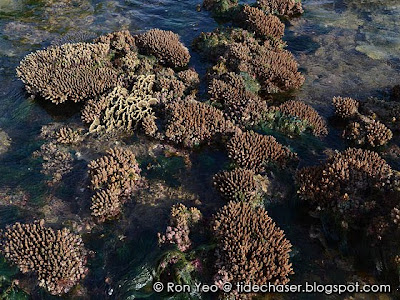
The most abundant coral here will be the Acropora corals. And here at Raffles Lighthouse, there are many different species with different growth forms!

There are the encrusting ones with hardly any branching.
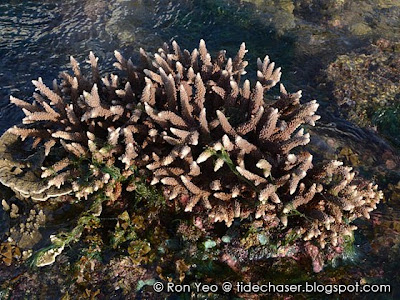
The ones with antler-like appearances.

And table-forming colonies.

This colony is also green in colour like the previous one, but it has finer branching.
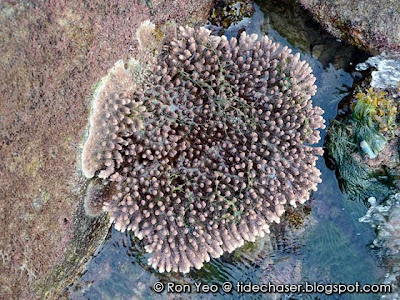
There are reddish colonies too.
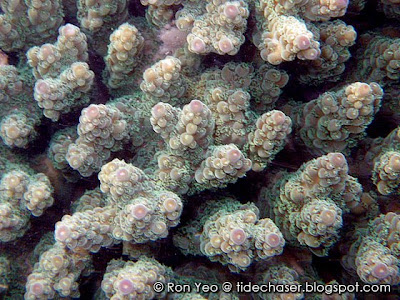
All Acropora species will have a polyp at the tip of the branch.

I even found one growing on a spider conch (Lambis lambis)!

This is a blue coral (Heliopora coerulea). Technically it is not a hard coral, even though it has a hard skeleton, as it is more closely related to soft corals.

And among the blue corals I found a Hairy Reef Hermit Crab (Dardanus lagopodes).

A few other animals we saw include this Saron shrimp (Saron sp.).

A pretty little brittler star...

Several nudibranchs, including this Gymnodoris sp., were spotted.

And there were many little fishes in the lagoon.
Glad to see so much life returning to this little island, as we witnessed massive coral bleaching last year. I did not see a number of hard coral genera which were commonly seen last time though. Hopefully they will soon re-establish themselves here...
Raffles Lighthouse certainly is one of the best places to look at the amazing coral diversity in Singapore, and so here I am going to focus on the hard corals I saw during this trip.

Just look at how dense the coral cover is! A lot of people would probably find it hard to believe that this is part of Singapore.

In just one small area, I could already spot quite a few corals from different genera.

Here's another patch.
Some of coral genera I saw include:

Massive colonies of Goniastrea with the typical paliformed lobes in the corallites.

Favites, where the corallites have joint walls without paliformed lobes.

Encrusting Oulastrea colony, with black coenosteum.

The so-called brain coral, Symphyllia sp., with distinct septal teeth and the corallites have joint walls.

The similar-looking Lobophyllia with separate walls.

Psammocora sp.

The "leafy" Pavona sp.

The mushroom coral, Fungia sp. Doesn't it appear like a big mushroom?

The galaxy coral, Galaxea sp., with crown-shaped corallites.

Echinopora sp., in the plating form with a few branching structures. The surface of the colony is granulated.

The turban coral, Turbinaria sp., which exhibits a plating growth form.

Closely related is the cave coral, Tubastrea sp., which is usually found under rocks.

A branching Hydnophora sp.

Another branching coral - Montipora sp.

This one with fine branching is the Porcillopora coral.

The most abundant coral here will be the Acropora corals. And here at Raffles Lighthouse, there are many different species with different growth forms!

There are the encrusting ones with hardly any branching.

The ones with antler-like appearances.

And table-forming colonies.

This colony is also green in colour like the previous one, but it has finer branching.

There are reddish colonies too.

All Acropora species will have a polyp at the tip of the branch.

I even found one growing on a spider conch (Lambis lambis)!

This is a blue coral (Heliopora coerulea). Technically it is not a hard coral, even though it has a hard skeleton, as it is more closely related to soft corals.

And among the blue corals I found a Hairy Reef Hermit Crab (Dardanus lagopodes).

A few other animals we saw include this Saron shrimp (Saron sp.).

A pretty little brittler star...

Several nudibranchs, including this Gymnodoris sp., were spotted.

And there were many little fishes in the lagoon.
Glad to see so much life returning to this little island, as we witnessed massive coral bleaching last year. I did not see a number of hard coral genera which were commonly seen last time though. Hopefully they will soon re-establish themselves here...
Subscribe to:
Posts (Atom)
