
Sea hares (clade Aplysiida) are marine slugs with a rounded body and two long rhinophores projecting backwards on their heads (resembling rabbit’s ears). They somewhat resemble rabbits or hares, and hence their common name. Sea hares have a soft body with an internal shell under a fleshy mantle. In Singapore, they sometimes gather in large numbers, possibly for reproduction purposes.

Like other marine slugs, sea hares are hermaphrodites with both male and female reproductive organs. As they mate, many individuals may form mating chains - in the line, each acts as the male to the animal in front and as a female to the animal behind.

The egg masses of sea hares typically resemble a messy clump of noodles. The colour varies from brownish, orange to even greenish, depending on the species.

Sea hares feed on a variety of algae. When threatened, most sea hares can exude a purple or white ink to confuse predators. The above sea hare is an Aplysia sp. which I am still not too sure of its exact species. Some sea hare can burrow too, and most of them can swim by flapping their parapodia - which are a pair of wing-like outgrowths on the sides of their body.
The species I have seen in Singapore are from the family Aplysiidae, and here are some of them.

The Geographic Sea Hare (Syphonota geographica) is commonly found in seagrass habitats with a sandy or muddy substrate. In the day, it usually hides in the soft sand and emerges to feed when it's darker.
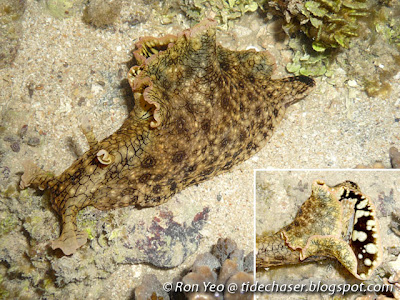
The White-speckled Sea Hare (Aplysia argus), so named due to the spots and circles on its body, usually only emerge at night to feed. In the day, it usually hides in crevices and under rocks. The species name "dactylomela" means "finger black", possibly refers to the black blotches on the insides of the parapodia. Studies have shown that the skin of this sea hare contains toxins, and hence it has few predators. Interestingly, the right giant neuron of this species is similar to that of vertebrates, and hence this species has been used in various neurological researches.
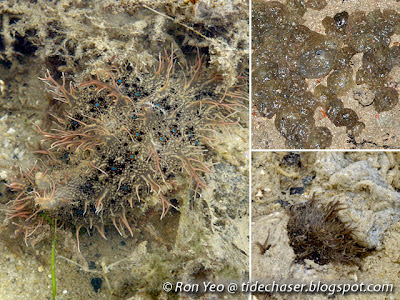
The Hairy Sea Hare (Bursatella leachii) can occur in the hundreds sometimes on our shores, especially when there is a bloom of cyanbacteria, which it feeds on. Its body is covered with papillae (thin and long structures), giving it a hairy appearance. They can burrow very well into soft substrates (lower-right), and in the intertidal areas most of them disappear without trails within a few hours after sun rise, unless they are trapped by the low tide or on harder substrates.

The Striated Sea Hare (Stylocheilus striatus) can be quite abundant during a cyanobacteria bloom as well. They got their name from the striations (striped markings) on their body.

This sea hare, Aplysia reticulata, is reddish as a juvenile but turns brownish as it matures.

Like other marine slugs, sea hares are hermaphrodites with both male and female reproductive organs. As they mate, many individuals may form mating chains - in the line, each acts as the male to the animal in front and as a female to the animal behind.

The egg masses of sea hares typically resemble a messy clump of noodles. The colour varies from brownish, orange to even greenish, depending on the species.

Sea hares feed on a variety of algae. When threatened, most sea hares can exude a purple or white ink to confuse predators. The above sea hare is an Aplysia sp. which I am still not too sure of its exact species. Some sea hare can burrow too, and most of them can swim by flapping their parapodia - which are a pair of wing-like outgrowths on the sides of their body.
The species I have seen in Singapore are from the family Aplysiidae, and here are some of them.

The Geographic Sea Hare (Syphonota geographica) is commonly found in seagrass habitats with a sandy or muddy substrate. In the day, it usually hides in the soft sand and emerges to feed when it's darker.

The White-speckled Sea Hare (Aplysia argus), so named due to the spots and circles on its body, usually only emerge at night to feed. In the day, it usually hides in crevices and under rocks. The species name "dactylomela" means "finger black", possibly refers to the black blotches on the insides of the parapodia. Studies have shown that the skin of this sea hare contains toxins, and hence it has few predators. Interestingly, the right giant neuron of this species is similar to that of vertebrates, and hence this species has been used in various neurological researches.

The Hairy Sea Hare (Bursatella leachii) can occur in the hundreds sometimes on our shores, especially when there is a bloom of cyanbacteria, which it feeds on. Its body is covered with papillae (thin and long structures), giving it a hairy appearance. They can burrow very well into soft substrates (lower-right), and in the intertidal areas most of them disappear without trails within a few hours after sun rise, unless they are trapped by the low tide or on harder substrates.

The Striated Sea Hare (Stylocheilus striatus) can be quite abundant during a cyanobacteria bloom as well. They got their name from the striations (striped markings) on their body.

This sea hare, Aplysia reticulata, is reddish as a juvenile but turns brownish as it matures.

The body is marked with white spots, forming a reticulated pattern. The inner side of the parapodia has elongated white blotches. It is often seen on coral reefs and in seagrass meadows, feeding on red coralline algae. It can swim by flapping its parapodia.

There are a number of Seagrass Sea Hare (Phyllaplysia spp.) species in the region, so I am not sure which species this is. They are usually found on seagrasses, but as they are so tiny (about 1cm) and blend in so well with the surrounding seagrasses, they are not often seen.
References
- Gosliner, T. M., D. W. Behrens & Á. Valdés 2008. Indo-Pacific nudibranchs and sea slugs: a field guide to the World’s most diverse fauna. Sea Challengers/California Academy of Sciences: Gig Harbor/San Francisco, 426 pp.
- Rudman, W. B. 2012. Sea Slug Forum. Retrieved May 10, 2012, from http://www.seaslugforum.net.
- Tan, S. K. & H. P. M. Woo, 2010. A preliminary checklist of the molluscs of Singapore. Raffles Museum of Biodiversity Research, National University of Singapore, Singapore. 78 pp. Uploaded 02 June 2010.
- Tan, S. K. & R. K. H. Yeo, 2010. The intertidal molluscs of Pulau Semakau: preliminary results of “Project Semakau”. Nature in Singapore, 3: 287–296.


