
Would just like to share here on how I identify the shrubs and trees with simple leaves (the leaves are not divided into leaflets) that I have seen around Singapore's coastal areas. The descriptions are more for mature plants, as young plants may not be exhibiting all the distinguishing characteristics. Also, this guide can only be used in Singapore, as the same species may exhibit a different growth form in other countries.
Generally, shrubs refer to plants that are short (no more than a few metres tall) with a few woody stems, while trees are taller with one main woody stem. As some young trees may appear shrubby, I have decided to put both shrubs and trees together here.
The seashore environment is a very harsh environment for the trees and shrubs growing there. It is usually very dry, due to the land and sea breeze which increases the rate of evaporation. This is more so on rocky and sand shores since the substrates are rather porous. Salt sprays from the sea also have a drying effect on the plants living there. These coastal shrubs and trees, unlike true mangrove plants, are usually found in areas seldom or not inundated such as the back mangroves. Hence, they are also called mangrove associates. Many of them can also be found growing in other types of seashore ecosystems, such as sandy or rocky shore.
To identify the tree/shrub, just go through the following questions:
A) It is a monocot?
B) It has no conspicuous leaf blades?
C) It has opposite leaves?
D) It has alternate leaves?
A) It is a monocot.
1. The margins of the leaves are lined with sharp spines.

Seashore Pandan (Pandanus odorifer) - Apart from the palms, this is the only other monocot tree on our seashore. Like other monocots, it has parallel veins and one can peel off each leaf with the leaf sheath. There are lots of spines along the edges of the leaves. It may develop prop roots, and there are numerous warts on the stem. The male flowers occur in cone-like bunches, and are yellowish-white in colour. The female flowers appear like miniatures of the fruits but are whitish or greenish. The fruits turn orange as they mature. The leaves are used for weaving hats and mats, and for thatching. The male flowers yield an essential oil used to scent clothes.
B) It has no conspicuous leaf blades.
2. It has needle-like green twigs but no conspicuous leaves.

Ru (Casuarina equisetifolia) - The Ru is often mistaken for a pine tree, with its needle-like twigs often mistaken to be leaves. The actual leaves are very much reduced, occuring as small triangular scales arranged in whorls at the joints of the twigs. The bark is brown, ridged and fissured. The male flowers (right-bottom inset) occur as long terminal spikes. The female flowers (right-top inset) occur as spherical heads with reddish styles. Fruits are small and spiky, with lots of small compartments which open up upon maturity to release winged seeds dispersed by wind. This plant usually occurs in sandy areas. The wood is heavy and hard, and is used as firewood and for making charcoal. The bark yields a good resin that can be used for tanning.
C) It has opposite leaves.
3. It has leathery, broadly oblong/elliptic leaves and hidden leaf buds.

Seashore Mangosteen (Garcinia hombroniana) - This endangered tree is sometimes seen in our coastal forests, occuring on sandy or rocky substrates. Dark green streaks can be found on the younger branches, and it has white flowers occuring in clusters. The fruits are round and turn pink as they mature. They are seldom consumed as they have thin and sour flesh. It is sometimes planted as an ornamental plant.
4. It has leathery leaves with an obvious marginal vein running along the edge.
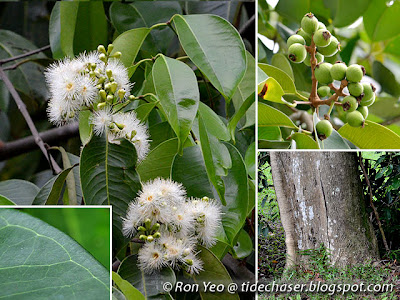
Sea Apple (Syzygium grande) - This tree with a greyish bark is commonly seen in our coastal forests. It has white, pom-pom like flowers with numerous stamens, occuring in clusters and blooming usually after a dry spell. The fruits are small and round, and provide food for many species of animals, such as monkeys, squirrels, bats and birds. This tree is commonly planted as a wayside tree as it provides good shade. Previously, it was also planted as fire breaks as it is quite fire-resistant (being a coastal plant, it has adapted to survive in the dry environment by retaining water in its trunk and leathery leaves). The wood is used for building boat and houses.
5. It has leathery, narrowly ovate leaves oriented in the same plane, and a short leaf stalk (about 0.5cm).

Blue Strawberry Flowers (Memecylon caeruleum) - This critically endangered shrub/tree usually has many stems near its base. It occurs in coastal forests. It has little blue flowers occuring in clusters, and the fruits may be pinkish or purplish, eventually turning black with age. It is planted as an ornamental plant, and the wood is used as firewood.
6. It has leathery, broadly ovate leaves oriented in the same plane, and a longer leaf stalk (about 1cm).
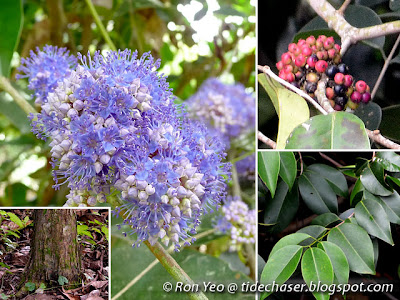
Delek Ayer (Memecylon edule) - This endangered coastal tree can be found in coastal forests, and on rocky shores. It flowers in clusters, usually purple or blue in colour. The fruits are small and round, turning reddish and eventually black as they mature. The wood is hard and durable, and used for building and as firewood. A yellow dye can be extracted from the leaves. Fruits are edible.
7) It has papery, elliptic leaves with 3 or more main nerves, tapering to a pointed tip. Both sides of the leaves are densely covered with hair.

Senduduk (Melastoma malabathricum) - This common shrub occurs in coastal forest, secondary forest and open country habitats and other disturbed areas. The flowers can be a pale purple, pink or white. The small fruits turn purple as they mature, and eventually split open to reveal the black flesh when they are ripe. They can be eaten but stain the mouth black, hence the genus name Melastoma, which means "black mouth". The young leaves are edible as well, and are used to treat stomach complains. The leaves are also crushed and applied to wounds from leech bites.
8) It has leathery and elliptic leaves with 3 or more main nerves, and are leathery and elliptic with a rounded trip. The undersides of the leaves are hairy.
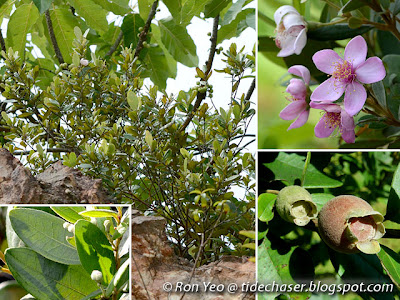
Kemunting (Rhodomyrtus tomentosa) - This coastal shrub can be found sometimes in inland forest edges as well. The flowers are pink with numerous stamens, and the colour of the petals turn whitish with age. The small and round fruits are capped with persistent calyx lobes, and are edible, turning purplish as they mature. They can be used to produce wine. It is also planted as an ornamental plant for its pretty flowers and edible fruits.
9. It has stiff and leathery leaves with numerous fine veins perpendicular to the main nerve.

Penaga Laut (Calophyllum inophyllum) - The genus name of this critically endangered tree, Calophyllum, means "beautiful leaf". The flowers are white, occuring in clusters, while the fruits are round. It occurs in back mangroves and sandy beaches. The wood is very hard and used in construction and making furniture. Oil extracted from the seed is used as hair grease and bio-fuel. Most part of this plant, including its fruit and sap, are poisonous. It is sometimes planted as a shade tree.
10. It has leathery, broadly obovate leaves, with a pair of swollen stipule-like structures at the base of the leaf stalk.

Pelir Musang (Fagraea auriculata) - This nationally critically endangered plant's Malay name interestingly means "civet's testicles", refering to the swollen structures at the base of the leaf stalk. It occurs in coastal forests, including rocky cliffs. The flowers are creamy white trumpets. Apart from reproducing sexually, it can be propagated by roots as well. It is planted as an ornamental plant.
11. It has leathery, broadly obovate leaves, but lacks the swollen structures are the base of the leaf stalks.

Buah Telan Kenyalang (Fagraea ridleyi) - There is only one known living specimen of this rare plant in Singapore. The Malay name means "fruit swallowed by the hornbill". It can be found on coastal cliffs and both coastal and inland forests, and may occur as a woody climber or a shrub. It was named after Henry Nicholas Ridley, the first scientific director of the Singapore Botanic Gardens who has contributed immensely to tropical botany.
12. It has large fleshy elliptic leaves, sometimes spirally clustered at the branch tips.

Great Morinda (Morinda citrifolia) - This plant was believed to be nationally extinct in the wild, but naturally-occuring ones have settled in many of our back mangroves in recent years. The small flowers occur on roud flower heads, and the fruit is a multiple fruit, either oblong or ovoid, turning white as it matures. Also called noni, the fruit has a strong smell and bitter taste, and is consumed either cooked or raw. Some people believe the juice to be highly nutritious, but so far studies done on the fruit have not produced any conclusive results on its health benefits. A yellowish dye can extracted from its roots.
13. It has large and succulent broadly elliptic, ovate or obovate leaves with hair on both sides or only below, spirally clustered at the branch tips.

Beach Gardenia (Guettarda speciosa) - This small tree occurs on sandy/rocky shores and the landward margins of mangroves. The fragrant flowers are white and occur in small clusters. They are pollinated by moths, blooming at night and falling the next morning. The fruits are round, turning white as they mature. The bark is smooth and greyish brown. Women wear these flowers in their hair for their fragrance, or string them into necklaces. The bark is used to treat dysentery.
14. It has obovate or oblong leaves with a slightly notched leaf edge that initially has a gland in each notch.

Barat-barat (Cassine viburnifolia) - This critically endangered mangrove associate occurs as a small tree or shrub. The small, white flowers occur in clusters. The fruits are small and corky, turning brownish with age. They are dispersed by water. It is used for firewood, and the husk of the fruit is said to be used to stun fish. More photos and details here.
15. It has very variable leaf shapes (ovate, oblong or elliptic with pointed or rounded tips) but the leaves emit a foetid smell when crushed or rubbed against.
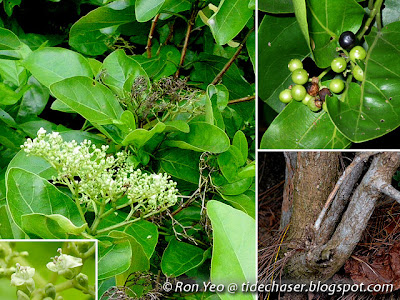
Buas Buas (Premna serratifolia) - This shrub/small tree can be found in coastal forest and occasionally inland forest edges as well. It has numerous small flowers occuring in big clusters. The fruits turn black with age. The leaf-shapes are highly variable, ranging from ovate to oblong and even elliptic. The leaves have a bad smell, especially when crushed. They are sometimes boiled and used to relieve itchiness. The wood is hard and durable, and can be made into handles of small tools.
D) It has alternate leaves.
16. It has broadly heart-shaped leaves with faint veins. The leaf underside is usually covered with short hair.

Sea Hibiscus (Talipariti tiliaceum) - This common seashore plant can be found on a wide variety of substrates, including sandy/rocky shores, river banks and back mangroves. There are numerous lenticels on the bark. The flowers are yellow, turning orange or red towards the end of the day, and will be shed usually by the next day. The calyx of the round fruit has 5 lobes, and the fruit usually dries up and opens while still attached to the tree. The seeds, which can remain buoyant due to an air cavity, are dispersed by water. Glands on the veins on the underside of the leaves secrete a sugary syrup which attracts ants. The ants are believed to protect the tree from herbivores in return. The fibre from the bark is used to make ropes and caulk boats. The wood is used to make musical instruments and utensils.
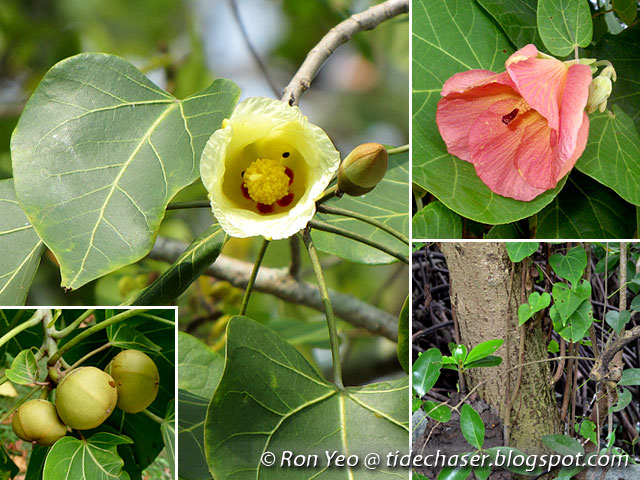
17. It has heart-shaped leaves with obvious veins. Older leaves have a smooth upper surface.

Portia Tree (Thespesia populnea) - This seashore plant usually occurs on sandy/rocky beaches or at the landward side of mangroves. The bark may be irregularly marked with some lenticels. The flowers are yellow, turning pinkish orange at the end of the day. The fruit is round and the calyx is not lobed. It usually does not open up while still attached to the tree. The seeds are dispersed by water, and have been tested to be viable even after floating in seawater for a year. The wood has been used for making musical instruments, religious sculptures, utensils, and other woodwork. Fibre from the bark is sometimes used for caulking of boats.
18. It has ovate leaves with short hair on the upper side.

Sea Trumpet (Cordia subcordata) - This tree is locally critically endangered, and on mainland Singapore, there is only one ancient naturally occuring tree at Changi, though it can also be found on some of our southern islands. It is usually found on sandy beaches or the landward side of mangroves. The flowers are trumpet-like and orange in colour. The bark is shallowly fissured and flaky. Fruits are small and egg-shaped or round, about 2-3cm long. The seeds are edible, and the wood is used as firewood (burns very readily) or for construction (resistant to termites). The leaves are used to treat stings and bites from marine animals.
19. It has ovate leaves with a glossy surface oriented in the same plane.
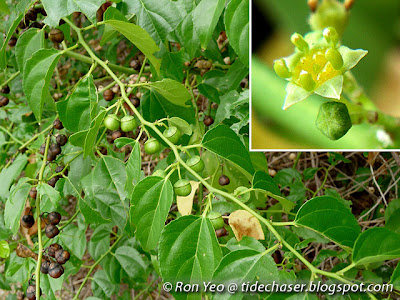
Latherleaf (Colubrina asiatica) - This rather common coastal shrub with drooping or climbing branches can be found growing in coastal forest or among sandy beach vegetation. The small flowers are greenish white with triangular petals, and fruits are small and round, turning brown with upon drying. The ovate leaves are used to treat skin diseases, while the stem is used treat stomach disorder.
20. It has obovate to ovate papery leaves with prominent parallel secondary veins. Mature plants often have tassels of dangling bracts.
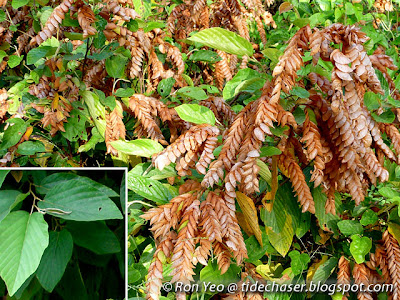
Serengan (Flemingia strobilifera) - This curious-looking shrub with tassels of dangling bracts (modified leaves) is only found growing naturally on Pulau Ubin at coastal areas, though many of them are also planted by the authorities. It is said to be a weed of uncertain origins. The brownish things you see above are neither the fruit nor flower. They are modified leaves called bracts. If you open up the bracts, you will be able to find the little flowers (in green bracts) or fruits (in dried brown bracts) in them. The dried bracts are very fluffy and light, and are used for stuffing pillows and cushions in some places.The Malay name is derived from the word "rengan", which means "light-weight", refering to the bracts.
21. It has leathery leaves that are ovate or broadly elliptic, often spirally clustered at the branch tips. The leaves exude a white sap when broken.

Sea Fig (Ficus superba) - This strangling fig can be seen at back mangroves and coastal forests edges. Figs are called "无花果", meaning "no-flower-fruit" in Chinese, but actually the fruit-like figs produced by the fig plants are not fruits, but a "container" for the tiny hidden flowers within. They are pollinated by tiny fig wasps. The figs of the Sea Fig are small and round, turning from white to purplish as they mature. As they produce figs regularly and provide food for many species of animals, fig trees are generally seen as keystone species - like the keystone of an arch - and without them the entire ecosystem may be drastically affected. Some studies suggest that the variety and abundance of animals in a forest is dependent on the variety and abundance of figs. It is sometimes planted as a wayside plant. This plant is deciduous, and the new leaves are enclosed in bright maroon stipules.
22. It has leathery leaves that are broadly elliptic or ovate with a groove at the base due to the winged petiole (leaf stalk).

Simpoh Ayer (Dillenia suffruticosa) - This shrubby tree occurs from coastal forest to inland forest, usually found in wetter areas. It has large yellow flowers which bloom in the early morning while it's still dark and last for a day. The unopened fruits are round and resemble the flower buds, but have thick reddish sepals and point upwards, whereas the flower buds usually point downwards. The ripe fruits also open in the early morning when it's still dark, revealing seeds wrapped in red arils. The seeds are eaten and dispersed by birds. The large are used to wrap food and also used as a plate, and sap is applied to wounds to stop bleeding.
23. It has fleshy leaves that are narrowly obovate or oblong, spirally clustered at the branch tips. The leaves are so closely arranged that they may appear oppositely arranged sometimes unless examined closely.

Sea Lettuce (Scaevola taccada) - This spreading shrub occasionally develops into a small tree, and is commonly found at sandy/rocky beaches and the back mangroves. The stem is whitish-brown, and the leaves are oblong-obovate, often crowding at the ends of the branches. The flowers have a fan-like shape, with a yellow centre, sometimes with purplish patches. The round and fleshy are white when mature. The juice from the fruits are used as an eye-drop, and the leaves are used to treat stomach complains.
24. It has leathery, broadly ovate leaves, spirally clustered at the branch tips. The branching is layered horizontally.
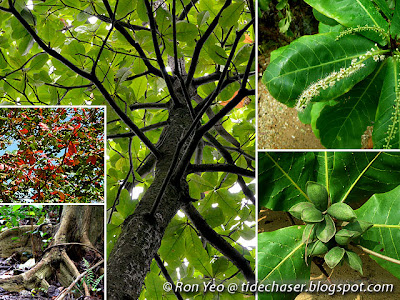
Sea Almond (Terminalia catappa) - This common coastal tree is commonly found along beaches and at the back mangrove. It is also planted as a wayside tree in Singapore. It is deciduous, shedding its leaves twice a year. The leaves turn orange or red before they are shed. The branching is somewhat layered horizontally (hence they are also called pagoda tree), and old trees may develop buttress roots. The flowers are whitish, occuring in long clusters. Fruits are somewhat almond-shaped and are dispersed by water or mammals. The wood is used to build houses and boats. The kernel of the fruit is edible, and taste somewhat like almond, hence the common name. The tannin extracted from the bark is used for tanning leather.
25. It has fleshy, glossy, obovate leaves, spirally clustered at the branch tips.

Sea Poison (Barringtonia asiatica) - Often mistaken for the Sea Almond, this critically endangered tree has shiny thicker branches and lacks the horizontally layered branching of the former. The flowers have numerous conspicuous stamens tinged pink at the ends. The fruits are somewhat cubic, and hence are sometimes called "box fruits". The thick husk allows the fruits to float on and be dispersed by water. It can be found on sandy beaches and at the back mangroves. The whole plant is poisonous, and the seeds and other plant parts are often grounded into a powder and used to stun fish.
26. It has narrowly obovate or elliptic leaves tapered to a pointed tip. The leaves are spirally clustered at the branch tips.
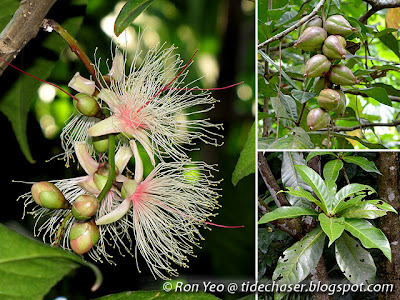
Powder-puff Tree (Barringtonia racemosa) - This locally rare tree got its common name from the fluffy-looking flowers with numerous stamens with a pinkish base. It occurs in mangroves on the landward side, along rivers, among beach vegetation and even in inland forests. The fruits are somewhat inversely pear-shaped, and are dispersed by water. The poison from the fruits and bark are used as fish poisons, while the leaves are eaten as a vegetable.
27. It has glossy, narrowly oblong or obovate leaves, spirally clustered at the branch tips. The leaves exude a milky sap when broken. The flower has a yellow centre.
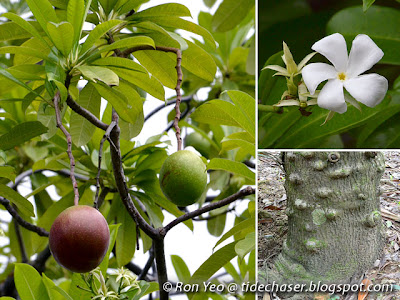
Pong Pong (Cerbera odollam) - This tree occurs in coastal forests and landward margins of mangroves. It has slightly fissured bark, greyish in colour, which exudes a milky white sap when cut. The flowers are white with a yellow centre, while the fruit is round, turning red to dark purple with age. The fruits are dispersed by water. The seed, sap and leaf are very poisonous. It is sometimes planted as a wayside tree, and the dried fibre mesh of the fruit is sometimes used in flower arrangement.
28. It has glossy, narrowly oblong or obovate leaves, spirally clustered at the branch tips. The leaves exude a milky sap when broken. The flower has a pink centre.

Pink-eyed Pong Pong (Cerbera manghas) - This critically endangered tree occurs on rocky and sandy shores in areas seldom inundated by seawater, and landward margins of mangroves. Very similar in appearance to the previous species, it has slightly fissured bark, greyish in colour, which exudes a milky white sap when cut. The flowers are white with a pink centre, while the fruit is round or ovoid, and may appear like a mango (hence the species name "manghas") turning red to dark purple with age. The fruits are dispersed by water. The seed and sap are very poisonous. The oil from the seed is sometimes used as a fish poison and as an insecticide, and also medically to treat itches, rheumatism, and the common cold.
29. It has leathery, narrowly oblong or obovate leaves, spirally clustered at the branch tips. Broken leaves exude a clear resin, turning black over time.

Sparrow's Mango (Buchanania arborescens) - This common tree can be found in coastal forests, swamp forests and even dryland forests. The small flowers occur in bunches with yellowish or white petals. The fruits are small and round, reddish in colour. The resins turn black when exposed to sun, and can be an irritant for people with sensitive skin. The fruits are edible, while the light wood is used for light construction.
30. It has slightly leathery leaves that are elliptic or obovate. The leaves exude a white sap when broken. The underside of the leaves may be brownish or green.
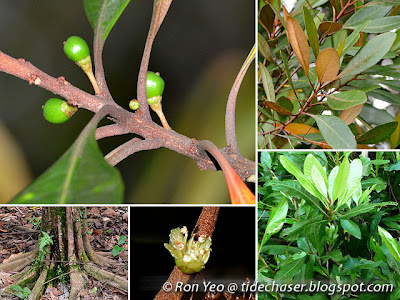
Sea Gutta (Pouteria obovata) - This coastal tree can be found on sandy/rocky shores, coastal forest, back mangroves and even inland forests. The trunk is often fluted, and sometimes twisted. The leaves of some specimens may have coppery undersides, while others will be greenish. The leaves exude a white sap when broken. The small flowers may be solitary or in small clusters. The fruits are small berries. The wood is sometimes used to make furniture, but is not very durable.
31. It has leathery, narrowly obovate leaves. The bark peels off easily, resulting in a colourful stem.

Sea Tristania (Tristaniopsis obovata) - This nationally critically endangered tree can be found in coastal forests. The bark peels off easily and the trunk may appear rather colourful, with the new bark in orange and the older bark in brownish or greyish tones. The flowers occur in bunches, and the fruits are small and somewhat ovoid, turning red as they mature. This tree is sometimes planted for ornamental purposes due to its beautiful bark.
32. It has leathery, narrowly obovate leaves. Mature trees have numerous small knobs on the branches left from the previous flowers.
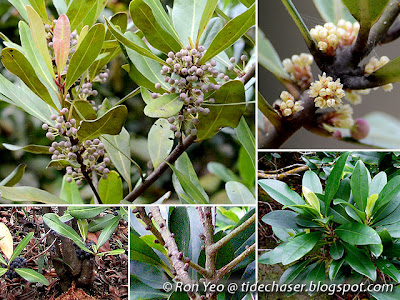
Dedahruang (Rapanea porteriana) - This coastal shrub/tree can be found in back mangroves, coastal forest and rocky high shores. The tiny white flowers occur as clusters in the axils of present or fallen leaves, while the fruits are small round berries. Even after the fruits have fallen off, stalk-like structures remain on the stem.
33. It has leathery, elliptic leaves. The branches are swollen at the base.

Mata Ayam (Ardisia elliptica) - This shrub/treelet is quite commonly seen in coastal forests or back mangrove. It is widely planted in parks and gardens too. The stem is brown or reddish brown, and the branches are swollen at the base and easily broken from the main stem. The flowers are pink, occuring in clusters, while the small fruits turn black when ripe, hence the common name "mata ayam" which means chicken eye. The fruits are used to treat intestinal worms or diarrhea, while the leaves are used to treat scabies.
34. It has slightly leathery, elliptic leaves. The bark peels off easily resulting in a colourful stem.
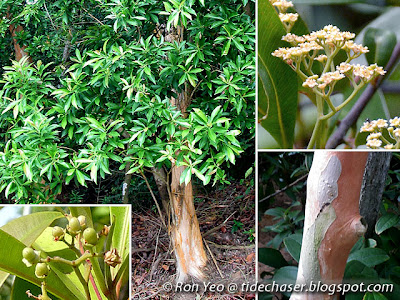
River Tristania (Tristaniopsis whiteana) - This nationally endangered tree can be found along the bank of rivers and in coastal forests. The bark peels off easily and the trunk hence usually appear rather colourful, with the new bark in orange and the older bark in brownish or greyish tones. The flowers occur in bunches, and the fruits are small and somewhat ovoid. This tree is sometimes planted for ornamental purposes due to its beautiful bark.
35. It has narrowly elliptic leaves oriented in the same plane, and the middle of the underside has a slightly darker band. The pale green twigs are flattened.

Wild Cocaine (Erythroxylum cuneatum) - This common tree does not just occur in coastal forest, but in inland forest as well. It has tiny white flowers and ovoid fruits which turn red as they mature. Easily recognised by its flattened twigs and often, there is a darker band in the middle of the underside of the leaves compared to the sides. Traditionally, it has been used to treat fever and inflammation, Studies have shown that extracts from this plant has some anticancer properties, and relieves morphine withdrawals. It is closely related to the Cocaine Tree (Erythroxylum coca), but some studies have shown that while it contains other chemical compounds (alkaloids), it does not contain cocaine.
36. It has elliptic or narrowly obovate leaves, and young twigs are dark green in colour. The leaves are somewhat oriented in the same plane.
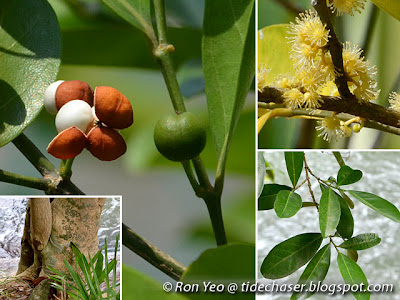
Limau Hantu (Suregada multiflora) - This nationally critically endangered tree is found on sandy/rocky shores, coastal forests and sometimes further inland. The bark is brownish/yellowish-grey. The flowers are small, occuring in clusters. The fruit resembles small lime, hence the Malay name "Limau Hantu" which means "ghost lime", and it is also called "False Lime". The fruit turns orange and splits open when it is ripe, revealing the white pulp surrounding three seeds. Studies shown that extracts from this plant has antibacterial and insecticidal properties. More recent studies showed that it has some anti-HIV and anti-cancer properties as well.
37. It has elliptic or oblong leaves that have a citrus (lime-like) smell when crushed. The branches have sharp spines.
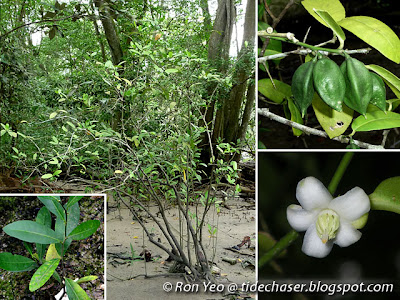
Mangrove Lime (Merope angulata) - This nationally critically endangered mangrove shrub usually occurs at the landward edge of mangrove forests and along river banks, and generally in areas with firm substrate. The branches has numerous spines, and the leaves are aromatic (lime like fragrance) when broken. The flowers are white, while the fruits are triangular in cross-section with 3 flattened sides, turning yellow as they mature. The roots are said to be used to treat abdominal complaints and assist womb contract after childbirth. Locals sometimes preserve the fruits and boil them to make a citrus drink. More details here.
38. It has papery leaves with wavy edges. The branches have numerous sharp spines.

Sea Lime (Ximenia americana) - This common treelet/shrub is found at the back mangrove or along sandy shores. It sometimes occur further inland, especially in dry areas with poor soil. The bark is greyish brown, and the branches has lots of sharp spines and covered with lenticels. The elliptic leaves may have rounded or pointed tips and can be quite variable. The flowers are greenish white, occuring in small clusters. The fruits are rounded, turning yellow as they mature. This plant is occasionally a root parasite, also on its own species. The pulp of the fruit is sometimes eaten, though it is mildly poisonous (cyanide). The wood is sometimes used as a substitute for white sandalwood due to its yellowish-brown colour, and pleasant smell when freshly cut. The leaves are sometimes eaten as vegetables.
39. It has slightly leathery oval leaves that exude a milky sap when broken. Two obvious lateral veins extend from the base of the leaf (tri-veined).

Malayan Banyan (Ficus microcarpa) - This strangling fig can be seen at back mangroves and inland forest edges. It has numerous aerial roots, which may later develop into pillar roots, giving the appearance of multiple stems. Like the Sea Fig, they are called "无花果", meaning "no-flower-fruit" in Chinese, but actually the fruit-like figs produced by the fig plants are not fruits, but a "container" for the tiny hidden flowers within. They are pollinated by tiny fig wasps. The almost stemless figs of the Malayan Bantan are small and round, turning red or even black as they mature. As they produce figs regularly and provide food for many species of animals, fig trees are generally seen as keystone species - like the keystone of an arch - and without them the entire ecosystem may be drastically affected. Some studies suggest that the variety and abundance of animals in a forest is dependent on the variety and abundance of figs. It is commonly planted as an ornamental plant.
40. It has papery, elliptic leaves, and young leaves have blotchy patterns on them. The twigs are silvery white in colour.
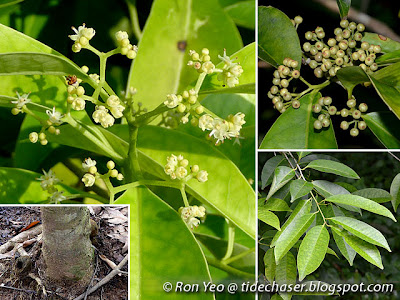
Marsh Holly (Ilex cymosa) - Related to the Christmas Holly, this common back mangrove/swamp forest tree lacks the latter's spiny leaves, but is still easily recognised with the patchy patterns on younger leaves, and white young twigs. The bark is light grey, and usually smooth but may appear pimply sometimes due to lenticels. The greenish-white flowers are small and occur in loose clusters, while the fruits are small and round, turning dark purple as they mature. The wood is used for firewood, and the roots are used to treat fever.
41. It has papery, narrowly lanceolate to elliptic leaves with brown undersides.

Dungun Air (Brownlowia tersa) - This nationally endangered plant usually occurs in areas with sand or firm mud on the landward side of mangrove forests. The branches are smooth and greyish brown. The simple, alternate leaves are lanceolate to elliptic-lanceolate with a pointed tip. The upper side is dark green, while the underside is densely covered with a layer of coppery scales. The small flowers are pink with numerous yellow stamens, the greyish-green fruits are woody capsules. This plant is sometimes used for fencing or as firewood. More details here.
42. It has narrowly oblong to lanceolate leaves oriented in the same plane.

Seashore Nutmeg (Knema globularia) - This critically endangered seashore tree can be found in coastal hill forests and inland forests. It has flaky bark, and young branches are usually covered with short hair. The leaves are oblong, usually with an obvious drip tip. The flowers are small and velvety on the outside, while the fruits are round, splitting open to reveal a red pulpy aril. The fruit is eaten and the seeds dispersed by big birds with strong stomachs, such as hornbills or large pigeons. The oil from the seed is used to treat skin infections, for making medicinal soaps and cosmetics, and to counteract putrefaction.
43. It has lanceolate leaves with numerous longitudinal nerves.

Gelam (Melaleuca cajuputi) - This tree is extinct in the wild in Singapore, but many have been planted in our coastal parks and along the roads. It occurs naturally on swamp ground near the coast, and also at the landward margins of mangroves, especially in the transition zone between mangrove and freshwater swamps. It has papery flaky bark which peels off easily from the stem. The flowers occur in clusters, appearing like a bottle brush with the numerous stamens. The fruits are small woody capsules without stalks. The leaves have a high content of aromatic cajuput oil that is used as an antiseptic, and is one of the ingredients for the popular tiger balm ointment used to relieve muscle pains and headaches. The wood is used as a fuel and for construction. The bark is used for caulking boats.
44. It has stiff linear leaves that are usually spirally clustered.

Sea Teak (Podocarpus polystachyus) - This critically endangered tree can be found on rocky/sandy shores or coastal hill forests. This plant does not produce flowers, but develops male and female cones instead. The male cones produce white powdery pollens, while female cones consist of a fleshy receptacle and ovule. The timber is hard and durable, and is used to make furniture and house interior. It is also planted for ornamental purposes.
References
Generally, shrubs refer to plants that are short (no more than a few metres tall) with a few woody stems, while trees are taller with one main woody stem. As some young trees may appear shrubby, I have decided to put both shrubs and trees together here.
The seashore environment is a very harsh environment for the trees and shrubs growing there. It is usually very dry, due to the land and sea breeze which increases the rate of evaporation. This is more so on rocky and sand shores since the substrates are rather porous. Salt sprays from the sea also have a drying effect on the plants living there. These coastal shrubs and trees, unlike true mangrove plants, are usually found in areas seldom or not inundated such as the back mangroves. Hence, they are also called mangrove associates. Many of them can also be found growing in other types of seashore ecosystems, such as sandy or rocky shore.
To identify the tree/shrub, just go through the following questions:
A) It is a monocot?
B) It has no conspicuous leaf blades?
C) It has opposite leaves?
D) It has alternate leaves?
A) It is a monocot.
1. The margins of the leaves are lined with sharp spines.

Seashore Pandan (Pandanus odorifer) - Apart from the palms, this is the only other monocot tree on our seashore. Like other monocots, it has parallel veins and one can peel off each leaf with the leaf sheath. There are lots of spines along the edges of the leaves. It may develop prop roots, and there are numerous warts on the stem. The male flowers occur in cone-like bunches, and are yellowish-white in colour. The female flowers appear like miniatures of the fruits but are whitish or greenish. The fruits turn orange as they mature. The leaves are used for weaving hats and mats, and for thatching. The male flowers yield an essential oil used to scent clothes.
B) It has no conspicuous leaf blades.
2. It has needle-like green twigs but no conspicuous leaves.

Ru (Casuarina equisetifolia) - The Ru is often mistaken for a pine tree, with its needle-like twigs often mistaken to be leaves. The actual leaves are very much reduced, occuring as small triangular scales arranged in whorls at the joints of the twigs. The bark is brown, ridged and fissured. The male flowers (right-bottom inset) occur as long terminal spikes. The female flowers (right-top inset) occur as spherical heads with reddish styles. Fruits are small and spiky, with lots of small compartments which open up upon maturity to release winged seeds dispersed by wind. This plant usually occurs in sandy areas. The wood is heavy and hard, and is used as firewood and for making charcoal. The bark yields a good resin that can be used for tanning.
C) It has opposite leaves.
3. It has leathery, broadly oblong/elliptic leaves and hidden leaf buds.

Seashore Mangosteen (Garcinia hombroniana) - This endangered tree is sometimes seen in our coastal forests, occuring on sandy or rocky substrates. Dark green streaks can be found on the younger branches, and it has white flowers occuring in clusters. The fruits are round and turn pink as they mature. They are seldom consumed as they have thin and sour flesh. It is sometimes planted as an ornamental plant.
4. It has leathery leaves with an obvious marginal vein running along the edge.

Sea Apple (Syzygium grande) - This tree with a greyish bark is commonly seen in our coastal forests. It has white, pom-pom like flowers with numerous stamens, occuring in clusters and blooming usually after a dry spell. The fruits are small and round, and provide food for many species of animals, such as monkeys, squirrels, bats and birds. This tree is commonly planted as a wayside tree as it provides good shade. Previously, it was also planted as fire breaks as it is quite fire-resistant (being a coastal plant, it has adapted to survive in the dry environment by retaining water in its trunk and leathery leaves). The wood is used for building boat and houses.
5. It has leathery, narrowly ovate leaves oriented in the same plane, and a short leaf stalk (about 0.5cm).

Blue Strawberry Flowers (Memecylon caeruleum) - This critically endangered shrub/tree usually has many stems near its base. It occurs in coastal forests. It has little blue flowers occuring in clusters, and the fruits may be pinkish or purplish, eventually turning black with age. It is planted as an ornamental plant, and the wood is used as firewood.
6. It has leathery, broadly ovate leaves oriented in the same plane, and a longer leaf stalk (about 1cm).

Delek Ayer (Memecylon edule) - This endangered coastal tree can be found in coastal forests, and on rocky shores. It flowers in clusters, usually purple or blue in colour. The fruits are small and round, turning reddish and eventually black as they mature. The wood is hard and durable, and used for building and as firewood. A yellow dye can be extracted from the leaves. Fruits are edible.
7) It has papery, elliptic leaves with 3 or more main nerves, tapering to a pointed tip. Both sides of the leaves are densely covered with hair.

Senduduk (Melastoma malabathricum) - This common shrub occurs in coastal forest, secondary forest and open country habitats and other disturbed areas. The flowers can be a pale purple, pink or white. The small fruits turn purple as they mature, and eventually split open to reveal the black flesh when they are ripe. They can be eaten but stain the mouth black, hence the genus name Melastoma, which means "black mouth". The young leaves are edible as well, and are used to treat stomach complains. The leaves are also crushed and applied to wounds from leech bites.
8) It has leathery and elliptic leaves with 3 or more main nerves, and are leathery and elliptic with a rounded trip. The undersides of the leaves are hairy.

Kemunting (Rhodomyrtus tomentosa) - This coastal shrub can be found sometimes in inland forest edges as well. The flowers are pink with numerous stamens, and the colour of the petals turn whitish with age. The small and round fruits are capped with persistent calyx lobes, and are edible, turning purplish as they mature. They can be used to produce wine. It is also planted as an ornamental plant for its pretty flowers and edible fruits.
9. It has stiff and leathery leaves with numerous fine veins perpendicular to the main nerve.

Penaga Laut (Calophyllum inophyllum) - The genus name of this critically endangered tree, Calophyllum, means "beautiful leaf". The flowers are white, occuring in clusters, while the fruits are round. It occurs in back mangroves and sandy beaches. The wood is very hard and used in construction and making furniture. Oil extracted from the seed is used as hair grease and bio-fuel. Most part of this plant, including its fruit and sap, are poisonous. It is sometimes planted as a shade tree.
10. It has leathery, broadly obovate leaves, with a pair of swollen stipule-like structures at the base of the leaf stalk.

Pelir Musang (Fagraea auriculata) - This nationally critically endangered plant's Malay name interestingly means "civet's testicles", refering to the swollen structures at the base of the leaf stalk. It occurs in coastal forests, including rocky cliffs. The flowers are creamy white trumpets. Apart from reproducing sexually, it can be propagated by roots as well. It is planted as an ornamental plant.
11. It has leathery, broadly obovate leaves, but lacks the swollen structures are the base of the leaf stalks.

Buah Telan Kenyalang (Fagraea ridleyi) - There is only one known living specimen of this rare plant in Singapore. The Malay name means "fruit swallowed by the hornbill". It can be found on coastal cliffs and both coastal and inland forests, and may occur as a woody climber or a shrub. It was named after Henry Nicholas Ridley, the first scientific director of the Singapore Botanic Gardens who has contributed immensely to tropical botany.
12. It has large fleshy elliptic leaves, sometimes spirally clustered at the branch tips.

Great Morinda (Morinda citrifolia) - This plant was believed to be nationally extinct in the wild, but naturally-occuring ones have settled in many of our back mangroves in recent years. The small flowers occur on roud flower heads, and the fruit is a multiple fruit, either oblong or ovoid, turning white as it matures. Also called noni, the fruit has a strong smell and bitter taste, and is consumed either cooked or raw. Some people believe the juice to be highly nutritious, but so far studies done on the fruit have not produced any conclusive results on its health benefits. A yellowish dye can extracted from its roots.
13. It has large and succulent broadly elliptic, ovate or obovate leaves with hair on both sides or only below, spirally clustered at the branch tips.

Beach Gardenia (Guettarda speciosa) - This small tree occurs on sandy/rocky shores and the landward margins of mangroves. The fragrant flowers are white and occur in small clusters. They are pollinated by moths, blooming at night and falling the next morning. The fruits are round, turning white as they mature. The bark is smooth and greyish brown. Women wear these flowers in their hair for their fragrance, or string them into necklaces. The bark is used to treat dysentery.
14. It has obovate or oblong leaves with a slightly notched leaf edge that initially has a gland in each notch.

Barat-barat (Cassine viburnifolia) - This critically endangered mangrove associate occurs as a small tree or shrub. The small, white flowers occur in clusters. The fruits are small and corky, turning brownish with age. They are dispersed by water. It is used for firewood, and the husk of the fruit is said to be used to stun fish. More photos and details here.
15. It has very variable leaf shapes (ovate, oblong or elliptic with pointed or rounded tips) but the leaves emit a foetid smell when crushed or rubbed against.

Buas Buas (Premna serratifolia) - This shrub/small tree can be found in coastal forest and occasionally inland forest edges as well. It has numerous small flowers occuring in big clusters. The fruits turn black with age. The leaf-shapes are highly variable, ranging from ovate to oblong and even elliptic. The leaves have a bad smell, especially when crushed. They are sometimes boiled and used to relieve itchiness. The wood is hard and durable, and can be made into handles of small tools.
D) It has alternate leaves.
16. It has broadly heart-shaped leaves with faint veins. The leaf underside is usually covered with short hair.

Sea Hibiscus (Talipariti tiliaceum) - This common seashore plant can be found on a wide variety of substrates, including sandy/rocky shores, river banks and back mangroves. There are numerous lenticels on the bark. The flowers are yellow, turning orange or red towards the end of the day, and will be shed usually by the next day. The calyx of the round fruit has 5 lobes, and the fruit usually dries up and opens while still attached to the tree. The seeds, which can remain buoyant due to an air cavity, are dispersed by water. Glands on the veins on the underside of the leaves secrete a sugary syrup which attracts ants. The ants are believed to protect the tree from herbivores in return. The fibre from the bark is used to make ropes and caulk boats. The wood is used to make musical instruments and utensils.
17. It has heart-shaped leaves with obvious veins. Older leaves have a smooth upper surface.
Portia Tree (Thespesia populnea) - This seashore plant usually occurs on sandy/rocky beaches or at the landward side of mangroves. The bark may be irregularly marked with some lenticels. The flowers are yellow, turning pinkish orange at the end of the day. The fruit is round and the calyx is not lobed. It usually does not open up while still attached to the tree. The seeds are dispersed by water, and have been tested to be viable even after floating in seawater for a year. The wood has been used for making musical instruments, religious sculptures, utensils, and other woodwork. Fibre from the bark is sometimes used for caulking of boats.
18. It has ovate leaves with short hair on the upper side.

Sea Trumpet (Cordia subcordata) - This tree is locally critically endangered, and on mainland Singapore, there is only one ancient naturally occuring tree at Changi, though it can also be found on some of our southern islands. It is usually found on sandy beaches or the landward side of mangroves. The flowers are trumpet-like and orange in colour. The bark is shallowly fissured and flaky. Fruits are small and egg-shaped or round, about 2-3cm long. The seeds are edible, and the wood is used as firewood (burns very readily) or for construction (resistant to termites). The leaves are used to treat stings and bites from marine animals.
19. It has ovate leaves with a glossy surface oriented in the same plane.

Latherleaf (Colubrina asiatica) - This rather common coastal shrub with drooping or climbing branches can be found growing in coastal forest or among sandy beach vegetation. The small flowers are greenish white with triangular petals, and fruits are small and round, turning brown with upon drying. The ovate leaves are used to treat skin diseases, while the stem is used treat stomach disorder.
20. It has obovate to ovate papery leaves with prominent parallel secondary veins. Mature plants often have tassels of dangling bracts.

Serengan (Flemingia strobilifera) - This curious-looking shrub with tassels of dangling bracts (modified leaves) is only found growing naturally on Pulau Ubin at coastal areas, though many of them are also planted by the authorities. It is said to be a weed of uncertain origins. The brownish things you see above are neither the fruit nor flower. They are modified leaves called bracts. If you open up the bracts, you will be able to find the little flowers (in green bracts) or fruits (in dried brown bracts) in them. The dried bracts are very fluffy and light, and are used for stuffing pillows and cushions in some places.The Malay name is derived from the word "rengan", which means "light-weight", refering to the bracts.
21. It has leathery leaves that are ovate or broadly elliptic, often spirally clustered at the branch tips. The leaves exude a white sap when broken.

Sea Fig (Ficus superba) - This strangling fig can be seen at back mangroves and coastal forests edges. Figs are called "无花果", meaning "no-flower-fruit" in Chinese, but actually the fruit-like figs produced by the fig plants are not fruits, but a "container" for the tiny hidden flowers within. They are pollinated by tiny fig wasps. The figs of the Sea Fig are small and round, turning from white to purplish as they mature. As they produce figs regularly and provide food for many species of animals, fig trees are generally seen as keystone species - like the keystone of an arch - and without them the entire ecosystem may be drastically affected. Some studies suggest that the variety and abundance of animals in a forest is dependent on the variety and abundance of figs. It is sometimes planted as a wayside plant. This plant is deciduous, and the new leaves are enclosed in bright maroon stipules.
22. It has leathery leaves that are broadly elliptic or ovate with a groove at the base due to the winged petiole (leaf stalk).

Simpoh Ayer (Dillenia suffruticosa) - This shrubby tree occurs from coastal forest to inland forest, usually found in wetter areas. It has large yellow flowers which bloom in the early morning while it's still dark and last for a day. The unopened fruits are round and resemble the flower buds, but have thick reddish sepals and point upwards, whereas the flower buds usually point downwards. The ripe fruits also open in the early morning when it's still dark, revealing seeds wrapped in red arils. The seeds are eaten and dispersed by birds. The large are used to wrap food and also used as a plate, and sap is applied to wounds to stop bleeding.
23. It has fleshy leaves that are narrowly obovate or oblong, spirally clustered at the branch tips. The leaves are so closely arranged that they may appear oppositely arranged sometimes unless examined closely.

Sea Lettuce (Scaevola taccada) - This spreading shrub occasionally develops into a small tree, and is commonly found at sandy/rocky beaches and the back mangroves. The stem is whitish-brown, and the leaves are oblong-obovate, often crowding at the ends of the branches. The flowers have a fan-like shape, with a yellow centre, sometimes with purplish patches. The round and fleshy are white when mature. The juice from the fruits are used as an eye-drop, and the leaves are used to treat stomach complains.
24. It has leathery, broadly ovate leaves, spirally clustered at the branch tips. The branching is layered horizontally.

Sea Almond (Terminalia catappa) - This common coastal tree is commonly found along beaches and at the back mangrove. It is also planted as a wayside tree in Singapore. It is deciduous, shedding its leaves twice a year. The leaves turn orange or red before they are shed. The branching is somewhat layered horizontally (hence they are also called pagoda tree), and old trees may develop buttress roots. The flowers are whitish, occuring in long clusters. Fruits are somewhat almond-shaped and are dispersed by water or mammals. The wood is used to build houses and boats. The kernel of the fruit is edible, and taste somewhat like almond, hence the common name. The tannin extracted from the bark is used for tanning leather.
25. It has fleshy, glossy, obovate leaves, spirally clustered at the branch tips.

Sea Poison (Barringtonia asiatica) - Often mistaken for the Sea Almond, this critically endangered tree has shiny thicker branches and lacks the horizontally layered branching of the former. The flowers have numerous conspicuous stamens tinged pink at the ends. The fruits are somewhat cubic, and hence are sometimes called "box fruits". The thick husk allows the fruits to float on and be dispersed by water. It can be found on sandy beaches and at the back mangroves. The whole plant is poisonous, and the seeds and other plant parts are often grounded into a powder and used to stun fish.
26. It has narrowly obovate or elliptic leaves tapered to a pointed tip. The leaves are spirally clustered at the branch tips.

Powder-puff Tree (Barringtonia racemosa) - This locally rare tree got its common name from the fluffy-looking flowers with numerous stamens with a pinkish base. It occurs in mangroves on the landward side, along rivers, among beach vegetation and even in inland forests. The fruits are somewhat inversely pear-shaped, and are dispersed by water. The poison from the fruits and bark are used as fish poisons, while the leaves are eaten as a vegetable.
27. It has glossy, narrowly oblong or obovate leaves, spirally clustered at the branch tips. The leaves exude a milky sap when broken. The flower has a yellow centre.

Pong Pong (Cerbera odollam) - This tree occurs in coastal forests and landward margins of mangroves. It has slightly fissured bark, greyish in colour, which exudes a milky white sap when cut. The flowers are white with a yellow centre, while the fruit is round, turning red to dark purple with age. The fruits are dispersed by water. The seed, sap and leaf are very poisonous. It is sometimes planted as a wayside tree, and the dried fibre mesh of the fruit is sometimes used in flower arrangement.
28. It has glossy, narrowly oblong or obovate leaves, spirally clustered at the branch tips. The leaves exude a milky sap when broken. The flower has a pink centre.

Pink-eyed Pong Pong (Cerbera manghas) - This critically endangered tree occurs on rocky and sandy shores in areas seldom inundated by seawater, and landward margins of mangroves. Very similar in appearance to the previous species, it has slightly fissured bark, greyish in colour, which exudes a milky white sap when cut. The flowers are white with a pink centre, while the fruit is round or ovoid, and may appear like a mango (hence the species name "manghas") turning red to dark purple with age. The fruits are dispersed by water. The seed and sap are very poisonous. The oil from the seed is sometimes used as a fish poison and as an insecticide, and also medically to treat itches, rheumatism, and the common cold.
29. It has leathery, narrowly oblong or obovate leaves, spirally clustered at the branch tips. Broken leaves exude a clear resin, turning black over time.

Sparrow's Mango (Buchanania arborescens) - This common tree can be found in coastal forests, swamp forests and even dryland forests. The small flowers occur in bunches with yellowish or white petals. The fruits are small and round, reddish in colour. The resins turn black when exposed to sun, and can be an irritant for people with sensitive skin. The fruits are edible, while the light wood is used for light construction.
30. It has slightly leathery leaves that are elliptic or obovate. The leaves exude a white sap when broken. The underside of the leaves may be brownish or green.

Sea Gutta (Pouteria obovata) - This coastal tree can be found on sandy/rocky shores, coastal forest, back mangroves and even inland forests. The trunk is often fluted, and sometimes twisted. The leaves of some specimens may have coppery undersides, while others will be greenish. The leaves exude a white sap when broken. The small flowers may be solitary or in small clusters. The fruits are small berries. The wood is sometimes used to make furniture, but is not very durable.
31. It has leathery, narrowly obovate leaves. The bark peels off easily, resulting in a colourful stem.

Sea Tristania (Tristaniopsis obovata) - This nationally critically endangered tree can be found in coastal forests. The bark peels off easily and the trunk may appear rather colourful, with the new bark in orange and the older bark in brownish or greyish tones. The flowers occur in bunches, and the fruits are small and somewhat ovoid, turning red as they mature. This tree is sometimes planted for ornamental purposes due to its beautiful bark.
32. It has leathery, narrowly obovate leaves. Mature trees have numerous small knobs on the branches left from the previous flowers.

Dedahruang (Rapanea porteriana) - This coastal shrub/tree can be found in back mangroves, coastal forest and rocky high shores. The tiny white flowers occur as clusters in the axils of present or fallen leaves, while the fruits are small round berries. Even after the fruits have fallen off, stalk-like structures remain on the stem.
33. It has leathery, elliptic leaves. The branches are swollen at the base.

Mata Ayam (Ardisia elliptica) - This shrub/treelet is quite commonly seen in coastal forests or back mangrove. It is widely planted in parks and gardens too. The stem is brown or reddish brown, and the branches are swollen at the base and easily broken from the main stem. The flowers are pink, occuring in clusters, while the small fruits turn black when ripe, hence the common name "mata ayam" which means chicken eye. The fruits are used to treat intestinal worms or diarrhea, while the leaves are used to treat scabies.
34. It has slightly leathery, elliptic leaves. The bark peels off easily resulting in a colourful stem.

River Tristania (Tristaniopsis whiteana) - This nationally endangered tree can be found along the bank of rivers and in coastal forests. The bark peels off easily and the trunk hence usually appear rather colourful, with the new bark in orange and the older bark in brownish or greyish tones. The flowers occur in bunches, and the fruits are small and somewhat ovoid. This tree is sometimes planted for ornamental purposes due to its beautiful bark.
35. It has narrowly elliptic leaves oriented in the same plane, and the middle of the underside has a slightly darker band. The pale green twigs are flattened.

Wild Cocaine (Erythroxylum cuneatum) - This common tree does not just occur in coastal forest, but in inland forest as well. It has tiny white flowers and ovoid fruits which turn red as they mature. Easily recognised by its flattened twigs and often, there is a darker band in the middle of the underside of the leaves compared to the sides. Traditionally, it has been used to treat fever and inflammation, Studies have shown that extracts from this plant has some anticancer properties, and relieves morphine withdrawals. It is closely related to the Cocaine Tree (Erythroxylum coca), but some studies have shown that while it contains other chemical compounds (alkaloids), it does not contain cocaine.
36. It has elliptic or narrowly obovate leaves, and young twigs are dark green in colour. The leaves are somewhat oriented in the same plane.

Limau Hantu (Suregada multiflora) - This nationally critically endangered tree is found on sandy/rocky shores, coastal forests and sometimes further inland. The bark is brownish/yellowish-grey. The flowers are small, occuring in clusters. The fruit resembles small lime, hence the Malay name "Limau Hantu" which means "ghost lime", and it is also called "False Lime". The fruit turns orange and splits open when it is ripe, revealing the white pulp surrounding three seeds. Studies shown that extracts from this plant has antibacterial and insecticidal properties. More recent studies showed that it has some anti-HIV and anti-cancer properties as well.
37. It has elliptic or oblong leaves that have a citrus (lime-like) smell when crushed. The branches have sharp spines.

Mangrove Lime (Merope angulata) - This nationally critically endangered mangrove shrub usually occurs at the landward edge of mangrove forests and along river banks, and generally in areas with firm substrate. The branches has numerous spines, and the leaves are aromatic (lime like fragrance) when broken. The flowers are white, while the fruits are triangular in cross-section with 3 flattened sides, turning yellow as they mature. The roots are said to be used to treat abdominal complaints and assist womb contract after childbirth. Locals sometimes preserve the fruits and boil them to make a citrus drink. More details here.
38. It has papery leaves with wavy edges. The branches have numerous sharp spines.

Sea Lime (Ximenia americana) - This common treelet/shrub is found at the back mangrove or along sandy shores. It sometimes occur further inland, especially in dry areas with poor soil. The bark is greyish brown, and the branches has lots of sharp spines and covered with lenticels. The elliptic leaves may have rounded or pointed tips and can be quite variable. The flowers are greenish white, occuring in small clusters. The fruits are rounded, turning yellow as they mature. This plant is occasionally a root parasite, also on its own species. The pulp of the fruit is sometimes eaten, though it is mildly poisonous (cyanide). The wood is sometimes used as a substitute for white sandalwood due to its yellowish-brown colour, and pleasant smell when freshly cut. The leaves are sometimes eaten as vegetables.
39. It has slightly leathery oval leaves that exude a milky sap when broken. Two obvious lateral veins extend from the base of the leaf (tri-veined).

Malayan Banyan (Ficus microcarpa) - This strangling fig can be seen at back mangroves and inland forest edges. It has numerous aerial roots, which may later develop into pillar roots, giving the appearance of multiple stems. Like the Sea Fig, they are called "无花果", meaning "no-flower-fruit" in Chinese, but actually the fruit-like figs produced by the fig plants are not fruits, but a "container" for the tiny hidden flowers within. They are pollinated by tiny fig wasps. The almost stemless figs of the Malayan Bantan are small and round, turning red or even black as they mature. As they produce figs regularly and provide food for many species of animals, fig trees are generally seen as keystone species - like the keystone of an arch - and without them the entire ecosystem may be drastically affected. Some studies suggest that the variety and abundance of animals in a forest is dependent on the variety and abundance of figs. It is commonly planted as an ornamental plant.
40. It has papery, elliptic leaves, and young leaves have blotchy patterns on them. The twigs are silvery white in colour.

Marsh Holly (Ilex cymosa) - Related to the Christmas Holly, this common back mangrove/swamp forest tree lacks the latter's spiny leaves, but is still easily recognised with the patchy patterns on younger leaves, and white young twigs. The bark is light grey, and usually smooth but may appear pimply sometimes due to lenticels. The greenish-white flowers are small and occur in loose clusters, while the fruits are small and round, turning dark purple as they mature. The wood is used for firewood, and the roots are used to treat fever.
41. It has papery, narrowly lanceolate to elliptic leaves with brown undersides.

Dungun Air (Brownlowia tersa) - This nationally endangered plant usually occurs in areas with sand or firm mud on the landward side of mangrove forests. The branches are smooth and greyish brown. The simple, alternate leaves are lanceolate to elliptic-lanceolate with a pointed tip. The upper side is dark green, while the underside is densely covered with a layer of coppery scales. The small flowers are pink with numerous yellow stamens, the greyish-green fruits are woody capsules. This plant is sometimes used for fencing or as firewood. More details here.
42. It has narrowly oblong to lanceolate leaves oriented in the same plane.

Seashore Nutmeg (Knema globularia) - This critically endangered seashore tree can be found in coastal hill forests and inland forests. It has flaky bark, and young branches are usually covered with short hair. The leaves are oblong, usually with an obvious drip tip. The flowers are small and velvety on the outside, while the fruits are round, splitting open to reveal a red pulpy aril. The fruit is eaten and the seeds dispersed by big birds with strong stomachs, such as hornbills or large pigeons. The oil from the seed is used to treat skin infections, for making medicinal soaps and cosmetics, and to counteract putrefaction.
43. It has lanceolate leaves with numerous longitudinal nerves.

Gelam (Melaleuca cajuputi) - This tree is extinct in the wild in Singapore, but many have been planted in our coastal parks and along the roads. It occurs naturally on swamp ground near the coast, and also at the landward margins of mangroves, especially in the transition zone between mangrove and freshwater swamps. It has papery flaky bark which peels off easily from the stem. The flowers occur in clusters, appearing like a bottle brush with the numerous stamens. The fruits are small woody capsules without stalks. The leaves have a high content of aromatic cajuput oil that is used as an antiseptic, and is one of the ingredients for the popular tiger balm ointment used to relieve muscle pains and headaches. The wood is used as a fuel and for construction. The bark is used for caulking boats.
44. It has stiff linear leaves that are usually spirally clustered.

Sea Teak (Podocarpus polystachyus) - This critically endangered tree can be found on rocky/sandy shores or coastal hill forests. This plant does not produce flowers, but develops male and female cones instead. The male cones produce white powdery pollens, while female cones consist of a fleshy receptacle and ovule. The timber is hard and durable, and is used to make furniture and house interior. It is also planted for ornamental purposes.
References
- Chong, K. Y., H. T. W. Tan and R. T. Corlett, 2009. A Checklist of the Total Vascular Plant Flora of Singapore: Native, Naturalised and Cultivated Species. Raffles Museum of Biodiversity Research, National University of Singapore. Singapore. 273 pp.
- Giesen, W., S. Wulffraat, M. Zieren and L. Scholten. 2006. Mangrove guidebook for Southeast Asia. RAP Publication 2006/07. FAO Regional Office for Asia and the Pacific and Wetlands International. Bangkok. 769 pp.
- Ng, P. K. L. and N. Sivasothi. 1999. A guide to the mangroves of Singapore 1 : the ecosystem and plant diversity. Singapore Science Centre. Singapore. 168 pp.


