
Technically, the ellobiids are classified as terrestrial snails, and are considered by many to be the most primitive of terrestrial pulmonates (snails which have lungs instead of gills) found along our shores. However, since they are commonly found in mangrove forest and nearby forested areas, and sometimes even on sandy and rocky shores, I decided to include them here.
In mangrove forests, ellobiids are often seen grazing algae on dead logs and stiff mud or on trees. They are air-breathing, and hence will move up trees or to areas not inundated by sea water during high tide.
The inner shell walls of most species are partially or completely resorbed, and hence empty shells are very buoyant. That is also why they are commonly called "hollow-shelled snails". Locally, they are called "Belongkeng". They are also characterised by the lack of an operculum. Like other land snails, they are hermaphrodites, and hence each animal has both male and female reproductive organs.
Here are the hollow-shelled snails that I have seen so far (thanks to Siong Kiat who gave tips on how to identify them!). You may want to take a look at my diagram on the parts of a snail's shell if you are not familiar with the names of the parts, so as to better understand the terms used below.

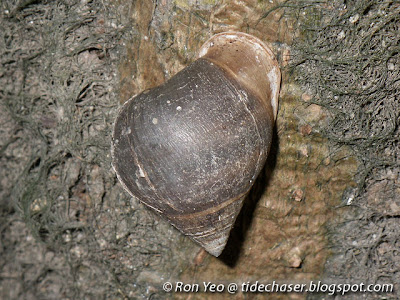
The Mida's Ear Shell (Ellobium aurismidae) is the biggest hollow-shelled snails in Singapore, growing to about 9cm long. They can be easily found in the back mangrove, usually away from sea water, and sometimes hidden among the leaf litter.

The body of the animal is brown in colour, with small light grey patches.

The Juda's Ear Shell (Ellobium aurisjudae) has a proportionally narrower shell compared to the previous species. It is also smaller, with the shell getting to about 5cm long. The animal has a light brown base colour, marked with small white patches.

The Cat's Ear Cassidula (Cassidula aurisfelis) can be easily found in our mangrove forests. They have a thickened outer lip that extends beyond the columella. Some specimens may have a pale band on the shoulder of the shell.

On the underside, it has a cleft lowest columellar tooth in the aperture, which unfortunately is not obvious in this photo. It can grow to about 2.5cm long.

The Singapore Hollow-shelled Snail (Melampus sincaporensis) was interestingly given a mispelled species name of "sincaporensis". However, since this was the name given by the author who described this species, it must not be spelled as "singaporensis" or it will be deemed scientifically incorrect. This small snail with an ovate shell of about 1cm long is often found on mangrove trees on on the mud towards the back mangrove. The spiral bands on the shell are variable - from many bands to a few thick bands.

The Trigonal Pythia (Pythia trigona) has a somewhat triangular shell which appears dorso-ventrally compressed. It can be found in the mangroves among rotting wood or on the leaves and branches of mangrove trees.

On cleaner shells, dark patches on a brown background can be seen. It can grow to over 2cm long.
The Plicated Pythia (Pythia plicata) can be easily confused with the previous species, but has a taller spire and is more narrowly triangular in shape. It usually lacks the darker patchy patterns on the shell.

Here is a look at the underside. It can grow to over 2cm long as well.
References
In mangrove forests, ellobiids are often seen grazing algae on dead logs and stiff mud or on trees. They are air-breathing, and hence will move up trees or to areas not inundated by sea water during high tide.
The inner shell walls of most species are partially or completely resorbed, and hence empty shells are very buoyant. That is also why they are commonly called "hollow-shelled snails". Locally, they are called "Belongkeng". They are also characterised by the lack of an operculum. Like other land snails, they are hermaphrodites, and hence each animal has both male and female reproductive organs.
Here are the hollow-shelled snails that I have seen so far (thanks to Siong Kiat who gave tips on how to identify them!). You may want to take a look at my diagram on the parts of a snail's shell if you are not familiar with the names of the parts, so as to better understand the terms used below.

The Mida's Ear Shell (Ellobium aurismidae) is the biggest hollow-shelled snails in Singapore, growing to about 9cm long. They can be easily found in the back mangrove, usually away from sea water, and sometimes hidden among the leaf litter.
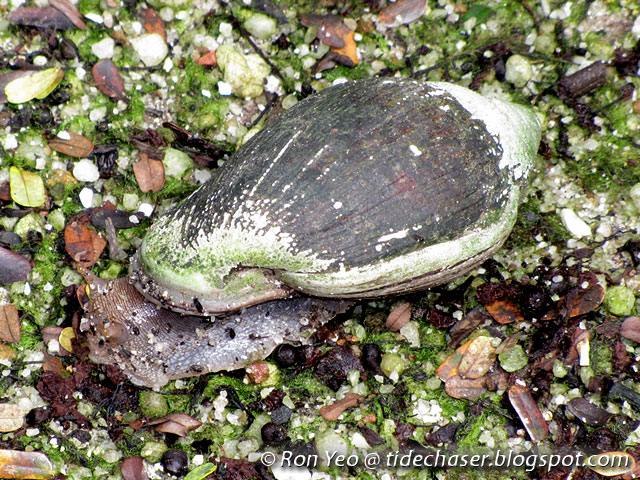
The body of the animal is brown in colour, with small light grey patches.

The Juda's Ear Shell (Ellobium aurisjudae) has a proportionally narrower shell compared to the previous species. It is also smaller, with the shell getting to about 5cm long. The animal has a light brown base colour, marked with small white patches.

The Cat's Ear Cassidula (Cassidula aurisfelis) can be easily found in our mangrove forests. They have a thickened outer lip that extends beyond the columella. Some specimens may have a pale band on the shoulder of the shell.

On the underside, it has a cleft lowest columellar tooth in the aperture, which unfortunately is not obvious in this photo. It can grow to about 2.5cm long.

The Singapore Hollow-shelled Snail (Melampus sincaporensis) was interestingly given a mispelled species name of "sincaporensis". However, since this was the name given by the author who described this species, it must not be spelled as "singaporensis" or it will be deemed scientifically incorrect. This small snail with an ovate shell of about 1cm long is often found on mangrove trees on on the mud towards the back mangrove. The spiral bands on the shell are variable - from many bands to a few thick bands.

The Trigonal Pythia (Pythia trigona) has a somewhat triangular shell which appears dorso-ventrally compressed. It can be found in the mangroves among rotting wood or on the leaves and branches of mangrove trees.

On cleaner shells, dark patches on a brown background can be seen. It can grow to over 2cm long.

The Plicated Pythia (Pythia plicata) can be easily confused with the previous species, but has a taller spire and is more narrowly triangular in shape. It usually lacks the darker patchy patterns on the shell.

Here is a look at the underside. It can grow to over 2cm long as well.
References
- Tan, K. S. & L. M. Chou, 2000. A guide to common seashells of Singapore. Singapore Science Centre, Singapore. 168 pp.
- Tan, S. K. & H. P. M. Woo, 2010. A preliminary checklist of the molluscs of Singapore. Raffles Museum of Biodiversity Research, National University of Singapore, Singapore. 78 pp. Uploaded 02 June 2010.
- Tan, S. K., S. Y. Chan & G. R. Clements, 2012. A guide to snails and other non-marine molluscs of Singapore. Science Centre, Singapore. 176 pp.
- World Register of Marine Species. 2012. Retrieved Oct 22, 2012, from http://www.marinespecies.org.


