
Finally, I was back to explore Kusu Island! Was really glad that I managed to round up a small gang to visit this island during the pilgrimage season! I always like to visit Kusu Island during this period just to enjoy the festive mood.
Unfortunately, possibly because of the rain in the morning, there were not many that people on the island. Most of the pasar malam and food stalls were also closed. When I was here last year, it was a lot more fun with all the stalls and enthusiastic devotees shouting "huat ah!"
We only saw one Hawksbill Turtle (Eretmochelys imbricata) in the lagoon today, unlike my last trip which I saw 3 of them. Not sure where did the other two go.
As the tide got lower, we entered the sandy lagoon and the first animal that I saw was this Sand-sifting Sea Star (Archaster typicus). Also called the Common Sea Star by some, this is one of the most commonly seen sea stars in Singapore. It's often sold under the wrong name of Astropecten sp. in the aquarium trade, but more unfortunately, these sea stars feed on tiny organic particles in the sand, and hence usually cannot survive in home marine tanks.
Nearer the sea wall, several colonies of soft corals can be seen. The above is a Lobophytum sp., which has vertical outgrowths on the top surface of the colony.
There were a few Tube Anemones (Order Ceriantharia) too.
On some of the loose rocks from the sea wall, several huge patches of Corallimorphs (Order Corallimorpharia) can be seen. They are closely related to the hard corals, but do not secrete a hard skeleton like the latter.
There was a really extensive population of Branching Monitpora Corals (Montipora sp.) in the lagoon, and lots of little crabs and shrimps can be found hiding among them.
Several pretty luminous green Favid Corals (Family Faviidae) were also spotted. The bright colour comes from the coral's colour pigments, which act as sun screen to block harmful rays.
The were lots of huge Magnificent Anemones (Heteractis magnifica), many of them clustering on the same rock. These anemones can reproduce asexually by fission, and hence the various individuals found on the same rock could have originated from just one of them.
There were several Gigantic Carpet Anemones (Stichodactyla gigantea) too. And in some of the sea anemones, we saw the Ocellaris Clownfish (Amphiprion ocellaris)!
Talking about fish, the Silverside (Atherinomorus duodecimalis) was definitely one of the most abundant fishes in the lagoon.
There were quite a few halfbeaks and needlefish too. The above needle fish was quite huge, possible about 50cm long.
I saw a young Fringe-eyed Flathead (Cymbacephalus nematophthalmus), probably about 10cm long. Just see how well-camouflaged it was!
But an even better master of camouflage would be Mr Stonefish (Synanceia horrida), when you can even find encrusting ascidians, sponges and algae growing on it. Fortunately, nobody stepped onto it, as it's very venomous and the spine on its back can easily poke through shoes! And unfortunately, Syalabi who came with us got stung by something! We didn't see what stung him, but from the position on his foot, I would suspect it to be a stingray. It was a very seriously sting though, being protected by his booties, and though it was very painful initially, it got a lot better after a while. And that's why it's always very important to wear covered shoes while exploring our shores!
We also saw a Stonefish Sea Cucumber (Actinopyga lecanora), which was not venomous at all, but got it's commercial name from the fact that it's very smooth and often found stuck among rocks and coral rubble, just like another stone! Next to the sea cucumber was a Red Swimming Crab (Thalamita spinimana).
There were many Purple Climber Crabs (Metopograpsus sp.) on the sea wall, but they can be be shy and hard to photograph sometimes. I was lucky to encounter a no-so-shy one here.
Related to the purple climber was this Sally-light-foot (Grapsus albolineatus), which unfortunately had lost one of its claws! It should be able to replace it when it next moult though.
Red Egg Crabs (Atergatis integerrimus) were quite plentiful too. These brightly coloured crabs are mildly poisonous.
A few Smooth Spooner Crabs (Etisus laevimanus) were seen in the lagoon too. The tips of its claws were spoon-like to enable it to scrape algae to feed on.
As we were heading out of the lagoon, we encounter a few of these fast runners - Ghost Crabs (Ocypode ceratophthalmus).
There were also a few Land Hermit Crabs (Coenobita sp.). Didn't have time to examine one closely to confirm the species though.
One of the prettier shrimp that can be found in Singapore waters must be this brightly coloured Red Shrimp (Processa sp.)!
Yet another very pretty shrimp would be this Anemone Shrimp (Periclimenes brevicarpalis), which lives among the stinging tentacles of huge anemones for protection.
We also saw a few octopuses, which changed their colours as they moved around!
I found this Arabian Cowrie (Cypraea arabica) under a rock. It's one of the bigger cowries that can be found in Singapore.
This was another huge cowrie I found under a rock, about the size of an Arabian Cowrie. Not sure if it could be a juvenile Arabian cowrie, but the patterns on the shell were just not right.
From the underside, it did look like a juvenile cowrie as the shell still appeared incomplete.
Another cowrie highlight for me would be this Four-spotted Cowrie (Cypraea quadrimaculata), which previously I had only seen dead ones at Semakau.
We found a few flatworms, but this was the only one that I managed to take a photo - an Orsak's Flatworm (Maiazoon orsaki).
There were quite a number of feather stars near the reef edge, including these 3 Red Feather Stars (Himerometra robustipinna) on a Barrel Sponge (Xestospongia testudinaria).
And I was especially happy to see a Yellow-lipped Sea Krait (Laticauda colubrina), which I had not seen for a while! In case you are wondering why it is called a sea krait, the kraits are a group of venomous snakes from the the genus Bungarus, and they come with bold striped patterns of alternating black and light-colored areas. As Laticauda colubrina also come with striped patterns, and it lives in coastal areas, it is hence commonly called "sea krait".
It was great to be out exploring our shores with friends, and I was relieved to hear from Syalabi that he's feeling ok from his injury now. While I enjoyed guiding people on nature walks, it's always nice to be able to take my own time to explore our shores, especially these days I often conduct walks without hunter-seekers, which can be super stressful when you try to find things on your own. Haha..
Saturday, October 01, 2011
Kusu Island on Children's Day 2011

Thursday, February 22, 2007
Kusu Island on CNY Day 3
The last time I went to Kusu Island was almost a year ago. We were with Dr Dan and his students then, and I saw quite a number of interesting things, including a nemo, i.e. a false clownfish (Amphiprion ocellaris) in a pool surrounded by lots of sponges and corals. Dr Dan wasn't with me then, and it was only later when I got to know they didn't managed to find any nemo that day :P
This time round, it's just the wildfilms crew and beachfleas. Zhiyuan and Weili decided to join me as well. We met up for a quick dinner before joining the others at Marina South Pier and took the boat to Kusu.
At Kusu, as we were heading towards the loo to do "you know what" before going into the lagoon, I heard someone yelling behind me.
"Don't go so fast! We want to follow you!"
Follow me to the loo???!!!????
She was one of the beachfleas who had also went with us to Sisters island the day before. But it's still quite bright now. And why did she want to follow a bunch of guys to go to the loo???!!!???
It then dawn on me that she thought that we were going into the lagoon, and she wanted to follow!!!
WAHAHAHAHahahaaaaa!!!!!
I yelled back at her that we were going to the loo, and everyone who heard us burst into laughter :D
Anyway, after the toilet break, we headed towards the lagoon. The first animal we saw at the sandy shore was this - a common seastar (Archaster typicus).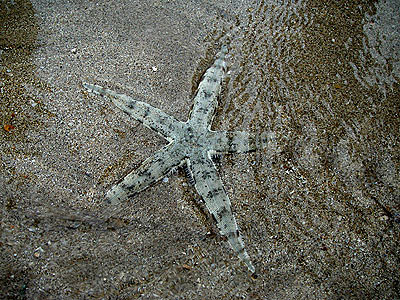
It was busy crawling over the sand, probably feeding on the organic particles (or detritus) on the surface.
I was really hoping to see nemos, but the water was a little murky and I had a bit of problem even to find the anemones. After searching high and low, and sinking to my knee at one point into the sand, I couldn't find any nemos despite finding quite a number of carpet anemones and magnificient anemones.
As the sky turned darker, we found a ghost crab (Ocypode sp.) on a patch of spoon seagrass (Halophila ovalis).
It was cream-coloured instead of the usual grey ones I've seen though, so not sure if this was a different species or just a colour variation. Ghost crabs are fast runners, and can move about 100 bodylengths per second, and they have excellent eyesight so as to see where they going. Otherwise, we will probably get a lot of dead ghost crabs on our shores, died from crashing into rocks or other hardy things :P
Most of the beachfleas were gathering around me then, some a little disappointed as we couldn't find the nemo. Hoping to show them more things, I decided to bring the gang to the reef near the jetty.
There were lots of zoanthids on the shore leading to the jetty, I really hoped we had not stepped on too many of them. On a rock near the jetty, we saw this beautiful Sally-light-foot crab (Grapsus albolineatus).
It is a scavenger, but also eats algae. And on another rock, we saw its close relative from the same family Grapsidae, a purple climber crab (Metopograpsus sp.)
Not to be confused with the tree-climbing or vinegar crabs (Episesarma spp. from the same family) found in mangroves and are primarily leaf-eaters (am clarifying this as I understand some beachfleas were confused), purple climber crabs mostly feed on algae, but they also scavenge and attack other small animals. I've seen them feeding on little fishes and sea slaters, though I'm not really sure if those were hunted or scavenged. They are quite common on our rocky shores, and can also be spotted in mangroves running over the roots and tree trunks.
As we walked along the rocky shore, I found a spiny oyster (Spondylus sp.) under a rock.
Unlike true oysters which cement to hard surfaces with their left valves, spiny oysters glued with their right valves.
As we walked towards the beacon, I spotted some reddish-orange thing smashing against the rocks with the waves. Picking it up, it was a loose sea fan (Order Gorgonacea)!!! Probably broken from its base by the dashing waves or something.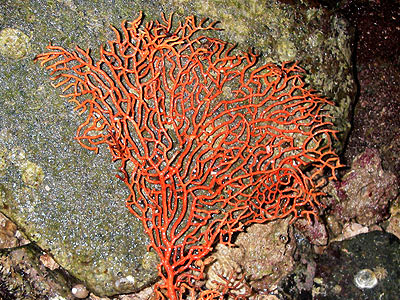
A sea fan is a colony of tiny animals (aka polyps) linked to each other, supported by a central rod made of a strong but flexible protein called gorgonin, which is similar to the material produced in the animal horns.
The water level was a little high when we reached the beacon and tide was rising. It was getting late and we decided to make our way back.
While this time round we couldn't find the nemo, it was nevertheless an interesting trip with a few good finds! :)