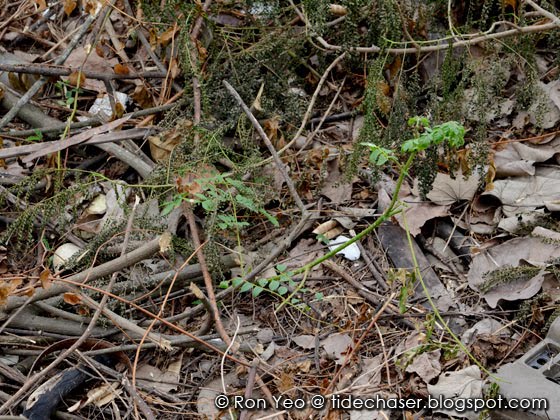
Showing posts with label Punggol and Sengkang. Show all posts

Sunday, July 24, 2011

Caesalpinia bonduc at Punggol on 24 July 2011

Today, I went back to Punggol Beach to check on the Grey Nicker (Caesalpinia bonduc) that was previously cut down by NParks contractors earlier this year.


It was good to see that it appeared to be regrowing well! There are only 3 known wild Grey Nicker in Singapore, one of which was this one at Punggol Beach, which I spotted earlier this year. I have informed the NParks Conservation Division people of its location, and hopefully the contractors won't mistake this rare plant for some common weed and cut it down again...


The two other plants can be found at Lazarus Island and Pulau Semakau.


The one at Lazarus was rather huge and healthy-looking. It's supposed to be a male plant.

So was the one at Semakau, which was a female plant. In fact, it was flowering the last time I visited it!

Thursday, February 24, 2011

Flowers and Fruits of Caesalpinia crista

It appeared to be the flowering season for Caesalpinia crista now! I have been seeing the flowers and even fruits in several of my mangroves, including Pulau Ubin and my trip to Punggol last week. Thought I will do a short blog on this since this is not something I often see throughout the year.

Caesalpinia crista
The flowers are yellow in colour, clustering to form a branched inflorescence. The fruits (on the left) are somewhat semi-circle in shape.

Caesalpinia crista
As this mangrove climber is often found creeping over the canopy, they are sometimes mistaken for the flowers of the Yellow Flame, a coastal plant which also has yellow inflorescence but flowers more frequently. And as I was taking photo of this plant, I suddenly saw some movements. Can you spot the animal that made the movement in the above photo?

Green-crested Lizard (Bronchocela cristatella)
It was a Green-crested Lizard (Bronchocela cristatella)! It's always nice to see our very own native lizard at our nature areas, instead of the exotic Changeable Lizard! :)

Sunday, February 20, 2011

NParks Contractor Cuts Down Only Caesalpinia bonduc on Mainland Singapore

Those of you who have been following my blog would remember that I found a locally critically endangered coastal climber, Caesalpinia bonduc, at Punggol Beach earlier this month.

I visited the plant again today, and this was what I saw.


The entire patch of coastal vegetation was cut down, and the Caesalpinia bonduc was barely alive!

Before NParks clear any vegetation, don't they get someone to double check if there are any endangered, or in this case, critically endangered plants among the vegetation?

It is really depressing to see that this has happened.

We have just lost the last Kandelia candel on mainland Singapore, so will this Caesalpinia bonduc suffer the same fate???

Update:
I informed NParks and they have taken measures to better protect the plant at Punggol by putting up some sticks for what's left of the plant. It was supposed to be rather hardy, so should be able to regrow well. NParks has also taken some cuttings of the plant to be grown in their nursery. I will also be passing them some of the seeds collected from Semakau. Would like to thank Mr Wong Tuan Wah, Geoffrey Davison, Shufen and other staff of the NParks conservation division for taking the necessary actions to better protect this critically endangered plant :)

Friday, February 04, 2011

Caesalpinia bonduc at Punggol

I had visited Punggol Beach a few times, but had never blogged about it as the intertidal life there somehow did not appeal to me much. Finding this particular plant, however, changed my mind this time round.

Caesalpinia bonduc
After exploring the marine life, I decided to check out the plants that had reestablished themselves on this reclaimed shore. And to my surprise, I spotted this Caesalpinia bonduc! This species is one of the rarest back mangrove plants in Singapore, though I understand it's rather common in the region.

Not sure if NParks or any of our botanists already know about this one at Punggol, or whether they had found other individuals in Singapore. But as far as I know, previously there's only one male plant recorded at Lazarus Island, and a female plant at Semakau. The one that I just spotted was not flowering or fruiting, so I don't really know if it's male, female or even bisexual.

Caesalpinia bonduc
Here's a look at the fruits of the Caesalpinia bonduc on Pulau Semakau.


Singapore has 2 native mangrove Caesalpinia species, the other one being the more common Caesalpinia crista, which can also be found at Punggol.

And here are some of the other interesting stuff I spotted at Punggol Beach:

Asterina coronata
Rock Star (Asterina coronata) - somehow they were a lot less abundant compared to the last time I was here. Only found 3 of them.

Dendrodoris fumata
A really tiny (less than 1cm long) Dendrodoris fumata, a nudibranch which feed on sponges.

Tube Snail (Vermetus sp.)
There were lots of Tube Snails (Vermetus sp.) stuck to the rocks.

Porcelain Crab
And of course, since there was a rocky shore, there were lots of Porcelain Crabs hiding around too.

Hoof-shield Limpet (Scutus sp.)
A few Hoof-shield Limpets (Scutus sp.) were spotted under the rocks.

sea anemones
In the tidal pools, lots of little sea anemones can be seen.

iridescent brittle worm
As it got darker, iridescent brittle worms started emerging.


Snapping Shrimps (Alpheus sp.)
And Snapping Shrimps (Alpheus sp.) too.

Green Mussels (Perna viridis)
Green Mussels (Perna viridis) were really abundant here.

Tide was not really low enough for me to see much stuff today, but guess I will be back here again, just to check on the Caesalpinia bonduc! :)

Friday, November 26, 2010

Another Visit to Sengkang Riverside Park

I didn't have much time to properly explore the new Sengkang Riverside Park the last time, and hence I decided to visit it again on 26 Nov 2010.

Sengkang Riverside Park
The park is located at Anchorvale Street along Sungei Punggol. In the middle of the river is a constructed wetland that collects and filters rainwater naturally through its aquatic plants.

Sengkang Riverside Park
Many of the aquatic plants were flowering, and attracted several sunbirds. There were also several herons and kingfishers, but unfortunately I did not get any decent photos of them :P

 Water Horn Fern (Ceratopteris thalictroides)
The Water Horn Fern (Ceratopteris thalictroides) that I spotted during my last trip was still there!

Crinum Lily (Crinum asiaticum)
Next to a patch of pandan leaves, I saw a lonely Crinum Lily (Crinum asiaticum). Suspect it's either a naturally occuring one, or the workers planted it here wrongly, as there was a planted patch not too far away. I later found a naturally occuring Crinum Lily among the mangroves plants though. Was quite sure it is not planted as it was a very mature plant right among the other wild mangrove plants.

Mangrove
Standing on the bridge over the constructed wetlands, you could see the nice stretch of mangrove trees on the river bank.

Api-api (Avicennia alba)
I did not really find any rare true mangrove species, but most of the usual suspects can be found here. The most abundant mangrove tree should be the Api-api (Avicennia alba). I later found a few Avicennia rumphiana and Avicennia officinalis too!

Mangrove Apple (Sonneratia alba)
Several mature Mangrove Apple (Sonneratia alba) can also be found here.

Bakau Putih (Bruguiera cylindrica)
There were several Bakau Putih (Bruguiera cylindrica), including a few young ones.

Bakau Kurap (Rhizophora mucronata)
I also saw a few Bakau Kurap (Rhizophora mucronata), with their long seedlings. Some people actually use these seedling to cane their children, and they supposedly do not leave much markings!

Blind-your-eyes
Among the minor local mangrove species, I only saw the Blind-your-eyes (Excoecaria agallocha)...
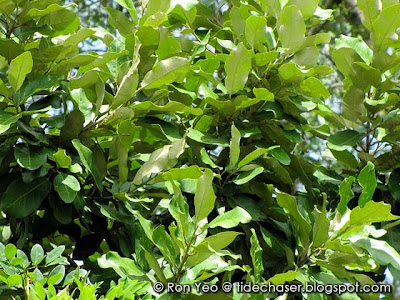
Dungun (Heritiera littoralis)
and Dungun (Heritiera littoralis).

Sea Hibiscus (Talipariti tiliaceum)
There were quite a few mangrove associates though. As per the other mangrove forests in Singapore, I saw many Sea Hibiscus (Talipariti tiliaceum) trees. The flowers only last for a day - starting off yellow in colour, and eventually turning orange towards the end of the day. It will usually drop off the next day.
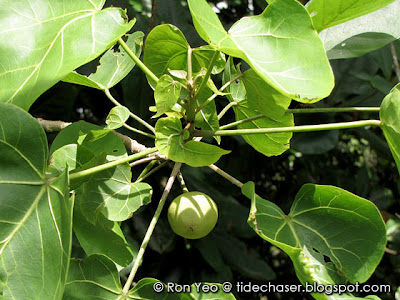
Portia Tree (Thespesia populnea)
The rather similar-looking Portia Tree (Thespesia populnea) was interestingly rather abundant here.
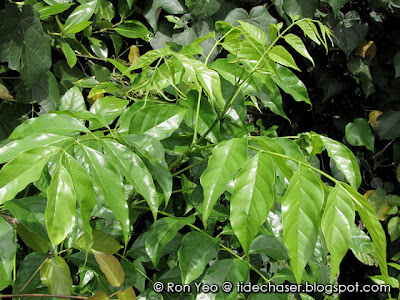
Mangrove Trumpet Tree (Dolichandrone spathacea)
I saw a young Mangrove Trumpet Tree (Dolichandrone spathacea), but did not see any mature plant.

Sea Poison (Barringtonia asiatica)
They authorities planted quite a few trees too, including the Sea Poison (Barringtonia asiatica), which was fruiting. The seeds are ground into powder in some places and used as a poison to stunt fishes. The poison is destroyed when the fish is cooked.

Mempari (Pongamia pinnata)
Several Mempari (Pongamia pinnata) were also planted. All parts of this plant are also poisonous. The oil extracted from the seeds is known as honge oil, and has been used in soap making, as a lubricant and as lamp oil for thousands of years!

Wild Jasmine (Clerodendrum inerme)
I found a few Wild Jasmine (Clerodendrum inerme), but mangrove climbers on the whoel were certainly not as abundant as other mangrove forest in Singapore, since Sungei Punggol had already been made into a reservoir and the water was no longer brackish. Most of the climbers I saw were the usual secondary forest climbers instead.
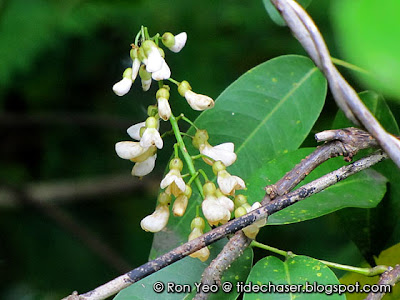
Sea Derris (Derris trifoliata)
Another mangrove climber I saw was the Sea Derris (Derris trifoliata), again another poisonous plant.

 Yellow Flame Tree (Peltophorum pterocarpum)
I later went over to Serangoon River, and again saw the same old usual mangrove plants. An exception was this naturally occuring Yellow Flame Tree (Peltophorum pterocarpum). Naturally occuring Yellow Flame Trees are considered to be critically endangered in Singapore, even though there are many planted ones in parks and along the roads! Wild Yellow Flame Trees can still be found on some of our islands, such as Pulau Ubin, Pulau Semakau and a few other of our southern islands.


Saw several of these birds at Punggol, but can't remember its name and too lazy to search my books. Have seen it several times at Semakau as well, and the name is definitely in my head some where. Maybe I'll remember it after a while. Haha...

Sunday, November 14, 2010

Quick Look at the New Sengkang Riverside Park

Managed to have a quick look at the new Sengkang Riverside Park this morning. It was generally a rather nice place, and certainly deserve a more proper exploration when I have the time.

Sengkang Riverside Park
Here's a look at the bridge in the middle of the new Punggol Reservoir.

Sengkang Riverside Park
There is a constructed wetland in the middle of the of the reservoir. At the edge of the reservoir are the original mangrove plants that were already here when the reservoir was still Sungei Punggol.

Cattail
The usual freshwater plants like the cattail (which unfortunately is a non-native plant) and cyperus were planted on the wetland.

Munias
It was drizzling a little when I was on the bridge over-looking the artificial wetland, but I could still see several birds, like the munias above.

Sunbird
There were a few sunbirds too.

Water Horn Fern (Ceratopteris thalictroides)
A surprise find will be this Water Horn Fern (Ceratopteris thalictroides - the spiky plant in the middle). It's rather uncommon in Singapore, and before this I think I have only seen them on Pulau Ubin in one of the disused prawn ponds. Don't think this is planted, since there was only one of it in the middle of no where. This fern is also cultivated as an ornamental and aquarium plant in the region. It is supposed to be edible, though I read some where saying it may contain toxins.


Mangrove
The original mangrove looks interesting, and just from a quick look I spotted a number of true mangrove species, including Rhizophora mucronata, Bruguiera cylindrica, Sonneratia alba, Avicennia alba, Avicennia officinalis, Heritiera littoralis, Exocoeria agallocha, Acrostichum aureum. I certainly need to come back again one of these days!

Fruit trees
The park also has lots of fruit trees, including longan, chiku, star apple, butterfruit, mangosteen etc. Certainly rather interesting for kids to learn about where their fruits come from.

We spent less than 15 minutes here, I think, and had to rush off. Am certainly going to check my calendar to see when I can visit this place again!