
Finally, Raffles Lighthouse with fine weathers! The past few trips were all rainy :P
Raffles Lighthouse certainly is one of the best places to look at the amazing coral diversity in Singapore, and so here I am going to focus on the hard corals I saw during this trip.

Just look at how dense the coral cover is! A lot of people would probably find it hard to believe that this is part of Singapore.

In just one small area, I could already spot quite a few corals from different genera.

Here's another patch.
Some of coral genera I saw include:

Massive colonies of Goniastrea with the typical paliformed lobes in the corallites.

Favites, where the corallites have joint walls without paliformed lobes.

Encrusting Oulastrea colony, with black coenosteum.

The so-called brain coral, Symphyllia sp., with distinct septal teeth and the corallites have joint walls.

The similar-looking Lobophyllia with separate walls.

Psammocora sp.

The "leafy" Pavona sp.

The mushroom coral, Fungia sp. Doesn't it appear like a big mushroom?

The galaxy coral, Galaxea sp., with crown-shaped corallites.

Echinopora sp., in the plating form with a few branching structures. The surface of the colony is granulated.

The turban coral, Turbinaria sp., which exhibits a plating growth form.

Closely related is the cave coral, Tubastrea sp., which is usually found under rocks.

A branching Hydnophora sp.

Another branching coral - Montipora sp.

This one with fine branching is the Porcillopora coral.
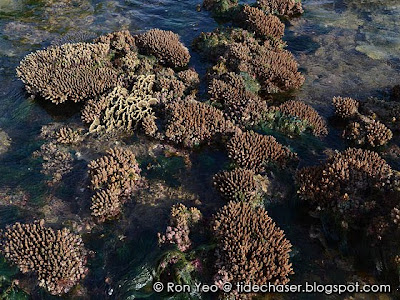
The most abundant coral here will be the Acropora corals. And here at Raffles Lighthouse, there are many different species with different growth forms!

There are the encrusting ones with hardly any branching.
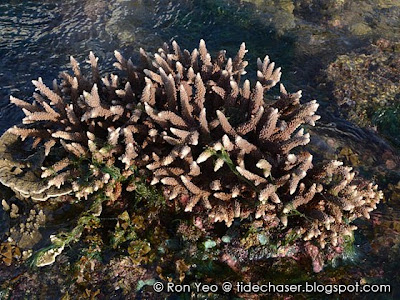
The ones with antler-like appearances.

And table-forming colonies.

This colony is also green in colour like the previous one, but it has finer branching.
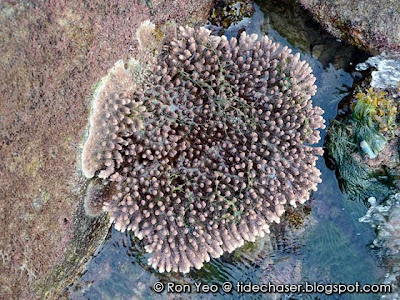
There are reddish colonies too.
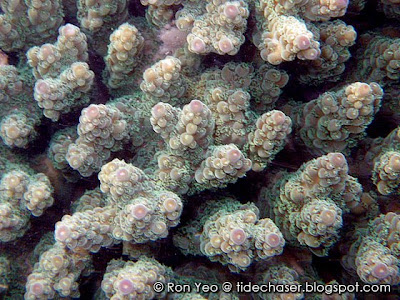
All Acropora species will have a polyp at the tip of the branch.

I even found one growing on a spider conch (Lambis lambis)!

This is a blue coral (Heliopora coerulea). Technically it is not a hard coral, even though it has a hard skeleton, as it is more closely related to soft corals.

And among the blue corals I found a Hairy Reef Hermit Crab (Dardanus lagopodes).

A few other animals we saw include this Saron shrimp (Saron sp.).

A pretty little brittler star...

Several nudibranchs, including this Gymnodoris sp., were spotted.

And there were many little fishes in the lagoon.
Glad to see so much life returning to this little island, as we witnessed massive coral bleaching last year. I did not see a number of hard coral genera which were commonly seen last time though. Hopefully they will soon re-establish themselves here...
Raffles Lighthouse certainly is one of the best places to look at the amazing coral diversity in Singapore, and so here I am going to focus on the hard corals I saw during this trip.

Just look at how dense the coral cover is! A lot of people would probably find it hard to believe that this is part of Singapore.

In just one small area, I could already spot quite a few corals from different genera.

Here's another patch.
Some of coral genera I saw include:

Massive colonies of Goniastrea with the typical paliformed lobes in the corallites.

Favites, where the corallites have joint walls without paliformed lobes.

Encrusting Oulastrea colony, with black coenosteum.

The so-called brain coral, Symphyllia sp., with distinct septal teeth and the corallites have joint walls.

The similar-looking Lobophyllia with separate walls.

Psammocora sp.

The "leafy" Pavona sp.

The mushroom coral, Fungia sp. Doesn't it appear like a big mushroom?

The galaxy coral, Galaxea sp., with crown-shaped corallites.

Echinopora sp., in the plating form with a few branching structures. The surface of the colony is granulated.

The turban coral, Turbinaria sp., which exhibits a plating growth form.

Closely related is the cave coral, Tubastrea sp., which is usually found under rocks.

A branching Hydnophora sp.

Another branching coral - Montipora sp.

This one with fine branching is the Porcillopora coral.

The most abundant coral here will be the Acropora corals. And here at Raffles Lighthouse, there are many different species with different growth forms!

There are the encrusting ones with hardly any branching.

The ones with antler-like appearances.

And table-forming colonies.

This colony is also green in colour like the previous one, but it has finer branching.

There are reddish colonies too.

All Acropora species will have a polyp at the tip of the branch.

I even found one growing on a spider conch (Lambis lambis)!

This is a blue coral (Heliopora coerulea). Technically it is not a hard coral, even though it has a hard skeleton, as it is more closely related to soft corals.

And among the blue corals I found a Hairy Reef Hermit Crab (Dardanus lagopodes).

A few other animals we saw include this Saron shrimp (Saron sp.).

A pretty little brittler star...

Several nudibranchs, including this Gymnodoris sp., were spotted.

And there were many little fishes in the lagoon.
Glad to see so much life returning to this little island, as we witnessed massive coral bleaching last year. I did not see a number of hard coral genera which were commonly seen last time though. Hopefully they will soon re-establish themselves here...


