
There is a Chinese saying - 出污泥而不染.
Basically, it is used to describe the lotus, which often grows in muddy water, but emerges untainted by the mud. Sometimes, this is also used to describe someone who grew up in a very bad environment, but yet remains a good person.
I was on a bus along Ang Mo Kio Ave 6 when I saw this lotus pond in Ang Mo Kio Town Garden. It was a truly beautiful sight. I couldn't resist the urge to get down the bus to take a closer look at it.
When did they plant all these? I have never noticed the lotuses before.
The lotus (Nelumbo nucifera) is a spectacular water plant that is commonly found in the tropics. Unlike the other water lilies, which have their leaves floating on the water surface, the leaves of the lotus are usually held above the water.
Personally, I also find the flower of the lotus to be the most spectacular among all the water lilies.
The flower starts off as a little flower bud.
Then one morning, the tips of the petals will slowly open.
Soon, the female reproductive structure and the tips of the stamens will be exposed, and they will start producing a strong perfume.
This will attract its potential pollinators - the insects, which may fertilise one or more ovules if they have previously visited other lotus flowers.
As night falls, the flower closes up, thus trapping any late pollinators in it. Pollen is shed within the flower to provide a reward to the pollinators wandering around the flower. It is possible that self-fertilisation may occur then.
The next morning, the flower will open into a bowl shape.
The overnight visitors will be free to leave, covered in pollen from this flower, ready to fertilise the ovules of other flowers they are visiting.
That night, the flower closes more loosely and traps potential pollinators again. The petals will also start to wither.
On the morning of the third day, the flower will open fully.
The petals and stamens will be shed over the following day or within a few days. Eventually, the fruit in the middle will be revealed.
And soon, only the green fruit is left.
The fertilised ovules will slowly develop into seeds, and the fruit grows bigger.
Finally, the seeds are mature and ready to be shed.
It is said that the seeds are very long-lived, and some seeds actually managed to germinate hundreds of years after they were formed! In fact, the oldest seed that has germinated into a viable plant was from an approximately 1,300-year-old lotus fruit, recovered from a dry lake bed in northeastern China!
Isn't that ULTRA AMAZING???
The lotus is also a very useful plant. The flowers, seeds, young leaves and rhizomes are edible. When dried, the stamens can also be made into a herbal tea, and the petals can be used for garnishing. The large leaves are used as a wrap for food.
The lotus is also the national flower of India, and is often seen as a sacred flower by the Hindus, Buddhists and Baha'i. In fact, when I went to India about two years ago, I saw this Baha'i Temple that was built to look just like a lotus!
The lotus pond attracted a number of insects, and I saw many dragonflies (Suborder Epiprocta) and a few damselflies (Suborder Zygoptera).
Here's a beautiful dragonfly, black with yellow stripes (or is it yellow with black stripes? Hmmmmm...)
During my kampong days, we used to call this 红阿姨, which basically means red auntie.
And here's a really pretty one in blue.
The one below is a damselfly though, not a dragonfly.
Damselflies are quite similar to dragonflies. To tell the difference, look at the the wings. Most damselflies held their wings along the body when they are at rest. They are also smaller and weaker fliers compared with dragonflies.
A beautiful lotus pond with lots of dragonflies and damselflies - that certainly made my day! I'll definitely return to this place again :)
Thursday, April 19, 2007
Emerged from the Mud Untainted

Wednesday, April 18, 2007
Clear Water at Sisters
The water was ultra clear when we went to Sisters Island last Sunday. There was another gang of 15-20 odd people on the island as well. Probably anglers, I guess.
Didn't have much time to explore as I had to assist Alvin, but that didn't stop me from snapping a few shots of the interesting stuff I saw along the way :)
Here's Alvin with his latest invention.
Heh heh, can't remember what's the name they give it. But anyway, it's a plastic box with a hole in front (ok ok, and another on top of course, I know I know) which Alvin covered with a piece of clear plastic. Anyway, he made it such that the thing was kind of waterproof, so that he could place the video camera inside and shoot through the hole... or rather, through the piece of acrylic covering the hole.
And here's the wild thing he was shooting, a yellow-lipped sea krait (Laticauda colubrina)!
These pretty snakes are highly venomous, but don't usually attack humans. I had several encounters with them on Sisters Island actually.
And here's a mole mushroom coral (Polyphyllia talpina).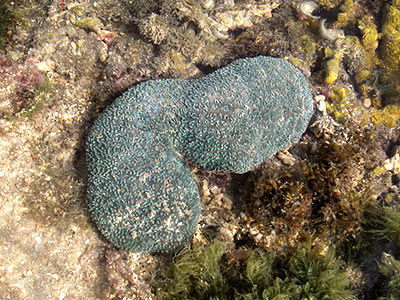
This coral is a free-living colony! It is also listed as one of the threatened animals in Singapore.
As the water was so clear, all the other corals also looked exceptionally beautiful! Here are some of the hard corals I saw that day.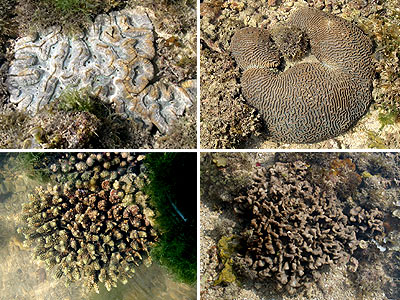
There were splashes of Halymenia red seaweeds (Halymenia sp.) here and there as well, and they looked really pretty underwater.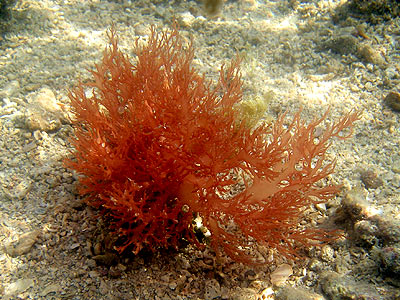
Some Halymenia species are eaten by people, but I'm not sure about this one though :P
But the highlight of the day must be this ultra cute little animal!
What does it looked it to you? Adapting from the line they often used in Superman...
It's a squid! It's a cuttlefish! It's a... slug???
Yes! This is a slug. A slug that swims. It's a sidegill slug (Euselenops luniceps).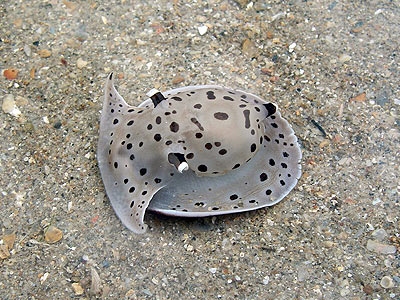
I remembered reading Dr Chua's book sometime back when I saw a picture of this slug, and I was thinking when will I finally get to see this cute little animal.
And finally! I got to see it!
This slug can actually dives under the surface of the sand to feed and hide from predators. Like other slugs, they are also hermaphrodites and each has both male and female reproductive organs.
They are, however, not nudibranchs, but pleurobranchs. According to the Sea Slug Forum, we can differentiate pleurobranchs from nudibranchs by the enrolled head tentacles and the large gill found along the right side of the body. Nudibranchs have very distinctly shaped rhinophores, and the gills, if present, form a circle in the dorsal midline.
And we found three of these slugs last Sunday! What a great day :)
However, on our way back to the jetty, and unsightly sight was waiting for us...
Read the Annotated Budak's blog for for details...