Wednesday, June 12, 2013

Barnacles (Phylum Arthropoda: Infraclass Cirripedia) of Singapore

Barnacles (phylum Arthropoda, subphylum Crustacea, class Maxillopoda, infraclass Cirripedia) are most easily seen on the upper shores, where they appear like miniature volcanoes attached to rocks and other hard structures.

They may resemble limpets (which are molluscs), but they are crustaceans, most obvious in their larva stage when they superficially resemble small shrimps with a segmented body and jointed legs. The larva eventually finds a suitable substrate and attaches itself permanently to it with a cement-like substance it produces, and secretes a conical shell around it. There is a hole at the top of the shell (hence appearing like a miniature volcano), which allows the animal to extend its hairy appendages to filter plankton from the water during high tide. During low tide, the animal will hide in the shell and block the opening with a trapdoor-like operculum.

Not all barnacles have this volcano-like appearance, and some species are stalked - appearing somewhat like a germinating seed. These are often called goose barnacles as some species resemble the head and neck of a goose (with some imagination), and may attach to rocks or flotsam.

Some barnacles are parasitic, and are found attached to the gills or other internal parts of other animals. These crustaceans have lost their legs and shells, and feed on the tissues of the hosts. Some parasitic barnacles may damage the reproductive systems of their hosts.

Most barnacles are hermaphroditic, and being sessile makes sexual reproduction a challenge. These barnacles have thus developed very long penises which extend out of their shells to fertilise other neighbouring barnacles. It is believed that barnacles probably have the longest penises relatively to the body size in the animal kingdom. For some species that have separate sexes, a tiny male often lives within the shell of a much larger female to make fertilisation easier. The fertilised eggs will hatch into planktonic larvae.

As barnacles tend to stick to any hard surfaces, including marine vessels and port structures, they are often viewed as a problem in the maritime industry (readers of the comic series Tin Tin will remember Captain Haddock cursing, "Billions of bilious blue blistering barnacles!"). Barnacles that grow on marine vessels add weight and slow down them down, while those that grow on maritime equipment may cause them to malfunction, or make them difficult to handle as the edges of these barnacles can be quite sharp, causing cuts and blisters. The research on reducing barnacle growth is hence a huge industry itself.

Some of the bigger barnacle species are consumed by human.

Several groups/species of barnacles can be found in Singapore, though the ones I have photographed so far are all from the superorder Thoracica. Members of this order may be sessile (stuck to hard surfaces in conical shells) or stalked.


A) Order Sessilia

This order comprises the sessile barnacles which secrete a conical shell permanently stuck to a hard surface. They normally feed by actively waving their "hairy" appendages during high tide to filter food particles from the water column.

Volcano Barnacles (Tetraclita sp.)
Volcano Barnacles (Tetraclita sp.) form hard, conical shells. The thick wall of the shell has numerous holes and gaps internally (much like a sponge!), holding many pockets of air for heat insulation. The width of the barnacle can get to about 3cm. It is often found on huge rocks, and unlike most of the other species below, does not usually occur in huge clusters.

Star Barnacles (Euraphia sp.)
Star Barnacles (Euraphia sp.) has a star-like appearance, and are usually not more than 1cm wide. They often occur high up on the shore, forming huge clusters on areas above the other barnacles.

Acorn Barnacles (Balanus sp.)
Acorn Barnacles (Balanus sp.) are possibly the most commonly seen barnacles. They often form a continuous layer on rocks and other hard structures on the high shore.

Acorn Barnacles (Balanus sp.)
Acorn Barnacles can also be found growing on the shells of other living things, such as the ones above growing on the shell of a crab hiding under the sand.

Acorn Barnacles (Balanus sp.)
Here is another example of Acorn Barnacles growing on the exoskeleton of a crab.
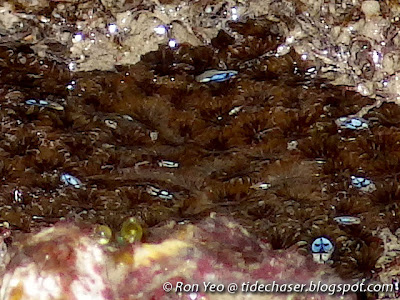
Coral Barnalces (Pyrgomatidae, Megabalanidae or Balanidae)
Many species of barnacles from the family Pyrgomatidae, Megabalanidae and Balanidae are known to embed themselves in corals. They are commonly called Coral Barnacles, and can be differentiated by the number of calcareous shell plates they posses. These plates, however, can only be examined if the specimen is removed from the coral host, and hence identification is usually hard in the field. The unidentified species featured in the above picture has a bluish coloration, and the specimens are embedded in a coral of the family Faviidae.

Coral Barnalces (Pyrgomatidae, Megabalanidae or Balanidae)
This unidentified species appeared to have gained some control over the hard coral's calcification ability, as the corallites which they are embedded in are much larger than the unaffected surrounding ones. The host coral appears to be of the family Faviidae.


B) Order Pedunculata

This order comprises barnacles that are attached to surfaces via a flexible stalk. Unlike the previous group, they are dependent on water movement to filter food particles, and generally do not actively move their "hairy" appendages.
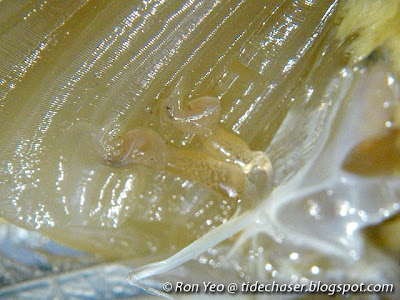
Parasitic Goose Barnacles (Octolasmis sp.)
Commensal Goose Barnacles (Octolasmis sp.) are sometimes found attached to the gills of crustaceans. They do not cause much harm to the host, but are just hitching a ride and benefiting from the water currents created by the gills, which bring plankton and other suspended food particles. However, when the crustacean hosts moult, these barnacles will be discarded with the old exoskeleton.


References
  • Achituv, Y. & N. Simon-Blecher. 2006. Pyrgopsella (Cirripedia: Balanomorpha: Pyrgomatidae) is not a sponge-inhabiting barnacle. Zootaxa (1319): 29-41.
  • Burnie, D. 2001. Animal. London: Dorling Kindersley. 624 pp.
  • Debelius, H. 1999. Crustacea - Guide of the world. IKAN, Frankfurt. 321pp.
  • Ng, P. K .L., R.T. Corlett & H.T.W. Tan (eds.). 2011. Singapore Biodiversity: An Encyclopedia of the Natural Environment and Sustainable Development. Singapore: Editions Didier Millet. 552 pp.
  • Ng, P. K. L., S. S. L. Lim, L. K. Wang & L. W. H. Tan. 2007. Private lives: An exposé of Singapore's shores. The Raffles Museum of Biodiversity Research, Department of Biological Sciences, National University of Singapore. 212 pp.
  • Simon-Blecher, N., D.  Huchon & Y. Achituv. 2007. Phylogeny of coral-inhabiting barnacles Cirripedia; Thoracica; Pyrgomatidae based on 12S, 16S and 18S rDNA analysis. Molecular Phylogenetics and Evolution 44(3): 1333-1341

Insects (Phylum Arthropoda: Class Insecta) of Singapore

Insects (phylum Arthropoda, subphylum Hexapoda, class Insecta) form the largest group of arthropods on Earth, with more than a million species being described. Insecta is also the class with the most number of known animal species - roughly one out of every four known animal species is an insect. In fact, more than half of the known species of livings things on Earth are insects.

As with other arthropods, insects have jointed legs ("arthropoda" means "jointed legs" in ancient Greek), a bilaterally symmetrical body, and an exoskeleton (or external skeleton) composed largely of a tough material called chitin. As they grow, they need to moult, i.e. discard the old skeleton and grow a new one. 

Parts of an insect
They have three pairs of legs, and hence they are placed in the subphylum Hexapoda, which means "six legs". Their body is made up of a head, thorax and abdomen. Insects, however, can be distinguished from other hexapods by their external mouthparts. Many species also have wings, and they are the only group of arthropods capable of powered flight.

While they can be found on land, in the air, underground, or even in the water, all adult insects breathe air through openings in the cuticle called spiracles. The nymph or larvae of some species have gills to breathe in water though. Most insects have two types of eyes - compound eyes which consist of hundreds of light-sensitive units giving them true vision, or simple eyes which mostly can only sense light and darkness.

Most insects reproduce by sexual reproduction, though some species are known to reproduce by parthenogenesis (the embryos develop without fertilisation). Fertilisation is usually internal, with the male either inserting its reproductive structure directly into the female's reproductive parts, or depositing a sperm package to be picked up by the female.

Insects generally begin their lives as an egg, but may subsequently undergo an ametabolous development, an incomplete metamorphosis, or a complete metamorphosis. Ametabolous development occurs in some wingless insects, whereby a nymph with little difference from the adult emerges from the egg, and moults several times to grow bigger into an adult. In an incomplete metamorphosis, the nymph appears similar to the adult but lacks wings and reproductive organs. It gradually moults several times to become an adult (with wings and reproductive parts). In a complete metamorphosis, a larva (usually appear worm-like looking nothing like the adult) emerges from the egg. It will moult several times, and become a pupa within a protective rigid covering or cocoon during the last moult. Eventually, an adult will emerge from the pupa.

As there are many species of insects in Singapore, and I am certainly no expert in this area, I will only attempt to provide an introduction to identifying some of the common insects groups to their order, but will not go into the exact species.


A) Bristletails (Order Archaeognatha)

Bristletails (Order Archaeognatha)
Bristletails (order Archaeognatha) are primitive, wingless insects with three long tail filaments. They usually appear a humpbacked when viewed from the sides. They have simple mouthparts and feed mostly on algae and plant materials. Bristletails have a pair of large compound eyes that meet at the top of their head, unlike the similar-looking silverfishes which have relatively widely separated eyes or none at all. They can also jump (silverfishes do not jump), and hence they are also sometimes called jumping bristletails.

Bristletails are ametabolous, meaning the nymph does not differ much from the adult, and moults several times to grow bigger into an adult. Unlike most insects, they will continue to moult even after reaching adulthood. To breed, the males will deposit a sperm package for the female to pick up with her genitalia, and the fertilised eggs are usually laid in cracks and crevices.


B) Cockroaches & Termites (Order Blattodea)

Cockroaches & Termites (Order Blattodea)
Cockroaches and termites (order Blattodea) may appear rather different at first look, but both have chewing mouthparts, sturdy legs, an abdomen with 10 segments for adults, and two pairs of membranous wings when present. The wings are usually folded left over right when at rest. They undergo an incomplete metamorphosis (see introduction at the top) in their life cycle.

The cockroaches (left three photos) generally have flattened, oval-shaped bodies. The head is usually covered by a shield-like plate. The top pair of wings are usually tougher. Some are solitary, while others may live in small family groups. They generally feed on dead or decaying organic matter (including household items made from plant or animal products).

The termites (right-top and right-bottom) have a soft and roundish abdomen. These are eusocial (means true social) animals living in huge colonies with caste systems, with a reproductive caste comprising a pair or more reproductives (kings and queens which can reproduce), a worker caste comprising numerous sterile workers which gather food and maintain the nest, and a soldier caste (only in some colonies) comprising bigger termites with enlarged jaws for protecting the colony. They feed on dead plant material, such as wood and leaf litter.


C) Beetles (Order Coleoptera)

Beetles (Order Coleoptera)
Beetles (order Coleoptera) made up about one-third of the known insect species in the world. They can be easily recognised by the pair hardened forewings (also known as the elytra) which meet along the centre of the body, protecting the folded membranous hindwings underneath. The protective elytra allows the various species of beetles to survive well in a variety of habitats, such as underground or even underwater.

Beetles mostly feed on plant materials, but some species are known to be scavengers or predators. To breed, the male will usually ride on the back of the female. They undergo a complete metamorphosis in their life cycle. The above picture features a few beetles that can be seen in Singapore, including (clockwise from the main picture) a longhorn beetle, a ladybird, a female trilobite beetle (which stays in the larvae form), a firefly, a weevil, a leaf beetle, and a tortoise beetle.


D) Earwigs (Order Dermaptera)

Earwigs (Order Dermaptera)
Earwigs (order Dermaptera) got its common name from old wive's tale that they can crawl into a sleeping person's ear, causing pain or even death. They generally have flattened bodies and at the end of their abdomens are a pair of forceps-like pincers for capturing prey or defense. Interestingly, the pincers of males are more curved, while those of females are straight. The wings are short and seldom used, with the forewings being harder and usually shorter than the hindwings. Some species may lack wings altogether.

Depending on the species, earwigs can be omnivorous or mostly predatory, and their flattened bodies allow them to creep into cracks and crevices to forage for food and also to hide from predators. They go through an incomplete metamorphosis in their life cycle, and the females are often observed to provide maternal care for the young, including guarding the eggs and feeding the nymph.


E) Flies (Order Diptera)

Flies (Order Diptera)
True flies (order Diptera) are easily distinguished from other flying insects by having only one obvious pair of flight wings - the hindwings have been modified to become tiny, club-like structures called halteres which help them to balance. Some are wingless.

Examples from Singapore include (clockwise from biggest picture) the long-legged fly, cranefly, houseflies, stilt-legged fly, hoverfly, and mosquito. Many fly species are important pollinators and predators of pests, but others could be parasites, carrier of diseases and pests of crops. Flies go through a complete metamorphosis in their life cycle.


F) True Bugs (Order Hemiptera)

True Bugs (Order Hemiptera)
True bugs (order Hemiptera) comprise a wide variety of insects, with diverse shapes, sizes and colours. They all have tube-like mouthparts for piercing into and sucking up their food, and while some are predacious, most species feed on plant sap. The wings can be membranous, or in some species the forewings may be partially hardened.

Some bugs (such as the jewel bug in the left-top picture) may be mistaken for beetles due to their partially hardened forewings, others (such as the planthopper in the middle) may be mistaken for a moth due to the broad wings, while some others (such as the cicada in the right-bottom picture) may be mistaken for flies due to the membranous wings. Hence, checking the mouthparts is probably a more reliable way when identifying unfamiliar species as bugs. The other bugs featured above include the Thespesia firebugs (middle-top), a backswimmer (right-top), a leafhopper (middle-bottom), and mealybugs (left-bottom).

Hemipterans go through an incomplete metamorphosis, and the eggs may be laid on plants or underground. Some species produce live young, and some can reproduce without mating. Due to their sap diet, many hemiterans, such as aphids, mealybugs, leafhoppers and cotton stainers are considered agricultural and garden pests.

Many bugs (such as the cotton stainers and the jewel bug) can secrete distasteful or bad-smell chemicals to deter predators. Some, such as the male cicadas, can make loud screeching noises to attract mates. This sound is created by repeatedly contracting the abdomen, making a continuous "click" sound which becomes a screeching sound when heard.


G) Bees, Wasps, Sawflies & Ants (Order Hymenoptera)

Bees, Wasps, Sawflies & Ants (Order Hymenoptera)
Bees, wasps, sawflies and ants (order Hymenoptera) form a diverse group of insects with a variety of behaviours and shapes. Their wings, if present, are joined in flight by tiny hooks, and the forewings are usually larger than the hindwings. Most species have a constricted waist, and many are eusocial insects living in huge colonies with caste systems. These colonies may have one or more egg-laying queens, with the bulk of the population comprising workers which gather food, feed the young, maintain the nest, and defend the colony. A colony may have one or more nests.

Examples of hymenopterans from Singapore include (clockwise from biggest picture) the spider wasp, the giant forest ant, the red weaver ants, the honey bee, and the cuckoo bee. Many bees and wasps have a stinger at the tip of the abdomen, and can give painful stings. The venoms of some wasp species are known to be lethal. While ants lack the stingers, many species can spray acid to deter predators. Many hymenopterans are important pollinators and very important in crop and fruit production. Some prey on insects and help to regulate pest population. The young undergo a complete metamorphosis.


H) Butterflies & Moths (Order Lepidoptera)

Butterflies & Moths (Order Lepidoptera)
Butterflies and moths (order Lepidoptera) can be distinguished from other similar-looking insects by the tiny overlapping scales covering their body and wings, and most species (except some primitive groups with mandibles) the long, tube-like proboscis for sucking nectar and other liquid. When not in use, the proboscis is rolled up into a coil.

Technically, the butterflies are day-flying lepidopterans with club-shaped antennae, while all others without the club-shaped antennae are called moths. They are very important pollinators, though their young, the caterpillars, are sometimes regarded as pests since they feed on leaves. They undergo a complete metamorphosis.

The above photo features a Painted Jezebel butterfly with the caterpillars and pupa in the three pictures on top-left, and an Atlas Moth and its caterpillar and cocoon in the three pictures on the right panel. The bottom pictures features two unidentified moths and in the third bottom picture from the right, the protective case of a bagworm moth built with leaf materials.


I) Mantises (Order Mantodea)

Mantises (Order Mantodea)
Mantises (order Mantodea) can be recognised by their triangular heads with large, forward pointing eyes, giving them a binocular vision to seek out prey and judge distance accurately. When a prey is sighted, they will pounce and seize it very quickly with their modified front legs, which are armed with tiny spines so that they can have a firm grip. Most species have colours and forms which allow them to camouflage with their habitats. They are mostly diurnal, and feed on a wide variety of small animals, including small arthropods and even small frogs and lizards.

Mantises are also commonly known as praying mantises due to their habits of holding up their front legs as if in a prayer. They undergo an incomplete metamorphosis, and the eggs are laid in cases attached to plant parts. Male mantises are often eaten by the females during/after copulation, and the actual reason for this sexual cannibalism is still under much debate. The above picture features a variety of mantises seen in Singapore.


J) Netwings (Order Neuroptera)

Netwings (Order Neuroptera)
Netwings (Order Neuroptera), or net-winged insects, comprise insects with net-like wing venations with many cross veins. The wings are equal-sized, and usually held over the body like a roof when not in use. They have chewing mouthparts, and some are known to bite when disturbed. They are mostly predatory, except a few that feeds on plant materials like pollen and nectar. Due to their predatory habits, they are sometimes used biological pest control against garden pests, such as aphids and mites.

Netwings undergo a complete metamorphosis in their life cycle. Many species have larvae with jaws to catch prey and curved mouthparts (forming a tube) to suck up the juices of the latter. The picture above features (clockwise from the left) a lacewing, an adult antlion, an antlion larva, and an owlfly. Antlion larvae are usually seen creating small round depressions on sandy grounds to trap passing ants. Owlflies are sometimes confused with dragonflies, but can be distinguished from the latter by the long antennae.


K) Dragonflies & Damselflies (Order Odonata)


Dragonflies and damselflies (order Odonata) are predacious insects with biting mouthparts, short antennae, very large compound eyes and membranous wings. Dragonflies are more robust and usually hold their wings apart to the sides at rest, while damselflies are more slender and tend to close their wings together above the long abdomen while resting. They undergo an incomplete metamorphosis, and the eggs are usually laid in water or on aquatic plants, since the nymphs live in water.

Both adult and young feeds on other arthropods and sometimes other smaller animals (the young may feed on small fishes and tadpoles), and hence they are sometimes regarded as important biological pest controls, especially against insect pests such as mosquitoes and houseflies. The picture above features a damselfly larva in the middle, and three dragonflies on the left panel, and two damselflies on the right panel.


L)  Grasshoppers, Katydids & Crickets (Order Orthoptera)

Grasshoppers, Katydids & Crickets (Order Orthoptera)
Grasshoppers, katydids and crickets (order Orthoptera) can usually be distinguished from other insects by their tough, leathery forewings and enlarged/lengthened hindlegs adapted for jumping. Many species can produce sounds by rubbing their wings or legs, usually to attract mates. They have chewing mouthparts, and feed on plant materials. Some species can be very serious agricultural pests when they occur in huge populations and high densities.

Orthopterans go through an incomplete metamorphosis, and females usually lay their eggs in holes they have dug in the ground. A number of species are consumed by human. The above picture features three examples of grasshoppers on the left panel, a cricket in the right-top picture, and a katydid in the right-bottom picture.


M) Leaf & Stick Insects (Order Phasmatodea)

Leaf & Stick Insects (Order Phasmatodea)
Leaf and stick insects (order Phasmatodea) typically have long, leaf- or stick-like bodies, blending nicely into the environment. They are usually slow-moving, and remain motionless when disturbed. These insects feed mostly on leaves. The males of many species have wings, but the females are usually wingless.

Leaf and stick insects go through an incomplete metamorphosis. The females may just drop the eggs or the ground, or attach them to plants. In traditional Chinese medicine, the droppings of stick insects fed with guava leaves are used to treat stomach complaints.


N) Barklice & Booklice (Order Psocoptera)

Barklice & Booklice (Order Psocoptera)
Barklice and booklice (order Psocoptera) typically have soft and short bodies with a relatively large head and long, thread-like antennae. Adults often appear humpbacked when viewed from the front or the sides. The wings are membranous, and are held over the back like a roof when they are not in use.

Psocopterans are herbivorous, feeding on a variety of plant or fungi materials, such as algae, lichen, pollens and other plant tissues. Some species are gregarious, while others are solitary. A number of species build a continuous layer of web over the stem and hide underneath, where they will feed and breed. They undergo an incomplete metamorphosis, with most species laying eggs and a few bearing live young. The above picture features two unidentified barklice and the web built by an unidentified barklice.


References
  • Bartlett, T. & J. VanDyk. 2003. BugGuide. Retrieved May 24, 2013, http://bugguide.net.
  • Burnie, D. 2001. Animal. London: Dorling Kindersley. 624 pp.
  • Ecological Research & Development Group. The Horseshoe Crab. Retrieved May 24, 2013, http://www.horseshoecrab.org
  • Koh, J. K. H. 1989. A Guide to Common Singapore Spiders. Singapore Science Centre, Singapore. 160 pp.
  • McGavin, G. 2000. Dorling Kindersley Handbooks: Insects, spiders and other terrestrial arthropods. London: Dorling Kindersley. 255 pp 
  • Ng, P. K. L. & N. Sivasothi (eds.), 1999. A guide to the mangroves of Singapore II: animal diversity. Singapore Science Centre. 168p.
  • Ng, P. K .L., R.T. Corlett & H.T.W. Tan (eds.). 2011. Singapore Biodiversity: An Encyclopedia of the Natural Environment and Sustainable Development. Singapore: Editions Didier Millet. 552 pp.
  • Wang, L. K. & R. Tan. 2007. Fascinating Insects Of Singapore. (Guidesheet). Raffles Museum of Biodiversity Research.