
I had initially thought that I won't be able to make it in time for the guided walk at Chek Jawa, but luckily, I managed to finish my work and rushed down to Pulau Ubin.
The group that I guided was from Shell, and they were apparently volunteering at Sungei Buloh. We took a quick walk around the Mangrove Boardwalk at Chek Jawa, before heading down the intertidal area about 5pm.
Among the first things we saw was this little Thunder Crab hiding in a dead oyster's shell! There was a myth saying that if you are pinched by a Thunder Crab, it will not let go unless there is thunder. This, of course, is not true. You just have to put it in water, and it will usually let go.
The hunter-seekers found us a few Mangrove Horseshoe Crabs, and these animals quickly burrowed into the sand when we place them on the ground. Note that they are actually not crabs (they lack the 2 big claws and has no antennae), but more closely related to spiders and scorpions. They are very ancient animals that have hardly changed for over 400 million years, and hence are called "living fossils" by some.
The Orange Striped Hermit Crab is also not a crab. Unlike true crabs which have a hard exoskeleton covering the entire body, hermit crabs have a soft abdomen. Hence, they have to hide in dead snail shells for protection.
This animal here, however, is a true crab. It is called a Leaf-porter Crab, and are usually since carrying a leaf to hide itself from predators. This one was turned upside down.
Indeed, in order to survive well in the natural environment, many animals have evolved in various manners to better protect themselves. Many of them took to hiding like the Leaf-porter Crab.
The Estuarine Seahorse is one such example. It is often found coated with sediment and this allows it to blend in nicely into the seagrass environment. This seahorse is a male, and to differentiate it from the female, you will be able to find a brood pouch on its belly. This pouch is used to carry its eggs until they hatch. Sounds strange to hear the male carry eggs, but that is the case among seahorses and their relatives. The females will deposit their eggs into the males' brood pouches, and hence both genders share the burden of reproduction.
The Carpet Eel-blenny is another animal that tries to blend into its surrounding. The greenish colour and patterns on its body camouflage it so well with the seagrass that it can be really hard to spot this animal sometimes.
This Brittle Star also lives among the seagrass, and similarly, it blends into its surrounding with its dull colours. It got its name from the fact that it breaks its arms to escape from predators sometimes. It is able to regenerate the lost arm though.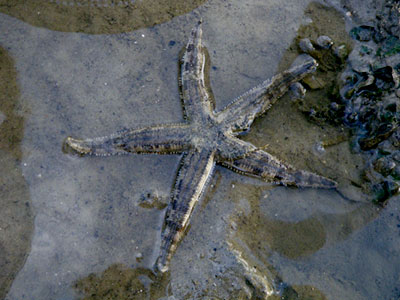
Looking rather similar to the Brittle Star will be the Sea Stars, such as the Sand-sifting Sea Star above. Brittle Stars swing their arms to move though, while Sea Stars using little tube feet located under each arm to slide around. This Sand-sifting Sea Star is often found on sandy substrates. Not only is it sandy coloured for camouflaging, it can burrow into the sand to escape predation as well. It feeds on tiny organic matter on the sand by pushing its stomach out of its mouth on the underside and digest its meal externally. Since digestion is external, it has little waste matter, which it will excrete through the anus on the topside.
Another Sea Star that burrows in the sandy area is this Sand Star. Unlike the previous one, it swallows it food (usually small snails and clams) into its stomach. The Sand Star, however, lacks an anus, and so it just expels undigested waste out of its mouth.
The Chek Jawa guided walk was conducted mainly on a sand bar surrounded by seagrass, and hence we came across many burrowing animals. The Sand Dollar above is yet another one. It has lots of little spines on its body to help it moving around and burrow into the sand.
This Sandfish Sea Cucumber also protects itself by burrowing into the sand. It also bears similar coloration with its surrounding. However, it has an additional protection - like most other sea cucumbers, it contains toxins. This is the sea cucumber that can be found in many Chinese restaurants. They must be properly processed to remove the toxins in them before they can be eaten.
Most sea cucumbers contain toxins, and the Pink Thorny Sea Cucumbers above advertised their toxins with their bright colours. The thorny structures on their bodies also make them distasteful.
Similarly, this Hypselodoris nudibranch has bright colours to advertise its toxicity. The name "nudibranch" means "naked gills", refering to the flower-like gills on the back of most species. This sea slug feeds on sponges, and is able to harness chemicals from the latter for its own defense.
One of the most well-known poisonous marine animal, however, will be the pufferfish, and we were quite fortunate today to see this Spotted Green puffer! In fact, this was my first time seeing this species of puffer at Chek Jawa! Previously, I had only seen them at Pasir Ris and Sungei Buloh. Pufferfish are poisonous enough to kill humans, and hence they must be properly prepared by licensed chefs before they can be consumed.
Sea anemones, such as the Haddon's Carpet Anemone above, use toxins in a different manner. Armed with venomous stinging tentacles, they can sting both prey and would-be predators and inject paralysing venom into them. The toxins are hence not just used for defense, but for obtaining food as well.
Related to the sea anemone is the Tube Anemone, which also has stinging tentacles. It lives in a tube it made from its own mucus and sand, and hence the common name.
The various adaptations are obviously to ensure that the animals can survive and reproduce, and we are lucky enough to witness reproduction in action during the walk - a Noble Volute laying eggs! Noble Volutes are one of the bigger snails found in Singapore. It feeds on smaller snails and clams by holding them in its pretty foot (the orange and black part) to suffocate them.
All too soon, we had to end the walk. But not before we had a quick group photo! Glad to have an enthusiastic group of nature lovers with me during this walk! And if any of you are here, just click on the group photo above to get the bigger version for downloading! :)
Monday, November 22, 2010
Chek Jawa on 22 Nov 2010

Thursday, November 18, 2010
Raffles Museum of Biodiversity Research (RMBR) Open House - 2-4 Dec 2010
The Raffles Museum of Biodiversity Research will be hosting an unprecedented three continuous days of open house and events to coincide with Explore Singapore! 2010. Visitors will get a chance to peep behind the scenes on what a curator does to prepare their specimens. Scientists from the museum will also be talking to visitors on the groups of animals they are working on. Various activities in the gallery will engage visitors to find out more about animals from Singapore and Southeast Asia.
A) How to get there?
The museum is located in NUS at the Science Faculty. Check out the location map. Free shuttle bus services are available hourly to and from Buona Vista MRT station and the museum from 9am to 5pm.
B) Are there any charges involved?
Admission to the museum is free. All activities are free. Some activities, however, required prior registrations.
C) What can we do there?
- Guided Tours – one-hour tours to be conducted by trained volunteer guides. There will be Gallery tours and Behind-the-scene tours. Tours are available on all three days of the open house. 40 places available per timing. Fixed schedules only.
- Scientists at work – Museum scientists will demonstrate how specimens are used for their research, and why is it important to collect specimens. Participants can talk to scientists about the specimens that they work on. 15 places available per timing. Fixed schedules only. Prior registration is required.
- A peek in the life of a museum curator – A series of hands-on activities that allow participants to have a glimpse of what a curator’s work is about. 15 places available per timing. Fixed schedules only. Prior registration is required.
- Show and Tell – These are projects where museum specimens have been used, highlighting the importance of a natural history museum. Posters and specimens will be put up in the gallery as additional exhibits, with presentations by researchers available at fixed schedules. Unlimited places.
- Gallery activities – Fun activities that participants, especially family groups, can take part in. Available from 9am to 5pm. Unlimited places.
- Treasure hunt – Seek for answers among the museum’s exhibits. Prizes to be won!
- Make your own museum buttons – participants can design, colour their own buttons, which will be made on the spot for them to keep.
You can download the schedule at http://rmbr.nus.edu.sg/ES2010/schedule.html
E) How to register for activities?
Details on how to sign up for activities can be found at http://rmbr.nus.edu.sg/ES2010/registration_form.html
