
Some of you may have read the heated discussion over the ID of the sea urchins found on Cyrene Reef on the Wildfilm's blog. Dr David Lane who visited Singapore recently told some of the guides that not all sea urchins with an orange anal ring are Diadema setosum, and one of the specimens spotted which has black-and-white stripes on its spines, and has smaller blue spines could be Echinothrix calamaris, while others with blue lines on the test could be Diadema savigyni.
On reading the first blog entry by Budak, I noticed that the specimen in his blog look dramatically different from the previous specimens of Echinothrix calamaris that I have seen. Most importantly from what I've read on several online guides, the orange anal ring is indeed a distinguishing feature for Diadema setosum.
For the second entry by Ria, I remembered I've read that while both Diadema setosum and Diadema savigyni looks rather similar, the former has the orange anal ring with 5 white spots on its test. Coincidently, the book I read was published by Dr Lane and another echinoderm expert.
With the various discrepancies, I see the need to perhaps seek the opinion of other experts to clarify things, though various other volunteers disagree.
While doing my research online, I found a study on the taxonomic significance of test morphology in the echinoid genera Diadema and Echinothrix published in the year 2006. Since the study is fairly recent, and to be published in a journal means it had been scrutinised by other experts in the field, I personally feel this paper is sufficient to shed some light on the confusion on the various IDs.
Update: I just realised many volunteers, including some experienced ones, had thought that the test refers to the skeleton of a dead urchin without spines. Actually, the test refers to the globular shell of the the sea urchin, whether it is alive or not. And the study is conducted on both living and denuded specimens. And one thing for certain, if the study has really been conducted on dead sea urchin tests, then the colours will already be all gone, and they won't be able to even conduct this study in the first place. Just also to clarify that Diadema sea urchins are some of the easiest species to identify in the field, and in fact, from photos if taken correctly to show the anal cone, test other other key features.
According to the paper, the key to identifying the 3 sea urchins and some of their characteristics are:
1. Diadema setosum
Key: Orange anal ring. Blue/green “spot” markings on genital plates.
Other characteristics: Lines of blue spots on test, no apical ring, white spot marking (day and night), no platelets on anal cone.
An example of this species showing the characteristics above is the one which Dr Lane said could be a Diadema savigyni in the cyrene reef blog.
2. Diadema savigyni
Key: Test distinctly circular not rounded pentagonal when viewed aborally. Test (in living echinoids) distinctly black, with a bold pattern of iridophores down the mid-lines of the interambulacra.
Other characteristics: Bold blue lines on test, bold blue apical ring, white spot marking typically at night only while showing small red/brown spot markings during the day, no platelets on anal cone.
An example of this species showing the characteristics above can be found at Poppe Images. Update: Noticed that the link above is inactive. So here's another example from one of my blog entries.
3. Echinothrix calamaris
Key: Ambulacra prominently raised aborally. Genital plates significantly longer than wide (brown colour morph). Ambulacra only slightly raised aborally. Genital plates not significantly longer than wide (white colour morph)
Other characteristics: Green bands on test, periproct is large and brown with white platelets.
An example of this species can be found on my blog.
You may view the entire paper here.
Personally, I never blindly believe in what an expert says, but always verify with a few sources. If you can find the info in a published journal, it's even better since it would have had several peer reviews before it's published - as good as you have consulted with several experts. While this may not mean the outcome will be 100 percent accurate, at least I minimise the chances of learning the wrong things. And also, the experts are not always the first to say that they could be wrong, as we must remember that the experts are humans too, and humans do, and will, make mistakes. The experts know that, and that's why they always have peer review, but unfortunately many lay people assume otherwise.
Asking question is the heart of Science. It's always beneficial to ask what if the one raising the question could be right and do some research on it.
Maybe some people may wonder why I bother to try to find out the correct IDs and correct other people's blog. Many of the volunteer bloggers I know would have probably gotten at least a few emails from me for wrong IDs. And I have received several emails myself from peers who noticed mistakes in my blogs. Perhaps it's because I'm a webmaster by profession, and I'm more sensitive to the power of the Internet. It has a multiplying effect. The people who read the wrong info will just pass it on, and worse still if the reader is a nature guide who may spread the wrong info to his participants, and blogs the wrong info to spread to whoever reading the blog entry.
I'm really no expert myself, so I'm also thankful to those who have corrected any mistakes on my blog, and even more thankful that there are so many scientific sites around these days for me to verify any information that I wish to clarify :)
Sunday, April 27, 2008
Differentiating between Diadema setosum, Diadema savignyi & Echinothrix calamaris

Saturday, May 16, 2009
Intertidal Echinoderms of Bali
During our Bali trip, we managed to spend 2 days at Sanur, which has a huge intertidal area with lots of seagrasses and animals. Since my favourite animal group are the echinoderms, I will highlight some of the ones we saw there before writing about the other animals :)
The Knobbly Sea Star (Protoreaster nodosus) is very abundant on some parts of the intertidal area. I totally lost count of the number of knobblies I saw.
The Luzon Sea Star (Echinaster Luzonicus) is quite common here. I saw this while diving too.
Here's another colour variation.
Not exactly sure what sea star this is. We found 2 of them, both hidden under rocks. The closest match is Linckia multiflora, but the pattern is somewhat different from previous specimens I have seen, and is much bigger, so can't really say for sure.
Yet another unidentified sea star, though I thought it looked like a juvenile Asteropsis carinifera.
This is probably a Linckia laevigata, but the pattern on its aboral side looks somewhat different, so can't really say for sure. Or perhaps the pattern is different because this is a juvenile?
Looks like a Gomphia gomphia to me. We found a few of these among the seagrasss and the coral rubble.
A very pretty pinkish brittle star which is very common here.
Black Long-spined Sea Urchin (Diadema setosum) were also very common, gathering in masses in the tidal pools. It can be differentiated from similar looking species with the orange ring on the anal cone, and 5 lines of blue dots radiating from it, though at night whitish lines may appear at where the blue dots are, making them less obvious.
A similar looking sea urchin is the Savigny's Sea Urchin (Diadema savignyi) with a bluish ring surrounding the anal cone, and 5 solid lines radiating from it.
We found several Double Spined Sea Urchin (Echinothrix calamaris) in the tidal pools too. This sea urchin has 2 distinctly different types of spines - thicker ones (usually with stripes) and thinner and shorter ones. It usually has 5 greenish lines radiating from the balloon-like anal cone.
This is probably a Black Diadema Sea Urchin (Echinothrix diadema), which may resemble the darker variations of D. calamaris sometimes. However, this sea urchin lacks the balloon-like anal cone, and instead has a small black anal cone. The one above happened to have 2 small commensal shrimps (Stegopontonia commensalis) with it. Can you spot them?
We also found one Red Sea Urchin (Astropyga radiata).
The Cake Urchin (Tripneustes gratilla) is another sea urchin with really pretty colours. The pretty colours, however, also acts as a warning telling predators that it is venomous.
This is probably another colour variation of the Cake Urchin or a Mespilia globulus. But photos of the latter that I found online appear to have more neatly arranged spines though, so I think it's more likely to be the former.
Not quite sure which species this sea urchin is though.
This very pretty Flower Sea Urchin (Toxopneustes pileolus) is actually one of the most venomous sea urchins in the world, with the flower shaped pedicellaria being able to give extremely painful and sometimes lethal stings.
The Matha's Sea Urchin (Echinometra mathaei) was very abundant here, but most of the time they were hiding in crevices or under rocks.
Interestingly, the only sea cucumbers we found at Sanur were Synaptid Sea Cucumbers (Family Synaptidae). In fact, I also did not see any sea cucumbers while diving in Bali. Kind of different from the dives I have done in Malaysia, where there are lots of sea cucumbers. The only other sea cucumber we saw in Bali was not in Sanur, but in Kuta, where we found several Lollyfish Sea Cucumbers.
This is one of the Lollyfish Sea Cucumbers [Holothuria (Halodeima) atra] we saw at Kuta.
At Kuta, we also found several Keyhole Sand Dollars (Family Mellitidae). Not sure of the species though.
Indeed, Bali, especially Sanur, is certainly a great place to spot echinoderms. You don't even have to dive to see all these!
Friday, March 23, 2012
Sea Urchins (Phylum Echinodermata: Class Echinoidea) of Singapore

The spines can come in various forms - long or short, smooth or rough, sharp or blunt. They not only help the sea urchin to move, but deter predators as well. Some sea urchins are venomous, and hence it's a good habit not to pick up any of them. The venom may be delivered by the spines or tiny stalk-like structures with biting jaws called "pedicellariae".
Like other echinoderms, sea urchins generally have a five-part body plan with radial symmetry (i.e. pentaradial symmetry), at least in some stage of life. In other words, you can divide a sea urchin into 5 equal parts. Also, they are able to regenerate lost body parts - such as spines lost to predators. Echinoderms are brainless, but despite that, they can still perform their daily functions - they can move, they can eat, they can shit, and they can reproduce - all these without a brain! Also, instead of blood vessels, echinoderms have a water vascular system. This system is essentially a network of water-filled vessels used for internal transportation of oxygen, food and waste.

The mouth of a sea urchin is on its underside, comprising five elongated vertical jaws held together in a structure known as the Aristotle’s lantern. Sea urchins generally feed on algae and seagrasses, though some may scavenge. The anus is on the top side. They have separate sexes, and usually reproduce by broadcasting their eggs and sperms into the water.
There are two main groups of sea urchins: the regular sea urchins with spherical tests; and irregular sea urchins with more flattened tests that are bilaterally symmetrical. The latter generally lacks the Aristotle’s lantern as well. Interestingly, the regular sea urchins are usually found in seagrass meadows and coral reefs, while the irregular sea urchins are typically burrowers in sandy substrates. In Singapore, more than 20 species of sea urchins have been recorded.
Here are the sea urchins found in Singapore that I managed to photograph.
Order Diadematoida
Members of this order are regular sea urchins with hollow spines, many of which contains venom. Many have long spines.

The Long-spined Sea Urchin (Diadema setosum) is a regular sea urchin commonly seen on our reefs. It has long, needle-like spines which break easily upon contact. These spines are hollow, containing a mild venom, and broken spines are very difficult to remove when they penetrate the victim's skin of the victim, causing pain and discomfort. This sea urchin has an orange anal cone and five equally spaced white spots on the upper side. The test can be up to 8cm wide.
Order Camarodonta
Members of this order are regular sea urchins, mostly with shorter spines. Their lanterns come with keeled teeth, and they usually have enlarged plates.

The Black Sea Urchin (Temnopleurus toreumaticus) is seasonally abundant on Singapore's northern shores, and at times hundreds, if not thousands, can be found along a shore among seagrasses.

In Latin, "toreuma" means "carved or embossed work", possibly refering to the numerous intricately arranged bumps (where the spines and tube feet extend from) on the small test (up to 4cm wide).

The White Sea Urchin (Salmacis sphaeroides), also seasonally abundant, usually occurs in seagrass meadows. They are often found camouflaged with dead shells, rock fragments, seaweed or seagrass. While it can occur in similar habitats as the previous sea urchin, it is usually much larger, with the test reaching almost 10cm wide.

While Salmacis species are mostly whitish in colour, individuals with brown, purple or pink spines have been seen too. This is the Purple-spined Sea Urchin (Salmacis virgulata). In the water, translucent tube feet can be seen extending out, which sticks to surface and hence help the sea urchin to move around and camouflage.
Order Cidaroida
Members of this order have thick, blunt spines on their tests. They somewhat resemble pencil-holders with "pencils" poking out, and hence the common name pencil sea urchins.

The Thorny Pencil Sea Urchins (Prionocidaris spp.) are seasonally abundant. Their thick spines often come with darker bands. Bits and pieces of seaweed and seagrass are often found entangled among the spines.

Two species have been seen in Singapore: one with thicker and shorter spines, and another with thinner, longer and sharper spines. One of the species also has purple or pinkish spots at the base of the main spines. The two sea urchins above should be Prionocidaris bispinosa, since they lack the spots. Some of the bigger specimens may have tests reaching width of more than 8cm.
Order Spatangoida
The sea urchins from this order are usually called heart urchins. They are irregular sea urchins with oval or heart-shaped tests. Unlike other sea urchins, they have a definite front and rear end. They often burrows in the sand and hence, they are not often spotted - there could be many of them under the sand that you are standing on! They feed on tiny organic particles (detritus).

Occasionally, they can be seen on the sand surface or on pebbles near sand, moving around with their short spines on the underside. Three species have been recorded from Singapore.

The Elongate Heart Urchin (Lovenia elongata) is heart-shaped, usually reddish or pinkish in colour, and about 3-5cm long. It usually comes with a few longer spines pointing backwards.

The Agassi’s Heart Urchin (Brissus agassizii) is larger, about 5-8cm long, and whitish in colour. It appears more oval than heart-shaped, and lacks the special longer spines found in the former species.

The Longspine Heart Urchin (Maretia planulata) is the smallest heart urchin recorded from Singapore. It is about 2-3cm long with brownish or reddish flower-like pattern on the top side. It has many long spines pointing backwards.
Order Clypeasteroida
Sea urchins from this order are often called sand dollars. They are also irregular sea urchins, and as their name suggests, they are mostly round shaped like coins, and live in the sand bank! They have a flat test covered with short, hair-like spines which helps them to move around and burrow. On the top side of sand dollars are five rows of pores in a flower-like pattern, and it is through these patterns that their tube feet poke out to breathe. These animals probably feed on algae and detritus.

The Placenta Sand Dollar (Arachnoides placenta) is the commonest sand dollar, and can occur in the hundreds in some areas. It is usually found on sandy shores with very fine sand. it can grow to about 10cm across.

More rarely seen is the Keyhole Sand Dollar (Echinodiscus truncatus) which has 2 distinctive slots (lunules) on the test. The exact function is still not fully understood, though scientist believe that they probably allow water to flow through and help prevent the sand dollar from being flipped over by strong currents. It can also grow to about 10cm across.

The Lesueur's Sand Dollar (Peronella lesueuri) is sometimes seen on Singapore's northern shores. It is pink in colour, and is usually found among seagrasses, sometimes just beneath the sand surface. The biggest I have seen is about 8cm across.

The Depressed Sand Dollar (Jacksonaster depressum) is sometimes seen, and usually several to many of them are seen together. They are usually light brown or pinkish brown in colour. I noticed it is often found in areas with some freshwater runoffs though. It is about 3-4cm across.
Like most other marine organisms, the sea urchins in Singapore are threatened by loss of habitats and collection.
References
- Castro, P & M. E. Huber, 2003. Marine biology. McGraw-Hill, US.
- Coleman, N., 2007. Sea stars: echinoderms of Asia/Indo-Pacific. Neville Coleman’s Underwater Geographic Pty Ltd, Australia.
- Davison, G.W. H., P. K. L. Ng & H. C. Ho, 2008. The Singapore red data book: threatened plants and animals of Singapore. Nature Society (Singapore).
- ETI BioInformatics. 2012. Marine species identification portal. Retrieved Oct 3, 2012, from http://species-identification.org.
- Lane, D. J.W. & D. Vandenspiegel, 2003. A Guide to sea stars and other echinoderms of Singapore. Singapore Science Centre.
- Lane, D.J.W., L.M. Marsh, D.VandenSpiegel, & F.W.E. Rowe. 2000. Echinoderm fauna of the South China Sea: an inventory and analysis of distribution patterns. The Raffles Bulletin of Zoology, Suppl.8: 459-493.
- Liao, Y. & A. M. Clark, 1995. The Echinoderms of Southern China. Science Press, China.
- World Register of Marine Species. 2012. Retrieved Oct 3, 2012, from http://www.marinespecies.org.
Wednesday, February 21, 2007
Sisters with Dan & Gang
Seems like I'm the slowest to put up my blog entry... again. Sometimes I really wonder how did the others put up their entires so quickly. Or was it because I'm ultra slow, since I'm always so long-winded with my blog entries? :P
After reading the other blogs, was considering if I should post an entry actually, since most of the things are already covered by Ria and Siyang. However, eventually decided to do it since this was really a very interesting trip, and also... for my blog's fans. (WAHAHAHHAHAAAAaa... Just kidding, like I have any fans in the first place. WAHAHAHHAHAAAAaa......)
Anyway, just to clarify things in case anyone is not familiar with Singapore's geography, the "sisters" in this entry's title refers to Sisters Island, NOT female Homo sapien siblings.
"Dan & gang" refers to Dr Dan Rittschof from Duke University and his students from US. I had the honour of guiding them at Sisters Island last Tuesday.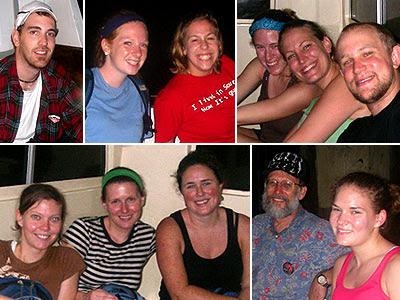
This was probably one of the most challenging guided walk I have led (the most challenging one being my first Semakau walk, when I was asked to guide without going through any on-the-job training). Seems like I'm saying this a lot these days, but I did not study biology in school last time. And now, I have to guide a marine biologist with his students???!!!???? Hopefully I didn't do too badly :P
It was raining when we reached Big Sisters, but that didn't stop us from venturing into the big lagoon. The first animal we found were a pair of orange striped hermit crab (Clibanarius sp.), which Dr Dan shared some really interested stories about them and their relatives, the swimming crabs. We then walked along the sandy shore on the edge of the water, and saw several other interesting animals, including flower crabs, moon snails, moon crabs, and a spider conch. As we proceeded into the lagoon, we had our first star find of the day - a diadema sea urchin!
While I know, and have seen, diadema sea urchins in our waters, I had never seen one on Sisters Island before! And some more, in the lagoon! That just shows how unexplored our islands are! Even though we have visited many of our islands many times, we are still seeing new things every now and then!
More things started appearing when the rain stopped. We found at least five species of flatworms, a polka-dot nudibranch (Jorunna funebris), a few phylid nudibranchs (Phyllidia nigra & Phyllidia pustulosa)a giant top shell (Trochus niloticus), several leaf slugs (Elysia ornata), several black sea cucumbers (Holothuria leucospilota) and a few octopuses. And of course, anemones, zoanthids, corallimorphs, and corals, both hard and soft, were every where.
Ria alerted us that James found a blue-spotted fantail ray (Taeniura lymma)trapped in a pool, which got many of the students excited.
We decided to take a break while waiting for nightfall, promising more exciting finds as we know more animals come out at night when it's cooler. And after having some 100 plus, cookies and curry puffs, we're back into business again!
And the first animal which greeted our re-entrance was this huge octopus.
And as per what Dr Dan told us earlier, the mushroom corals (Fungia sp.)were much more active and beautiful at night.
Dr Dan and his students were very interested in fishes, and thus we also found many fishes, including the flathead above.
But no night walks are complete without stars, and we managed to dig out a brittlestar (Class Ophiuroidea) under some dead coral pieces.
And yet another exciting find of the day, an eel (or at least it looked like one) feeding on an octopus!
And this was the first time we saw this eel! And in fact, we saw several of them that night!
And yet another exciting find, a pufferfish!
I've seen similar pufferfish with yellow fins when I was canoeing in our northen waters a long time ago, and have also seen a dead one at East Coast when I was rollerblading, probably caught by one of the anglers. Not sure if they were of the same species though, since I never took any photos.
Our walk finally ended as the tide turned. And on our way back, land hermit crabs! This one sitting in a coconut husk.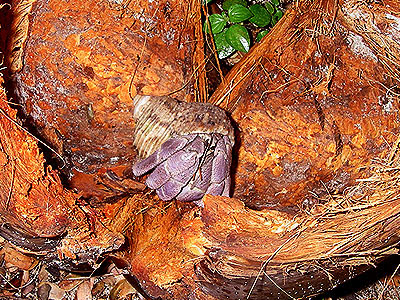
This was truly a very exciting day, and I have learnt a lot of things from Dr Dan. Looking forward to our next trip to Chek Jawa, and hopefully, I will learn even more things from Dr Dan and his students! :)
Sunday, March 04, 2007
First Semakau Public Walk of the Year
Was kind of excited today as it was the first Semakau walk for the year, and I had been really looking forward to it. We gathered at West Coast Pier and took a half-hour boat ride to get to the island. Reclaimed from two islands – Pulau Sakeng and Pulau Semakau, Semakau Landfill is the only landfill in Singapore. However, while all of old Sakeng and half of old Semakau were reclaimed, the other half of the original Semakau was left the way it was – with lots of corals and other marine life.
At the island, we started with a video presentation by NEA, followed by a land tour. However, Mother Nature seemed to be rather moody today, and she started crying.
We were stuck in the activity room for quite a while, but thankfully, the rain eventually stopped and we managed to go ahead with the walk :)
It turned out to be a very fruitful trip, despite the rain, and we saw lots of interesting things. It’s just impossible to include everything we see here, and so I’ll just highlight some of them.
The common sea star, also known as the burrowing sea star (Archaster typicus). You are now looking at its underside, with its mouth in the middle. This sea star, like many others, can push its stomach out of its mouth to digest externally organic materials (aka detritus) on the sand surface! A sea star uses sea water instead of blood to support its body and to move its tube feet, so don’t remove them out of water for too long, as it is very stressful for them.
We had to cross a seagrass lagoon to get to the coral rubble, and the seagrass lagoon at Semakau is HUGE.
Seagrasses are flowering plants, and their roots and underground stems help stabilise the sediments. Many marine animals thus like to lay their eggs here, as it is sheltered from strong waves, and has lots of food. We have a group of volunteers in Singapore who monitors the seagrass in Singapore. Find out more about them at the Team Seagrass blog!
On reaching the coral rubble, we saw this cute sandfish sea cucumber (Holothuria scabra).
This sea cucumber is edible, but must be properly treated before they can be consumed because they contain toxins. Sea cucumbers are related to sea stars, as they are all echinoderms, i.e. from the same phylum Echinodermata.
Towards the end of coral rubble, we saw an upside-down jellyfish (Cassiopea sp.).
This jellyfish usually remains in an upside-down position as it has symbiotic algae, mostly in its tentacles, which photosynthesise better with it being upside-down.
We also saw two long-spine sea urchins (Diadema setosum). This sea urchin species has an orange rim on its anal cone. They are echinoderms too! This was the first time we saw sea urchins on our guided walks!
But the Number One highlight of the walk was usually this – knobbly sea star (Protoreaster nodosus).
We found two of them today, each about 30cm wide!
We also saw many corals, including the sunflower mushroom coral (Heliofungia actiniformis) on below left and the lovely soft coral that I don’t know the name.
And near the soft coral, I had another surprise find – a seahorse (Hippocampus sp.) among some sargassum seaweed!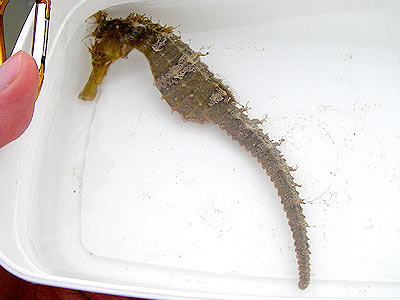
A seahorse is actually a fish. Interestingly, the male seahorse has a pouch, and the female seahorse will lay her eggs in it. Thus, if you see a seahorse that looks like it’s pregnant, it may be a male one! This is only the second time we found seahorse on a guided walk. They are usually very hard to find, since they are very well-camouflaged.
Today was also a day for nudibranchs, and we saw four different species! Nudibranchs are sea slugs, i.e. snails without shells.
Clockwise starting from top left, we found the orange-spotted gymnodoris nudibranch (Gymnodoris rubropapulosa, the black phyllid nudibranch (Phyllidiella nigra), the green ceratosoma nudibranch (Ceratosoma sinuata), and the polka dot nudibranch (Jorunna funerbris). Nudibranchs are hermaphrodites, meaning each slug has both male and female reproductive organs. Thus, they often fertilise each other when they mate. Sometimes, one may take on a male role, the other a female role. Read more sexy stories about the Gymnodoris on one of my earlier blog entry! And coincidentally, another fellow guide just asked me about the ceratosoma a few days ago, and today I actually saw it! I’ve only seen them once before at Sisters Island.
We also found two other species of sea cucumber.
The one on the left looked like a stonefish sea cucumber (Actinopyga leconora), but while it had the five ‘teeth’ usually found on a stonefish sea cucumber's anus, it didn’t have the whitish zone surrounding the anal region. Thus, I’m not really sure if it is a related species, or is it a stonefish sea cucumber that happened to have a less whitish anal zone. Not sure about the name of the one on the right though. This is the second time I saw it on Semakau.
And on the way back, we found two moon crabs (Ashtoret lunaris) having a wrestling match!
What were they actually doing? Was the smaller one the prey of the bigger one? Anyway, moon crabs have four pairs of paddle-like legs that they use for swimming and burrowing. When I touched the big one with my steel chopsticks, it immediately swam off and disappeared into the sand in an eye-blink, still holding onto the smaller one with the right pincer.
And here’s a shot of my group – the clown fish!
Although we didn't managed to find any clownfish today (they were probably hiding some where from the low tide), it still had been a very fruitful walk with lots of good finds. And of course, not to forget that we had a lovely sunset to end the day!
Thanks to all the participants for making the walk such an interesting one!
And if anyone reading this would like to join one of the intertidal walks or other nature walks, do drop by the WildSingapore Website's Calender of Events for more information!
Read also:
Samson's experience at Semakau!