It was NParks Volunteer Appreciation Day last Sunday, and this time round, the event was hosted on Pulau Ubin.
Initially, I was hoping to reach Ubin earlier and explore a bit, but the queue for the bumboat was surprisingly long, and I ended up reaching just half an hour before the meeting time, and hence only had time to look around the volunteers' hub.
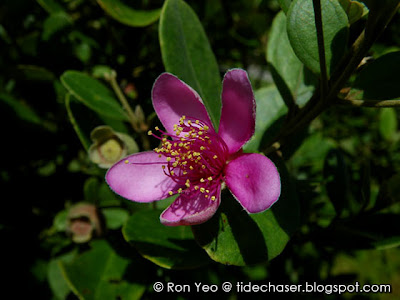
As usual, the Kemunting (Rhodomyrtus tomentosa) planted near the volunteers' hub was blooming with pretty pink flowers. This shrub is rather uncommon in Singapore, but interesting is an invasive species in some countries where it was introduced.

Here are the fruits.

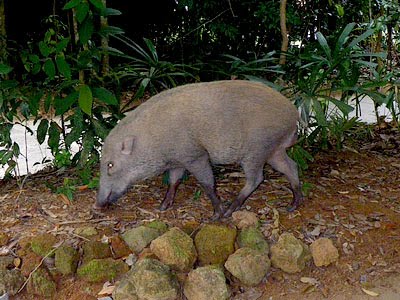
After the award presentation and lunch, we moved on to Chek Jawa for a walk. At the entrance, we were greeted by a rather tamed Wild Boar (Sus scrofa). Guess the visitors were really feeding it too much, and it was obviously sniffing around us for food!

I managed to take a look at the Pemphis (Pemphis acidula). There were lots of fruits.

Most of the flowers looked like they were withering though.

I also took a look at the Lenggadai (Bruguiera parviflora) near the mangrove boardwalk, which I noticed was flowering when I was guiding here two weeks back, but didn't have the time to take photos.

There was even a crab spider which climbed onto one of the flowers.
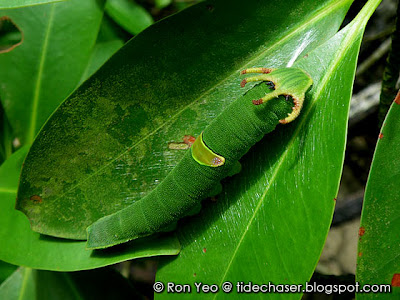
And I also spotted an interesting-looking caterpillar.

Also near mangrove boardwalk, I noticed a Dungun (Heritiera littoralis) fruiting! Wow! My first time having decent photos of the fruits! Previously when I saw them fruiting, they were always too high up, or I did not have my camera with me. Some of my friends call it the ultraman fruit, as the fruit has this ridge-like structure running across the middle of the fruit, making it appear like the head of the TV character, Ultraman.

The Sea Almond (Terminalia catappa) trees appeared to have just shed their leaves and were growing ones.

When we reached the intertidal area, many volunteers were already down on the sandflat!

The top find of the day must be this Honeycomb Stingray (Himantura uarnak). Adults are reported to be able to grow to more than 2m long! The one we found was probably just about 1m long.
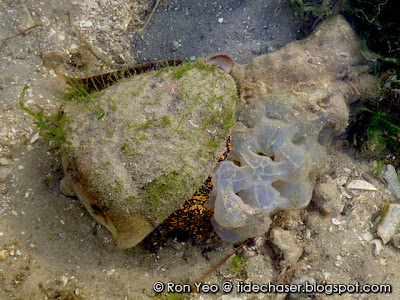
There were lots of Noble Volutes (Cymbiola nobilis) laying eggs that day! I saw at least 15 of them, and at one spot, 3 of them within a 1m radius!

There were lots of Glassy Bubble Shells (Haminoea sp.) on the soft sand. Like other headshield slugs (Order Cephalaspidea), they have well-developed headshield, which is a broadening at the head used to plow beneath the sand surface and help prevents the sand entering the mantle cavity.

We also found another headshield slug, a Philinopsis sp. Members from this genus generally feed on other headshield slugs, such as the Glassy Bubble Shells!

There were several Sandfish Sea Cucumbers (Holothuria scabra). These sea cucumbers are the same species that are usually served in restaurants, but must be treated to remove toxins in them before they can be eaten.

There were also several of this smooth and slimy sea cucumber which I am not sure of the exact ID.

Our hunter-seekers also found us a few Sand-sifting Sea Stars (Archaster typicus)! They feed on tiny organic particles among the sand, and digestion is done externally. And to do that, they have to push out their stomachs through their mouths located on their undersides, and lay the stomachs over the sand to digest the edible bits.
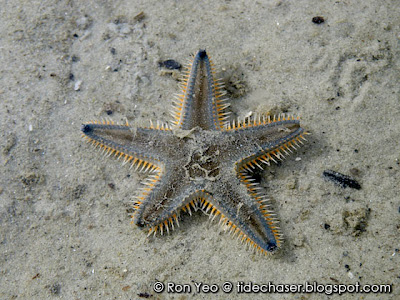
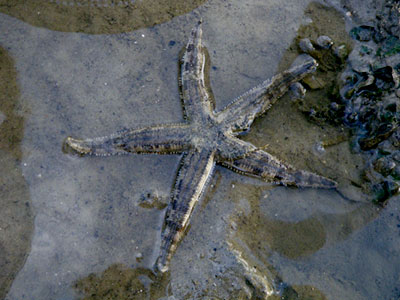
The Sand Star (Astropecten sp.), on the other hand, swallows its food and digest it internally. It feeds on small snails and clams.

We saw a Pencil Sea Urchin (Prionocidaris sp.) too! Unlike most other sea urchins, the spines of this sea urchin were thick like pencils (with some imagination), hence giving it its common name.

The animal above is a Pygmy Squid (Idiosepius sp.), and is only about 1cm long!

Several juvenile Mangrove Horseshoe Crabs (Carcinoscorpius rotundicauda) were spotted too, burrowing just beneath the sand surface, probably searching for little worms to feed on?
All too soon, tide was rising and we had to end the walk. We were really luck that the weather was fine throughout the entire event. Thanks to NParks for organising this! :)
Initially, I was hoping to reach Ubin earlier and explore a bit, but the queue for the bumboat was surprisingly long, and I ended up reaching just half an hour before the meeting time, and hence only had time to look around the volunteers' hub.

As usual, the Kemunting (Rhodomyrtus tomentosa) planted near the volunteers' hub was blooming with pretty pink flowers. This shrub is rather uncommon in Singapore, but interesting is an invasive species in some countries where it was introduced.

Here are the fruits.

After the award presentation and lunch, we moved on to Chek Jawa for a walk. At the entrance, we were greeted by a rather tamed Wild Boar (Sus scrofa). Guess the visitors were really feeding it too much, and it was obviously sniffing around us for food!

I managed to take a look at the Pemphis (Pemphis acidula). There were lots of fruits.

Most of the flowers looked like they were withering though.

I also took a look at the Lenggadai (Bruguiera parviflora) near the mangrove boardwalk, which I noticed was flowering when I was guiding here two weeks back, but didn't have the time to take photos.

There was even a crab spider which climbed onto one of the flowers.

And I also spotted an interesting-looking caterpillar.

Also near mangrove boardwalk, I noticed a Dungun (Heritiera littoralis) fruiting! Wow! My first time having decent photos of the fruits! Previously when I saw them fruiting, they were always too high up, or I did not have my camera with me. Some of my friends call it the ultraman fruit, as the fruit has this ridge-like structure running across the middle of the fruit, making it appear like the head of the TV character, Ultraman.

The Sea Almond (Terminalia catappa) trees appeared to have just shed their leaves and were growing ones.

When we reached the intertidal area, many volunteers were already down on the sandflat!

The top find of the day must be this Honeycomb Stingray (Himantura uarnak). Adults are reported to be able to grow to more than 2m long! The one we found was probably just about 1m long.

There were lots of Noble Volutes (Cymbiola nobilis) laying eggs that day! I saw at least 15 of them, and at one spot, 3 of them within a 1m radius!

There were lots of Glassy Bubble Shells (Haminoea sp.) on the soft sand. Like other headshield slugs (Order Cephalaspidea), they have well-developed headshield, which is a broadening at the head used to plow beneath the sand surface and help prevents the sand entering the mantle cavity.

We also found another headshield slug, a Philinopsis sp. Members from this genus generally feed on other headshield slugs, such as the Glassy Bubble Shells!

There were several Sandfish Sea Cucumbers (Holothuria scabra). These sea cucumbers are the same species that are usually served in restaurants, but must be treated to remove toxins in them before they can be eaten.

There were also several of this smooth and slimy sea cucumber which I am not sure of the exact ID.

Our hunter-seekers also found us a few Sand-sifting Sea Stars (Archaster typicus)! They feed on tiny organic particles among the sand, and digestion is done externally. And to do that, they have to push out their stomachs through their mouths located on their undersides, and lay the stomachs over the sand to digest the edible bits.

The Sand Star (Astropecten sp.), on the other hand, swallows its food and digest it internally. It feeds on small snails and clams.

We saw a Pencil Sea Urchin (Prionocidaris sp.) too! Unlike most other sea urchins, the spines of this sea urchin were thick like pencils (with some imagination), hence giving it its common name.

The animal above is a Pygmy Squid (Idiosepius sp.), and is only about 1cm long!

Several juvenile Mangrove Horseshoe Crabs (Carcinoscorpius rotundicauda) were spotted too, burrowing just beneath the sand surface, probably searching for little worms to feed on?
All too soon, tide was rising and we had to end the walk. We were really luck that the weather was fine throughout the entire event. Thanks to NParks for organising this! :)