
It was great to be back on Pulau Semakau, and this time, for a coastal cleanup! I was helping International Coastal Cleanup Singapore (ICCS) to coordinate the cleanup effort on Semakau, and this year we had 85 volunteers from HSBC, and 21 from Renesas Electronics Singapore.
I met up with the group from HSBC at 7am to follow the boat they chartered to go to Semakau. As this was the second time HSBC participated in ICCS, administrative work at the jetty progressed a lot smoother and faster compared to the previous one.
We reached the island about 8.30am and met up with the volunteers from Renesas. After convincing everyone (almost) to visit the toilet (out at the cleanup site there are no toilets), I conducted a briefing at the Semakau Visitor Centre to go through the work procedures and safety issues that the volunteers should take note of.
Special thanks to NEA which kindly provided 2 buses to take the volunteers to the entrance to the cleanup site. The HSBC volunteers arrived at the cleanup site first, as their assigned location was further away (i.e. they had to walk further to reach the lcoation).
The volunteers from Renesas had with them various interesting rubbish-picking tools!
To reach the shore, we had to walk for about 5 min to cut through a mosquito-infested secondary forest. It so happened that the deciduous Sea Almond (Terminalia catappa) had just shed their leaves, covering the forest trail with a layer of pretty yellow and red leaves!
Out on the shore, the Renesas volunteers were assigned to clean up the southern portion of the shore, and the site was about 500m long.
The HSBC volunteers werre assigned to do the northern portion of the shore.
The first few groups from HSBC had to walk about 1km before they reach their cleanup site. The shore here was full of debris from the sea.
Some of the rubbish could only be retrieved with a stick and going on all fours!
The amount of trash on the shore was so bad, that I seriously thought we did not even managed to clear 30 percent of them by the time we were done and the tide was rising.
The groups did a quick check on the headcounts before heading back into the forest.
Out of the forest and back on the road, it's time to weigh the rubbish collected!
Couldn't resist taking a photo of Amitha in her brightly coloured pants as she was weighing the rubbish.
For the heavier bags, it's easier to weigh with a stick so that two volunteers could share the load.
And here are the Renesas with the rubbish they collected - a total of 13 trash bags and 96.5kg worth of rubbish.
While the HSBC group collected 72 trash bags of rubbish weighing a total of 337kg.
And here are all the collected trash. Compared to the last coastal cleanup, we certainly collected a lot more rubbish in terms of volume, but a lot less (about half) if we look at the total weight. This was probably because we have already cleared most of the heavier trash left by the villagers who used to live on the island (including things like furniture parts etc) during the last clean up near the forest trail.
Since there are no regular recreational beach goers on the island, and the shore is only visited by those participating in nature walks or research work, most of the new trash come from the sea, and these are usually not as heavy as the ones left by the previous islanders. And rather unfortunately, we could only clear the heavier trash nearer to the forest tail, as it's just not feasible for the volunteers to lug along the heavy trash and walk for like 1km to reach the main road, when they could spend more time collect the smaller and lighter rubbish.
Due to the limited transport available on the island, and there was another major event conducted concurrently on the island, we had to wait for quite a while (either under the hot sun or in the shady but mosquito-infested forest) before we could proceed for the post-cleanup activities. But anything was better than having to walk under the hot sun for a few km to reach the activity sites! :P
The HSBC volunteers proceeded to the southern-most point for the island for a picnic and kite-flying, while Renesas went for a educational tour of the landfill. Both activities took about an hour, and we left Semakau about 12.45pm, slightly delayed due to the transportation issues.
Both groups collected a total of 85 trash bags of rubbish weighing 433.5kg, but there were still so much rubbish left on the shore! We certainly need more volunteers to clean up this shore on a more regular basis, and also, more strong volunteers to carry out the heavy trash that got left behind when the islanders were relocated to mainland Singapore!
Sunday, September 18, 2011
International Coastal Cleanup at Semakau on 17 Sep 2011

Saturday, July 16, 2011
Semakau Walk on 16 July 2011
It was nice to be back again for a guided walk at Semakau! The tide was really early for this trip, and hence instead of starting the guided walk from the mangrove, we did it in the reversed manner - starting with the coral reef at the reef edge and ended at the forest edge.
And so, the first organism that I shared with the participants (from HCI) was this:
This is the fluted giant clam (Tridacna squamosa) near the reef edge. On most trips, this clam would be submerged underwater, but as the tide was so low this time round, it was fully exposed.
We only saw one species of nudibranch, which was this funeral nudibranch (Jorunna funebris). There were three of them at different locations.
There was also a tigertail seahorse (Hippocampus comes). It was a pregnant male. We wondered where was the female though. Interestingly, it is the male seahorse that carries the eggs until they are hatched. The female seahorse will deposit the eggs into a pouch on the male's belly via an ovipositor.
We found this eel-like fish, but had no idea what exactly it was.
These two spider conches (Lambis lambis) were found trapped in a drift net.
So was this mosaic crab (Lophozozymus pictor), which was the most poisonous crab in Singapore.
A few years ago, a cushion star (Culcita novaeguineae) was an uncommon sight during an intertidal walk on Semakau, but since the launch of Project Semakau when we started sighting juveniles, they were now a common sight during our walks.
As usual the knobbly sea stars (Protoreaster nodosus) were the highlight of the trip! Most of our participants did not expect to see this big and pretty sea star in Singapore at all!
Here's the traditional group shot with the stars! For the HCI students, just click on this image to get the hi-res version!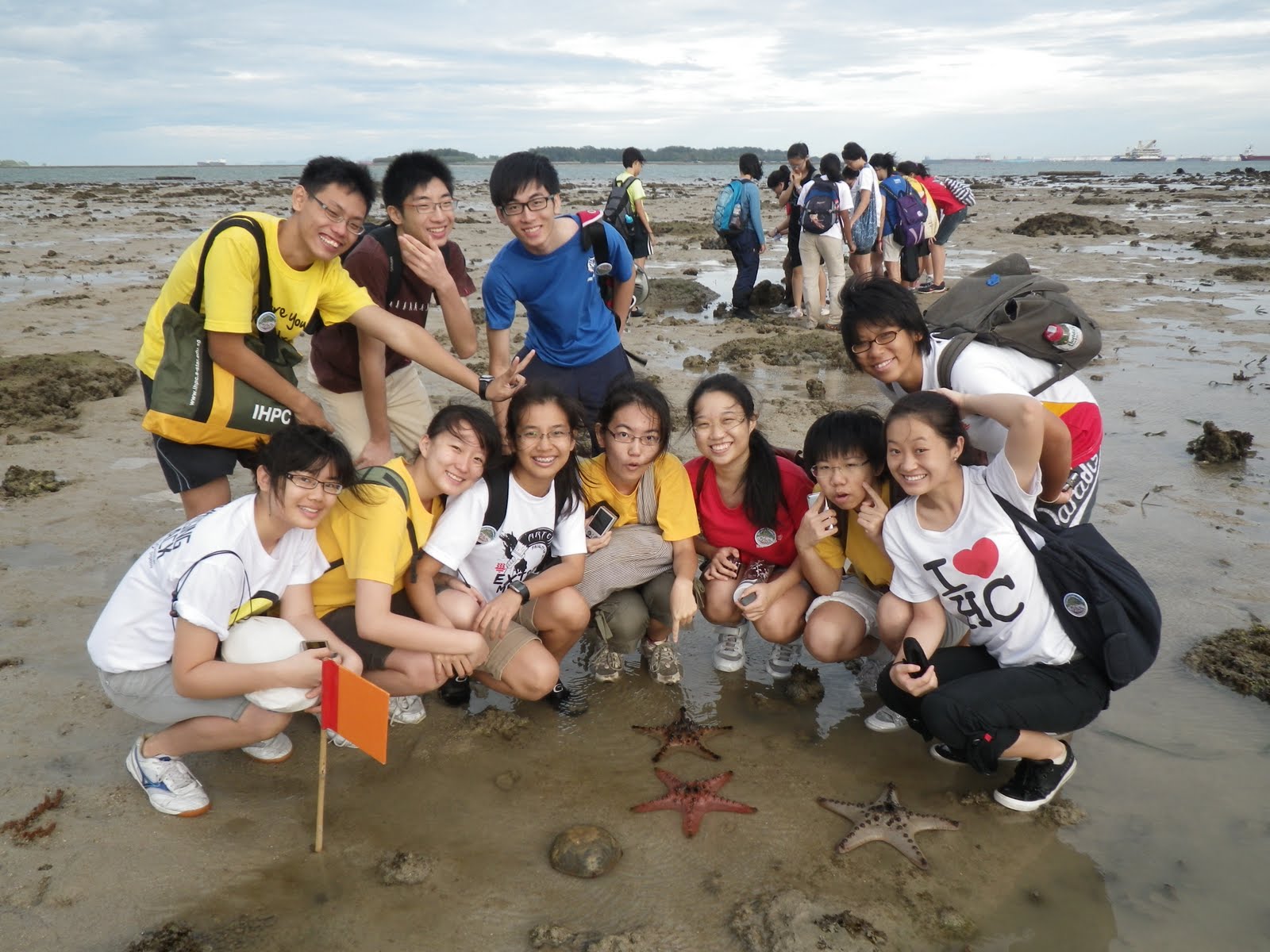
A slightly more "crazy" shot, which really wasn't all that crazy. Haha...
It's an early morning walk, which means a good chance of seeing octopuses!
As usual, there were lots of hairy crabs (Pilumnus vespertilio), but as they were so well-camouflaged, we probably missed most of them :P
I saw a trail on the sand, and managed to dig out a moon snail (Polinices mammilla). This snail preys on other small snails and clams.
We also saw several species of sea cucumber, including the stonefish sea cucumber (Actinopyga lecanora).
Here's a shot of the group on the way back, crossing the seagrass meadow.
Once again, another slightly crazier shot.
We took time to take a look at the many sponges at the edge of the seagrass meadow, before we finally head back to dry land.
Lucky that although it rained earlier, we still managed to see so many interesting things! :)
Monday, July 04, 2011
Recent Semakau Trips
I have made quite a few trips to Pulau Semakau over the past one month - some for Project Semakau surveys, but mostly as a guide for intertidal walks. Here are just some quick highlights of the various trips:
As usual, the Knobbly Sea Star (Protoreaster nodosus) was the main highlight of every intertidal walk. There is a good population - more than 300 of them - on the island, coming in various colours.
We usually got the participants to take a group shot with the Knobbly Sea Stars.
Here's another group I guided on another date.
And this one was just taken earlier this morning!
The Sand-sifting Sea Star (Archaster typicus) is probably the most common sea star on Semakau, and possibly for Singapore as well. They can be found in huge numbers on many of our shores.
In recent years, we had been seeing more Cushion Stars (Culcita novaeguineae) on Semakau, especially juveniles. These sea stars apparently feed on corals, but interestingly we have been finding the really small juveniles among the seagrass. Wonder what they feed on when they were little...
The Rock Stars (Asterina coronata) on Semakau come in a wide variety of colours. So far I have seen pinkish ones, bright red ones, orange ones, black ones and brown ones.
Here's one of the greyish brown ones.
Several species of sea cucumbers can be found here, and we could usually see at least 3 or 4 species per trip. The above is a Stonefish Sea Cucumber (Actinopyga lecanora).
Many of the participants were amazed that huge sea anemones, such as the Giant Carpet Anemone (Stichodactyla gigantea), can be found in Singapore. These sea anemones have stinging tentacles to paralyse their prey.
However, some animals have adapted to the situation such that they can live among the stinging tentacles for protection, such as the Anemone Shrimp (Periclimenes brevicarpalis). This shrimp coats a layer of mucus around it which prevent the sea anemone from stinging it, and at the same time, gain protection from predators among the venomous tentacles.
Related to the sea anemones are hard corals, which are also stinging animals. The hard corals are able to build a hard skeleton from calcium carbonate for protection. Most of them, like the Faviid Coral (Family Faviidae) above, are colonial animals, and a colony like this can house thousands of little coral animals (polyps).
The soft corals, on the other hand, do not build a hard skeleton. Most of them can secrete chemicals to protect them from predators or prevent other animals from growing over them.
Often mistaken for corals, this pretty sponge (Neopetrosia sp.) is much simpler than the former. It is poisonous though.
The Funeral Nudibranch (Jorunna funebris), however, is not afraid of the poison, and feeds on the blue sponge. In fact, it is able to retain the chemicals from the sponge to make it distasteful to predators. Nudibranchs are sea slugs - somewhat like snails without shells.
We also have many snails (of course, with their shells) on Semakau. The above is a Pear-shaped Moon Snail (Polinices mammilla), which feeds on other snails and clams. It can secrete acid to soften the shell of its prey, create a hole, then feed on it while the prey is still in the shell.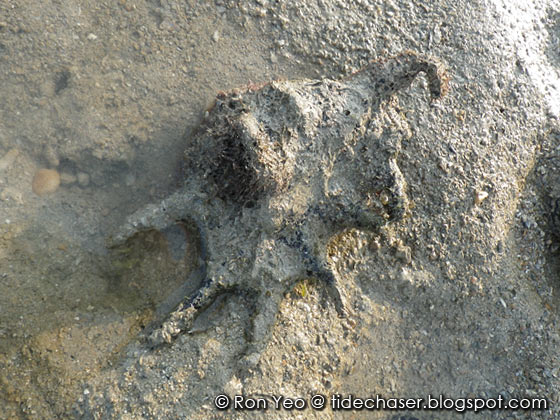
A much bigger snail will be this Spider Conch (Lambis lambis), which got its name from the spines on its shell, which makes it resembles a spider (with lots of imagination).
The biggest shell we have on Semakau would be the Fluted Giant Clam (Tridacna squamosa), which can grow to about 40cm long!
It's interesting to note that the octopus belongs to the same group as the snails and clams - they are all molluscs. The former, however, has lost its shell. In fact, the only hard part of the octopus is its beak, and it can give a nasty bite with it.
Another interesting mollusc would be this Chiton. Instead of a one-part shell like the snails, or a two-part shell like the clams, or no shells like the octopus and slugs, it has an eight-part shell!
The flatworm is sometimes mistaken for a mollusc, but it is a lot flatter. The above is a a Pseudoceros sp.
There are many fishes too. This goby, Amblygobius stethophthalmus, was exceptionally cooperative and stayed still for us to take photos of it.
Several Blue-spotted Fantail Rays (Taeniura lymma) were spotted during the recent trips. These rays can give painful stings.
We were rather lucky to see a Tigertail Seahorse (Hippocampus comes) on one of the trips. It got its name from the stripes on its tail.
We saw Marine Spiders (Desis martensi) on several of our trips. These spiders hide in trapped pockets of air among cracks and crevices during high tide, and come out to hunt for small animals during low tide.
Semakau has many different species of crabs. The above is a Crenate Swimming Crab (Thalamita crenata). It's last pair of legs are flat and paddle-like, enabling it to swim. It is sometimes collected for food in the region by the locals.
The Mosaic Crab (Lophozozymus pictor), on the other hand, is said to be the most poisonous crab in Singapore. One single crab can kill 42,000 mice!
During the plant survey, we saw several of these crabs. I believed we have the ID some where...
My top find for the plant survey will be this young Xylocarpus rumphii, which is critically endangered in Singapore!
The locally critically endangered Grey Nicker (Caesalpinia bonduc) is both flowering and fruiting!
Interestingly, the Yellow Flame (Peltophorum pterocarpum), which is commonly planted on roadsides in Singapore, is also critically endangered in the wild here.
As a matter of fact, there are so many critically endangered plants and animals here on Semakau, that it would really be a shame if the authorities decide to reclaim more parts of the island.
Certainly hope that this island can be protected as a Marine Park some day.
