
I was back on Changi Beach with a few friends today. Was rather worried that we may not see much stuff due to the rainy weather, but fortunately, there were still plenty to see! Here's a quick listing of some of the highlights:
A Sea Moth (Pegasus volitans) was found in a little tidal pool.
Several Transparent Sea Cucumbers (Paracaudina australis) were seen, and this one was in the process of burrowing into the sand.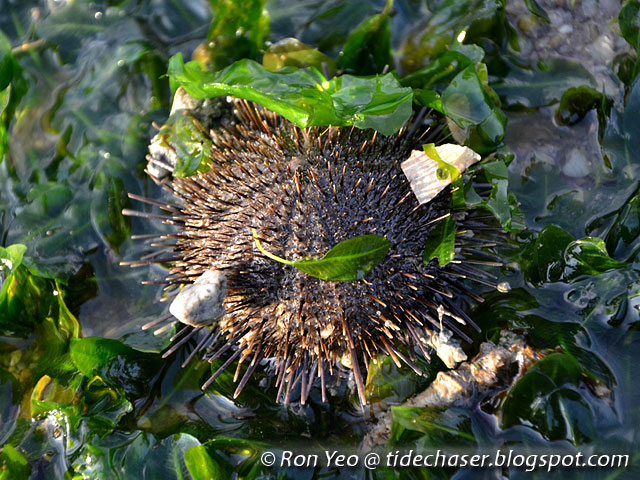
There were many little Black Sea Urchins (Temnopleurus sp.), though instead of clustering around the same area like what I saw last time, they were rather spread out.
I only saw one Salmacis Sea Urchin (Salmacis sp.).
The Swimming Anemones (Boloceroides mcmurrichii) were definitely in season, as they were every where!
Again, I saw a pair of Tiger Moon Snails (Natica tigrina). Not sure if they were mating or trying to eat each other.
This tiny little Snapping Shrimp (Alpheus sp.) had very pretty blue claws.
Some Snapping Shrimps live commensally in other animals, such as the one above which lives in a soft coral colony.
There were quite a few small Haddon's Carpet Anemones (Stichodactyla haddoni), but I did not see any big ones.
Flower Crabs (Portunus pelagicus) were still common among the seagrass.
There were much fewer sea stars though. I saw a few small- and medium-sized Biscuit Sea Stars (Goniodiscaster scaber), but no huge ones.
There were a few small Cake Sea Stars (Anthenea aspera) too.
The Sand Stars (Astropecten sp.) starting appearing only after it turned dark.
There were still lots of Asian Date Mussels (Musculista senhousia) and their nests.
I found a sea pen, and saw many little brittle stars on it.
The sea pen also had a few commensal Porcelain Crabs (Porcellanella picta).
The resident Sea Apple (Pseudocolochirus axiologus) was still around! Can you see a little butterflyfish just above it in the photo to the left?
On the Sea Apple. I also saw this little crustacean - not too sure what it was though. Some isopod?
I spotted this Diamond Tuskfish (Halichoeres dussumieri) as it turned dark.
This Mantis shrimp (Harpiosquilla sp.). kept stirring up the sediment as I was trying to get a photo of it.
Under a rock, I found an Ovum Cowrie (Cypraea ovum), a Rock Star (Asterina coronata) and a little porcelain crab, among the other sessile organisms.
There's also a peanut worm. Previously from the phylum Sipuncula, recent studies shown that it's actually an annelid (phylum Annelida) which has lost its segments through evolution.
Tube Anemones were surprisingly abundant today.
And lastly, a pretty colony of sea pen.
As usual, Changi had lots to offer :)
Saturday, October 29, 2011
Changi Beach on 29 Oct 2011

Thursday, August 04, 2011
Changi Beach on 31 July 2011
Last Sunday, I was back at Changi Beach to check out the intertidal life. Not sure if it's because of the hot weather over the previous few days, there were much fewer organisms compared to what we saw on our previous trips. The diversity was still quite good though.
There were several octopuses out and about today! This one appeared to have caught something and was holding it in its tentacles.
Have seen this many times at Changi, but still not sure exactly what it is.
The were a few clumps of Green Mussels (Perna viridis), sticking on to harder substrates.
Interestingly, we saw several pairs of moon snails, including the Tiger Moon Snails (Natica tigrina) above. Are they mating?
There were also a few pairs of Calf Moon Snails (Natica vitellus), and one lonely one shown above.
Here's a look at its underside.
Several crabs were spotted, but the most abundant one should be the Flower Crab (Portunus pelagicus).
Among the sea pens, a few commensal Porcelain Crabs (Porcellanella picta) were found.
The little Black Sea Urchins (Temnopleurus sp.) were not as abundant compared to my previous trip here last month, though I suspect they were probably in deeper water.
We only saw one Salmacis Sea Urchin (Salmacis sp.), and it was really well camouflaged!
There were also a few Sand Stars (Astropecten sp.).
We can usually see two different colorations among the Sand Stars. Not sure if they were of different species.
There were a few Biscuit Stars (Goniodiscaster scaber), but definitely not as abundant as our previous trips.
I only saw one Cake Sea Star (Anthenea aspera).
One of the main highlights for the other friends who came with me must be this Sea Apple (Pseudocolochirus axiologus). This poor animal was washed up onto higher shore when we saw it. We quickly put it into a pool of water, and were glad to see it moving a while later.
The Pink Thorny Sea Cucumbers (Colochirus quadrangularis) were still very abundant.
And once in a while, the Pink Warty Sea Cucumbers (Cercodemas anceps) are spotted.
This is one sea cucumber which we still have not managed to identify...
There appeared to be a lot more tube anemones than usual though.
And as usual, several of these sea anemones with red spots on its body column were found.
I was rather pleasantly surprised to see this dark red sea anemone, Bunodosoma goanensis, which was kindly identified by Dr Daphne during her recent trip here. Previously I have seen only seen it at Punggol.
While there were fewer things seen during this trip, Changi still had many nice surprises!
Wednesday, January 26, 2011
Changi Over Three Days
We conducted a seashore ecology lesson for some secondary school girls over three days last week from 19-21 Jan 2011. The tide was not really very low, but we still managed to see a number of interesting stuff.
Here are some of the things we saw:
On the first day, I spotted a dead Ghost Crab near the shelter. Ghost crabs generally are more active at night, when there are fewer aerial predators.
At the rocky shore area, we looked under some of the rocks, and found a few Stone Crabs and Porcelain Crabs.
Down at the sandy shore, the Sand Star was just slowly emerging from the sand, as it got cooler and darker.
Several Moon Snails were spotted, prowling just underneath the sand, seeking for smaller snails and clams to feed on.
There were many Sand Dollars too. It can be rather difficult for people new to seashore exploration to spot these animals, as they usually hide just beneath the sand.
There were only a few Salmacis Sea Urchin. This sea urchin can stick algae, sea shells and other stuff on it for camouflage.
And our seeker actually found us 2 living watering pot shell!
The Pink Thorny Sea Cucumber was as abundant as usual.
Several of this little Translucent Sea Cucumber were spotted.
As it got darker, other bigger sea cucumbers started emerging from the sand. Still not quite sure what species is this.
And I also found a few Notable Sea Cucumbers!
The students found this poor Pebble Crab that had lost most of its legs.
Moon Crabs are another group of crabs that are more active at night, though we can see them sometimes in the day too.
Saw some markings in the sand, and on uncovering the sand, I found this pretty Olive Snail.
LK found this snail which I don't know the species.
We were really lucky that the lesson went on smoothly and the weather held, despite it being the monsoon season at the moment! :)
