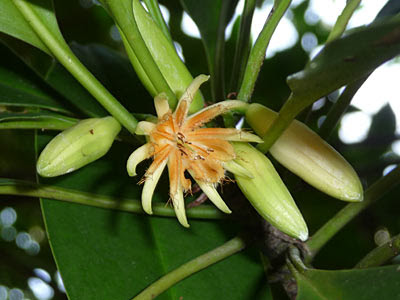
When I went to Pasir Ris to check out the only naturally occurring Pisang-pisang Laut (Kandelia candel) on mainland Singapore, I had a shock of my life!
Instead of the plant behind the barrier, I saw a black suitcase!
I tried to pull the suitcase away, and it was surprisingly heavy. I managed to pull off a little, and saw that all the leaves and smaller branches of the plant were gone. The two main stems were also broken, and in fact, part of the stems was under the suitcase until I pulled it away.
This was a really depressing sight. All along, we had known that this plant was in a rather problematic location, especially after NParks built the barrier around the plant. Beach-goers had been resting their bicycles against the barrier, setting up their BBQ pits next to the plant while they sat on the barrier, and threw the leftover charcoal onto the plant. I had sent a feedback to NParks last May and suggested building a proper fence to better protect the plant, but unfortunately my suggestion was not taken up, as NParks felt that the barrier served its purpose to protect the plant, though they also promised to "do our utmost best to keep this plant alive and to enhance its vigor."
For the past few times the stems were broken or burned, new shoots managed to grow. Will new shoots grow again this time round? To think that I just spotted the only Caesalpinia bonduc on mainland Singapore yesterday, and now, we may be losing the last Kandelia candel on mainland Singapore, though there is still a small population of this plant on Tekong.
On a side note, I seriously wonder what's in that suitcase and how it got there. It was rather heavy, and wouldn't move even when I kicked it. Tide shouldn't reach so high up as well. Peeping through a hole, I thought I saw some plastic materials inside. Did someone throw it there or what?
I was tempted to open up the suitcase, but on second thought, I think I better leave it to the NParks people...
Saturday, February 05, 2011
End of the Last Kandelia candel on Mainland Singapore?

Sunday, October 04, 2009
From Ubin to Pasir Ris on 3 Oct 2009
Had wanted to go Sungei Buloh initially, but changed my mind and went to Pulau Ubin instead. My main objective for the day was to get some photos of the Berus Mata Buaya (Bruguiera hainesii). Now that I had a camera with better zoom, I was hoping to get some better photos for use in future.
Along the way, I found several of the Mangrove Tit-berry (Allophylus cobbe) fruiting. The leaves of many of them were in rather bad shape though - many them were eaten up by some herbivores.
On some of them, I found lots of these little bug nymphs that I couldn't identify. Are these the ones feeding on the leaves? Hmm...
I also spotted a wild Rapanea porteriana. This was my first time seeing a wild specimen on Ubin! Understand there were a few huge trees on this island, but until this trip, I have only seen the ones planted by Nparks. Unfortunately, it wasn't flowering or fruiting though.
I also found many cicada moults. While I could hear them singing among the trees, I did not spot any adult cicadas during this trip though.
And finally, I reach Noordin Beach, and found the Berus Mata Buaya (Bruguiera hainesii). There were lots of flowers on the tree!
I managed to get a few close-ups of the flowers growing on lower branches. Unfortunately, none was as low as the one I saw at Pasir Ris last time.
A few had developed the seedlings already too! The calyx (cap-like structure on top) was pinkish in colour, with the sepals bending downwards like claws. However, I noticed that this bright colour was only present on seedlings exposed to sunlight.
This seedling under the shade had calyx that was greenish-yellow instead of pink.
After taking a few shots, I decided to head towards Kekek Quarry to take a look at the mangroves along the way.
Along the way, there was this Common Sandpiper (Actitis hypoleucos) that was rather cooperative, and I managed to get quite a few shots of it.
I had a pleasant surprise when I saw this young plant at the edge of the mangrove. It looked very much like a Sonneratia caseolaris from the leaves, especially with the reddish leaf stalk. However, the branching was more typical of Sonneratia ovata, and I have seen young S. ovata with slightly pointed leaves before. Guess I would have to wait till it's more mature to really confirm the ID.
Another nice surprise was this Oriental Whip Snake (Ahaetulla prasina). This mildly venomous snake can be regularly spotted on Pulau Ubin.
Saw a number of the usual mangrove plants before I reached Kekek. And as I was walking back, the ever-so-kind van driver, Mr Chu, saw me and gave me a ride back to Ubin town! Thank you so much, Mr Chu :)
Back at Changi Village, I stopped by the Creeping Fig (Ficus pumila) near the hawker centre to check out the figs. Wonder if they will change colour as they ripen?
As it was still early, I decided to go to Pasir Ris to check out the Berus Mata Buaya there. But before I reached, it started pouring! I had to seek shelter at the park to wait for the rain to stop.
Not far from the shelter were several Podocarpus trees. This tree is a conifer, and thus does not flower. Instead, the reproductive structures developed on cones, and there are male and female trees. This was a female, as I could see the ovules (the fruit-like structures).
On one of the trees, the ovules were already fertilised! The receptacle turned yellow and eventually, red, and the ovule became the seed.
I finally reached the Berus Mata Buaya at Pasir Ris. It had many seedlings too!
I remembered Nparks planted a few Rapanea porteriana and decided to go to the site to take a look. Unlike the one I found at Ubin early this morning, a few of them were fruiting! But due to the rain, I did not managed to get better shots.
Guess I probably have to come back again another day to get some better photos :)
Wednesday, July 08, 2009
Quick Look at Pasir Ris Park
I was meeting a few friends in the east last Sunday, and thus decided to drop by Pasir Ris Park for a quick look since I was early.
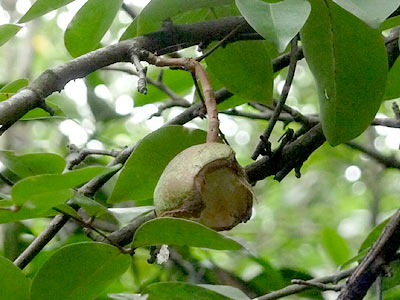
The Nyireh Batu (Xylocarpus moluccensis) was fruiting, but all the fruits I saw were half-eaten. I wonder what animals have been feeding on them. Hmm...
It was really noisy along the mangrove boardwalk, as there were lots of male Cicadas (Family Cicadidae) singing.
A number of the Bakau Putih (Bruguiera cylindrica) were flowering, and I decided to take a macro shot. It was then I noticed a pair of Crab Spiders on them! The female, which was whitish-green in colour, was much larger than the reddish-brown male. It's almost impossible to spot the male since it was half-hidden behind the petals of the flower in the middle.
I also found this Cotton Stainer Bug on this Portia Tree (Thespesia populnea). Previously, I had found a few Thespesia Firebugs on the same tree, but couldn't find any this time round. The above Cotton Stainer Bug is also not the usual ones that I have seen on the Sea Hibiscus. Not sure what species it is.
Along the boardwalk, I heard a man telling a few kids, "snake, snake". I went over to take a look, and saw that it was a Dog-faced Water Snake (Cerberus rynchops).
I also managed to found time before I went off to meet my friend to visit the fruiting Lenggadai (Bruguiera parviflora). There were quite a few propagules hanging off the branches.
I had to rush off soon after that, but still, it was a shot but pleasant walk :)


Thursday, April 16, 2009
Pasir Ris Park with Temasek Junior College on 15 Apr 2009
After helping out with guiding at Chek Jawa, I headed to Pasir Ris Park to give a guided walk for Temasek Junior College students. Since I was early, I managed to take a walk around the park while waiting for the students to arrive.
A pair of Zebra Doves (Geopelia striata) were spotted near Sungei Tampines. These small doves feed on small grass and weed seeds, though at times it may also feed on small invertebrates.
Standing in the middle of the river was a Grey Heron (Ardea cinerea). One of the biggest bird in Singapore, it feeds on fishes and other small animals.
The few Lenggadai (Bruguiera parviflora) trees were blooming, but unfortunately none had formed seedlings yet. This tree is said to produce good firewood and charcoal. The seedling is sometimes eaten as a vegetable.
The Bakau Putih (Bruguiera cylindrica) is one of the most common mangrove trees found at Pasir Ris. Several of them were flowering too. Interestingly, the wood from this tree is said to produce an odour that repels fish, and thus it was not used to make fish traps.
Here's the seedling of the Bakau Putih.
The Tumu (Bruguiera gymnorhiza) was not as common as the Bakau Putih, but there's a fairly healthy population at Pasir Ris. The hard, red wood from this tree can be used to make furniture, house posts and also used for firewood and making charcoal.
The Ceriops zippeliana was easily spotted in many parts of the mangrove. It can be differentiated from the other Ceriops species by the red collar on mature seedlings.
In other mangroves in Singapore, the Nyireh Batu (Xylocarpus moluccensis) is not very commonly seen, but there is a good population here at Pasir Ris.
The students soon arrived, and we took a walk around the Mangrove Boardwalk.
Among the first animals we saw was a horde of Cotton Stainer Bugs (Dysdercus decussatus) on a Sea Hibiscus (Talipariti tiliaceum). These bugs feed on the seeds of the Sea Hibiscus.
Not too far away, we saw several Thespesia Firebugs (Dysdercus simon) on a Portia Tree (Thespesia populnea). This bug is less common then the Cotton Stainer, and can be differentiated from the latter by its black head.
A juvenile Praying Mantis (Order Mantodea) was resting on the leaf of a Sea Hibiscus.
This Sea Holly (Acanthus ilicifolius) has pretty lilac petals, which can be differentiated from other species with white flowers.
This is probably a Lacewing (Family Chrysopidae).
I saw a few trees with the caterpillar of the Atlas Moth (Attacus atlas)! This moth is believed to be the largest moth in the world based on total wing surface area.
A few had gone into the pupa state, hiding in a cocoon. In Taiwan, these cocoons are made into pocket purses.
Some students spotted this pretty Face-banded Sesarmine Crab (Perisesarma eumolpe) which had deep red claws and an iridescent green band on the face.
Another crab we saw was the Tree-climbing Crab (Episesarma sp.). During high tide, they will climb up the trees to stay away from predatory fishes that comes in with the tide.
The Giant Mudskipper (Periophthalmodon schlosseri) is the biggest mudskipper found in Singapore. It is a fish, but is able to survive out of water by storing water in its mouth and gill chamber. When its skin is wet, it can breathe through its skin too.
Another mangrove tree we saw was the Bakau Kurap (Rhizophora mucronata). This tree produces big and long seedlings, which were used by natives in the region to cane children who misbehaved.
One of the students noticed this very well-camouflaged bird - a Little Heron (Butorides striatus). It eventually managed to catch a fish with its beak!
The Malayan Water Monitor (Varanus salvator) is one of the biggest lizard in the world, and it is very common in Singapore. This lizard is mildly venomous. While the weak venom may not kill, these lizards harbours lots of bacteria in its mouth that can cause serious infection if you are bitten by it.
Here's a quick group shot.
There were lots of male Cicadas (Family Cicadidae) singing in the mangrove forest. Studies shown that they sing a different song for different purposes, such as courtship songs or distress songs.
We soon ended the walk, and as we walked out of the mangrove area, we saw a few Red Jungle Fowls (Gallus gallus). This chicken is often believed to be the direct ancestor of the domestic chicken.
Yet another pleasant surprise was 3 Laced Woodpeckers (Picus vittatus), my first time seeing them, even though this species is supposed to be common in Singapore!
That certainly gives the guided walk a very nice closure! Hopefully all the students enjoyed the walk with me!
Friday, March 27, 2009
Pasir Ris Mangrove
Today, I met up with XF, his wife and his daughter for a walk at Pasir Ris mangrove. It started raining when we were in the cab, but fortunately stopped when we reached Pasir Ris.
After a quick look at the herbal garden, we headed for the mangrove boardwalk. Perhaps due to XF's beginner's luck, we managed to see quite a few interesting stuff.
The top find of the day must be this - a small population of Thespesia firebugs (Dysdercus simon) on a portia tree (Thespesia populnea)! It was initially thought that this bug could only be found in our mangrove in the western part, until we found a population on Pulau Ubin last December.
Not too far away from the portia tree was a sea hibiscus tree (Talipariti tiliaceum), and there was a huge population of cotton stainer bugs (Dysdercus decussatus) living on it. Unlike the less common Thespesia firebug, the cotton stainer bug has a red head instead of a black one.
There were lots of tree-climbing crabs (Episesarma spp.) on the trees, since the tide was still high. These crabs climbed up trees to escape from predatory fishes during high tide. The above crab has purple claws with white tips, so it's probably a violet tree-climbing crab (Episesarma versicolor).
Tree-climbing crabs are also called vinegar crabs, since they are sometimes pickled in vinegar by the Teochews, who will then eat them with porridge. The above crab with red claws should be the Singapore tree-climbing crab (Episesarma singaporense).
The giant mudskipper (Periophthalmodon schlosseri) at Pasir Ris were really huge. They are the biggest mudskippers in Singapore, and can be really fierce hunters of smaller animals.
And this is one of the mudskipper's prey. I initially thought that it was an eel, since it was rather long (about 50cm) and was swimming too quickly for me to see carefully.
However, when it was chomped into 2 halves by the mudskipper, the second half started wriggling on the spot, and I could see that it was a segmented worm (Class Polychaeta)! This was quickly eaten by the mudskipper.
After observing the several segmented worms swimming by and got chomped up, XF spotted a real eel! it was really huge, at least a metre long. And things got really exciting when it managed to set its teeth on a tree-climbing crab!
It was twisting and turning. Not sure if it was trying to hit the crab against the substrate to kill it.
Apart from the mangrove fauna, the plants were out to impress too, with many of the sea derris (Derris trifoliata) in full bloom!
Several of the bakau putih (Bruguiera cylindrica) had developing their seedlings, which were attached to the parent plant. This is one of the most common mangrove plant in Singapore.
This fat cigar-like seedling belongs to the tumu (Bruguiera gymnorhiza).
This mangrove tree, Ceriops zippeliana, was only recorded in Singapore a few years ago.
The mature propagules of the bakau minyak (Rhizophora apiculata) has a red collar. This plant is commonly planted in plantations to be harvested to make charcoal.
The bakau kurap has broader leaves and bigger propagules up to 70cm long.
The nipah palm (Nypa fruticans) is where you get your attap chee for your ice kacang. Several of them can be found by the sides of the boardwalk. The fruit is basically a cluster of seeds, and every seed will have one attap chee inside.
The Nyireh batu (Xylocarpus moluccensis) is rather commonly seen here compared to the other mangroves of Singapore. Unfortunately, all the trees I saw were not fruiting.
Apparently, Nparks have planted several rare plants here too, including the Rapanea porteriana above. This plant was once commonly found in the mangroves and coastal forests of Singapore, but is now seldom seen due to coastal development which destroyed most of its habitat.
This has been a nice little trip with quite a few surprise finds. Hopefully XF and family had enjoyed the trip :P