Showing posts with label Nature Areas. Show all posts

Friday, May 10, 2013

Singapore's Nature Reserves & Other Nature Spots

I often get blog comments or emails from readers telling me that they have found my blog posts on the nature reserves useful, as they can find out what to expect and what to prepare for their nature trips. Hence, I decided to blog about more of our nature spots as and when I have the time. This page will serve as a content page for the nature spots that I have blogged about so far.


Nature Reserves in Singapore

1. Bukit Timah Nature Reserve
 
Established in 1883, this is the oldest nature reserve in Singapore. The 163-hectare reserve has the country's highest hill - Bukit Timah - at 163.63m. The forest has very rich biodiversity, with more than 840 flowering plants and over 240 species of vertebrates.
 
2. Central Catchment Nature Reserve
 
At 3,043 hectares, this is Singapore's biggest nature reserve. Established in 1951, it is covered mostly by secondary forest, with only about 154 hectares of small primary dryland forest patches, and 87 hectares of primary freshwater swamp forest.
 
3. Sungei Buloh Wetland Reserve
 
This reserve covers an area of 130 hectares, comprising mangrove forests, freshwater marshes, and secondary forests. It was officially gazetted as a nature reserve on 1 Jan 2002 for its importance as a stop-over point for migratory birds and its rich mangrove biodiversity.
 
4. Labrador Nature Reserve
 
Otherwise known as Labrador Park, this 10-heactare reserve has a secondary forest and one of the few rocky shores and sea-cliffs on the mainland. It was re-gazetted as a nature reserve in 2002 after calls from the public to preserve the area's rich history and nature.


Other Nature Spots in Singapore

1. Semakau Landfill
 
Semakau Landfill is Singapore's only landfill in use, and is also the world's first offshore landfill created entirely from the sea from linking two islands. This island, however, still has a natural seashore, with a wide variety of marine animals which can be seen during low spring tide.
 
2. Chek Jawa Wetlands
 

Chek Jawa Wetlands is a 100-hectare protected nature area managed by the National Parks Board of Singapore. It is located at Tanjong Chek Jawa at the eastern coast of Pulau Ubin, an island which can be accessed by bumboats from Changi Point Ferry Terminal.
 
3. Sensory Trail
 

The Sensory Trail is a 1.5km nature trail on Pulau Ubin. Initially developed for the visually-handicapped but now open for all to enjoy, this trail allows visitors to see, touch, smell, and taste some of the plants along the trail, and also listen to animal and bird calls.
 
4. Pasir Ris Mangrove Boardwalk
 

The Pasir Ris Mangrove Boardwalk is located in a 6-hectare mangrove forest in Pasir Ris Park, a park managed by NParks in the northeastern part of Singapore. In Malay, "Pasir" means "beach", while "Ris" means "bolt-rope", refering to the long and narrow beach there.
 
5. Berlayer Creek & Bukit Chermin Boardwalk


Officially opened on 2 January 2012, the Berlayer Creek and Bukit Chermin Boardwalk runs for about 960m along the 5.6-hectare Berlayer Creek, home to one of the few natural riverine mangrove forests left in Singapore, before it winds towards Keppel Island.
 
More nature spots to be updated here soon! Do visited this space again!

Monday, December 31, 2012

Nature Interpretation for Beginners

I started doing nature guiding in 2005, and I could still remember that at that time, training for guides was quite location-specific - we discussed the standard operation procedures for the location, share about the background of the location, and learn about the flora and fauna found there. Although we also discussed about some of the guiding techniques, it was more of the experienced guides highlighting what they thought were important. While the techniques were useful, they were essentially what the guides could think of at that point in time, and hence we had to learn a lot of things on our own through trial-and-error. At that time, I have not even heard what nature interpretation is.

I started assisting with the training of nature guides in late 2006, and become a main trainer in 2007. The training content I used were consolidated from the experiences I gained as an active nature guide and from other experienced guides, as I tried to design a proper structure for training guides, and adopt a more systematic approach for the whole process.

It was only in recent years that I heard about nature interpretation, and started reading up about it. It felt weird to think that to some extend I had been trying to reinvent the wheel last time, though what I had come up with previously was more specific to Singapore, or at least to a particular nature spot. After finding out more about the experts' views on nature interpretation, I also realised then that there are definitely several good practices that are quite universal for most nature walks. It will be useful to train new guides with these universal good practices, and at the same time, include some practices that will be more relevant to the local scene.

So in this blog entry, I will attempt to share the things I have learned, the experiences I have gained, and what I personally feel is important with regards to nature interpretation.


A) What is Nature Interpretation?

Personally, I feel it is a communication process to facilitate the understanding of the various biotic and abiotic components of our natural environment and the relationships between them.

"Facilitate" is a key word here, as I feel it is not just about communicating what you know with the audience, but create a platform to allow the communication to take place. In other words, while in most cases the information may come from the nature guide, it is also possible that the information may come from a member of the audience. Hence, the guide should ensure that there is proper interaction and not a one way communication, and must also be humble enough to accept that sometimes the audience may know more about a particular topic than the guide.


B) Role of a Nature Interpreter/Guide

The interpreter will have to facilitate the communication of ideas, feelings and values so as to provoke audiences to do their own thinking and develop their own understanding of nature and appreciate the importance of nature, hence be inspired to play a part in nature conservation.

He/she also have to be a role model for the participants. Actions speak louder than words, and hence if the guide shows that he/she really care about nature, the audience will be more positively influence. For example, the guide should not make unnecessary noises and end up disturbing the wildlife, and also, should not feed animals or rescue prey from predators, but let nature takes its course.

It is also important that he/she ensures the safety and comfort of the audience, and that the entire programme is smoothly run.


C) Guiding is MAD!

A nature interpreter will need to manage the Message, the Audience, and the Delivery of the message during a nature walk.


D) Crafting the Message

The message is what the guide will be saying to the participants. A beginner nature interpreter should always write a script for the messages he/she will be conveying for a walk, and the script should be written as if he/she is talking to the participants, i.e. not in point form. Writing a script will give the interpreter an idea of how exactly he/she should do the commentary, and serves as a backup if the beginner guide gets stage fright. Experienced guides can also look at the script and give tips on how it can be improved.

The message should strive to be EROTIC - Entertaining, Relevant, Organised, Themed, Inspiring and Conversational.

Entertaining - When the participants find the nature walk enjoyable, there will be a higher chance that they will like the nature spot better, remember what they have learned during the walk, and more motivated to want protect the nature spot. As such, it is usually a good idea to include some jokes and topics most people are interested with (e.g. food and sex) to ensure that the participants are not bored. However, while jokes are to be included, the interpreter should avoid putting an organism in a bad light, e.g. saying it is disgusting or evil etc, or the participants may subconsciously develop negative emotions for nature.

Relevant - Avoid confusing the participants by talking about things that are not relevant to the topic. For example, I have witnessed a guide showing the participants a living snail, and ended up spending most of the time talking about hermit crabs occupying dead snails' shells. There was another occasion when I overheard a guide talking about vampire bats when the subject was a fruit bat. Unless the participants ask (which the guide may choose to give a short reply), the guide should focus on what is in front of them. And obviously, the script prepared by the guide should be regarding the flora and fauna that can usually be found along the chosen nature trail. While explaining difficult concepts, it is also useful to use analogies relevant to the participants, i.e. something that they are familiar with, so that they can relate better to them.

Organised - A message should be coherent, or else the participants will have a hard time trying to understand what the guide has said. Start the story with a statement that will draw the participants' attention to the organism. E.g. "We are really lucky to see this today! This is a XXX" or "Does anybody know what this is?" After that, elaborate 2 or 3 interesting topics regarding the subject matter, i.e. the plant, animal etc. The guide should avoid trying to show off how much he/she knows, or the participants may be put off. Ensure that the message flows smoothly, and a complete picture of every topic is presented. The message should have a proper closure, so that the participants got the signal that it has ended and they can move on.

Themed - The theme refers to the core idea(s) for the commentaries, and it is very important because it determines what the guide wants the participants to know, what he/she hope they will feel, and how he/she hope they will behave during and after the activity. A nature walk may have more than one theme. For example, if the theme is biodiversity, the guide will try to introduce more flora and fauna with shorter commentaries, but if the theme is conservation then the guide will spend more time on the conservation status of the flora and fauna, and how are they threatened, and what can be done to conserve them.

Inspiring - Singapore has very few nature spots left, and hence as far as possible we hope to inspire the participants to be involved with conservation. The guide can ask thought-provoking questions, e.g. what will happen if a particular plant/animal goes extinct? Will we lose a potential cure for some diseases? The guide should lead by example to care for the environment (actions speak louder than words!), but should never promote his/her personal achievements as some participants may be put off. The guide can also give suggestions on the little things everyone can do to contribute to conservation.

Conversational - The guide should avoid talking like he/she is giving a documentary commentary, but more like talking with a friend. The message script should hence also be written as such, and not in the form of an essay or in point form. If the commentaries are made like a speech, the personal touch will be absent, and it will be harder to get the participants to trust the guide and feel for the things that are discussed. Similarly, the guide should not be talking down in a superior tone (i.e. I know more than you). A few simple questions should be added to encourage the participants to interact and express their views. Questions requiring "Yes" or "No" answers make it easier for participants to answer. Questions can also be used to draw the participants' attention, and the response can be an action rather than a verbal response. E.g. "Can you see the tiny hair on XXX's back?"


E) Managing the Audience

The audience refers to the participants, and it is important to manage the audience well to ensure that a nature walk is a success. And really, managing the audience is a SCAM - the guide needs to ensure their Safety and Comfort, then try to get their Attention, and watch out for Misbehaviours.

Safety - It is always important to conduct a safety briefing and ensure that the audience follows instructions. As a usual rule, the participants should not touch anything along the trail without permission, as some of the things may be dangerous, e.g. poisonous plant, venomous animals etc. It is also important to remind them not to wander off the trail, as they may be causing damage to the nature area, and also there could be dangers (hidden holes, snakes etc). Singapore is usually quite hot, and hence it is good to remind them to drink water. Also, the guide should keep a look out for anyone not feeling well. The guide should also take note of bad weathers, and must be familiar with the evacuation procedures in case any emergencies.

Comfort - After ensuring the safety of the audience, the guide must ensure that their comfort as far as being realistic, since they my get very restless if they feel uncomfortable. For example, the guide should be the one facing the sun, not the participants. If the trail has biting insects, the audience should be reminded to spray insect repellent before they enter the trail. It is also important not to force participants to touch or taste things if they don’t want to. Sometimes, there could be delays in the trip, and hence the guide should communicate the reasons for the delay with the audience, and keep them occupied.

Attention - When the audience feel safe and comfortable, it will be easier to get their attention. The guide should take note of environmental noises (airplane, factory etc), and move away or wait for the sound to subside before continuing with the commentary. The message should also be tailored to the audience to get their attention. For example, the guide can also use analogies relevant to the audience's experience to allow them to relate to the subject matter better. It is also important not to use scientific or difficult words for a public group or they will not be able to understand the commentary. Also, the guide can choose topics that are more relevant to the type of audience, e.g. joke about reproduction adaptations with only adults; use examples from kids programmes when dealing with children; use local examples such as what can be eaten or used for local groups, or compare with foreign customs for foreign groups etc. It is hence important to interact with the audience to know what they want and adjust accordingly. Depending on the interest level, the guide may adjust the length of the message.

Misbehaviours - It is important to manage misbehaving participants, and they can affect the other participants. Examples of misbehaviours include: visitors doing anything dangerous; asking irrelevant questions repeatedly; asking too many questions and delay the trip; and wandering off the trail etc. to manage such participants, the guide can: remind them nicely to behave themselves; inform them time is running out, and you will answer the questions at the end one-to-one; or in cases which the participant refuses to improve his/her behaviour, inform the organiser, who can remove him/her from the group so that the walk can proceed smoothly and the mood of the other participants will not be spoilt.


F) Delivering the Message

When a guide delivers his/her commentary, he/she is actually communicating using both verbal communication and nonverbal communication.

Verbal Communication - This is communication using words i.e. the spoken message, which was what we have covered under the section Crafting the Message. But it is important to note that the scripted message is just a reference, and as mentioned under the section Managing the Audience, the actual verbal message delivered should be adjusted to match the type of audience.

Nonverbal Communication - This refers to communication without using words, which includes the use of the various Senses, Nonverbal aspects of talking, Attire, and Body language, otherwise shortened as SNAB.
  • Senses - The guide should try to use all the five senses to communicate with the audience. For example, he/she can listen out for bird or insect calls, look out for movements or camouflaging animals, smell the herbs and spices, touch and feel the texture of leaves, and taste edible fruits and herbs. All these experiences will make a nature walk more unforgettable for the audience!
  • Nonverbal aspects of talking - These include the pitch, clarity, intonation, volume, speaking style. It will be very boring if the guide use a monotonous voice all the time. When talking about something exciting, the guide can raise his/her pitch, speed of talking and volume, and when talking about something creepy, he/she can lower his/her pitch and volume. The varying way of making the commentary can make the experience a lot richer.
  • Attire - This refers to what the guide is wearing. To appear professional and enthusiastic about his/her role as a nature interpreter, slippers and other sloppy attire should be avoided. First impression does count, and the audience will tend to trust a guide who is properly attired more.
  • Body language - This includes facial expressions, eye contact, body posture, intentional and unintentional gestures, and personal space. It is good to keep eye contact with the audience, so as to grab their attention. Dramatic facial expressions will help to make the commentary more interesting. The guide should avoid slouching, as he/she will appear disinterested and lazy. It is good to have some gestures, but avoid having too many hand movements as it may confuse or distract the audience. It is always good to give the audience some personal space - they will move closer to the guide when they are more comfortable with him/her.


G) Conclusion

The above are just my 2 cents' worth of what I feel is important while doing nature interpretation. I will think that most experienced nature guides will have their own ideas about what makes a good nature guide, and hence I will assume that there will be guides who disagree with the above techniques. But I guess this should still serve as a good reference for beginner guides! All roads lead to Rome, and as long as the audience has a positive experience and their understanding and appreciation of nature are improved after the guided walk, I would think the nature interpreter has done a good job! :)

Tuesday, September 18, 2012

Berlayer Creek & Bukit Chermin Boardwalk

Officially opened on 2 January 2012, the Berlayer Creek and Bukit Chermin Boardwalk is part of the 2.1km-long Labrador Nature and Coastal Walk. The boardwalk runs for about 960m along the 5.6-hectare Berlayer (or Berlayar) Creek, home to one of the few natural riverine mangrove forests left in Singapore, before it winds towards Keppel Island.

Berlayer Creek is actually part of what used to be a small tidal river in the southern part of Singapore. Urban development work has claimed most part of the original river system, but a small portion near the estuary was spared. The area was named after a historic rock formation, Batu Berlayer, which means “Sail Rock” in Malay, that stood at its estuary. This rock formation, together with another similar-looking one on the opposite shore of Tanjong Rimau on Sentosa, once formed some kind of "gateway" for boats. Due to these two sharp rock formations, the gateway was called 龙牙门 in Chinese, meaning Dragon Teeth's Gate.


The National Parks Board has done up a very nice online guide on this nature spot, and hence I will focus more on some of the things to note, and the ecological aspects along this boardwalk instead.


Dos & Don'ts
  1. Stay on the boardwalk, or you may end up trampling the flora and fauna.
  2. Bring water and some light snacks, as you can only buy drinks at the end of the boardwalk at the cafe at Keppel Marina or from the vending machines at Labrador Park.
  3. Keep your volume down, or you may disturb the very animals you want to see, and they may hide away from you.
  4. Take nothing but photos, leave nothing but foot prints. Bring your litter out with you, and never take anything from the forest. Poaching has resulted in severe reduction in the population of much wildlife in many places.
  5. You may want to bring insect repellent just in case, though I personally have not encounter many mosquitoes there.
  6. Please bring a cap/hat in case of sunny weather, and raincoat/poncho in case of wet weather. I would also recommend bringing a few plastic bags to keep your electronic products in case it rains.
  7. Bring a camera along, but remember to have a plastic bag to keep it dry in case it rains.

What to Expect at the Boardwalk


The entrance to the boardwalk is located near the Labrador MRT Station. Do check out the various cultivated native plants around the MRT station before you enter the boardwalk beyond the pavilion.


Once you enter the boardwalk, you will be greeted by a beautiful riverine mangrove forest. Riverine mangrove forests are those that occur along tidal rivers. As a result, the river has more freshwater during low tide, fed by its tributaries upstream, but gets inundated with sea water during high tide. In a typical riverine mangrove forest, the trees are usually taller and healthier, as the area will be enriched by nutrients from its tributaries. However, due to development, the main source of freshwater for Berlayer Creek is now is left with a small drain, and hence the amount of nutrients received by the forest is also affected.

Like other mangrove forests, the plants found in a riverine mangrove forest still has to adapt to the various challenging conditions - the soft and unstable mud, the lack of oxygen in the soil, and the salt (which has a drying effect). As a result, most mangrove plants spread their roots widely for more stability; develop aerial roots to take in oxygen from the atmosphere; and either block most of the salt at the root level, or excrete salt through glands on the leaves.


Berlayer Creek is home to the largest population of the Bakau Pasir (Rhizophora stylosa) on mainland Singapore. This is a nationally vulnerable mangrove tree with hard and heavy wood traditionally used for making charcoal. It relies on its roots to exclude salt from entering the plant through a process called ultrafiltration. The thin and long structures seen hanging from the trees are the seedlings, not fruits - the seed develops shoots and roots while still attached to the tree. Mature seedlings are dispersed by water and have a greenish collar. The seedling floats horizontally for a few weeks, during which the root (lower part) will absorb water and become heavier, eventually causing the seedling to tip and float vertically. As the tide goes down, the vertically-oriented seedling will sink into the mud or other suitable substrates.


The Api-api Ludat (Avicennia officinalis), a common magrove tree, is also found here. "Api-api" means "fire-fire" or "firefly" in Malay, as some Avicennia species are noted to attract fireflies. Research indicated that roots of Avicennia species also exclude some salt from entering the plant. It also has glands to excrete salt that is not excluded at the roots.


After the short loop among the trees, the boardwalk continues along side with the forest. Several interesting coastal and mangrove plants can be seen along the trail. In the photo above, you can see a Malayan Banyan (Ficus microcarpa), which is a fig tree, with the long dangling roots. As fig trees produce figs very regularly, they are able to provide regular food supplies for all kinds of animals such as birds and monkeys, unlike other forest trees that fruit perhaps once a year or even once every few years. In fact, such large fig trees play a critical role in providing food and shelter, and studies suggest the number of such fig trees limit the number of animals found in a forest.

The authorities had planted many native plants along the boardwalk, making this a nice trail to learn some of our native coastal plant. I will just highlight a few of the planted ones here:


Many young Gedabu (Sonneratia ovata) have been planted here. This critically endangered mangrove bears round persimmon-like fruits which are edible. It uses ultrafiltration to block the salt at the roots, just like the Bakau Pasir.


The Limau Hantu (Suregada multiflora) is another nationally critically endangered tree planted here.The fruit resembles small lime, hence the Malay name "Limau Hantu" which means "ghost lime". Studies shown that extracts from this plant has antibacterial and insecticidal properties. More recent studies showed that it has some anti-HIV and anti-cancer properties as well.


Yet another critically endangered tree planted here is the Sea Teak (Podocarpus polystachyus). The timber from this tree is hard and durable, and is used in some places to make furniture and house interior. It is also planted for ornamental purposes.

Of course, looking at planted trees can never be as interesting as finding the wild ones. Apart from the Bakau Pasir and Api-api mentioned at the beginning of this post, there are a few other mangrove and coastal plants here like the Bakau Putih (Bruguiera cylindrica), Buta-buta (Excoecaria agallocha), Nipah Palm (Nypa fruticans), Mangrove Derris (Derris trifoliata) and Sea Hibiscus (Talipariti tiliaceum). But it would be a lot more interesting to try to spot the ones that are really uncommon at this particular mangrove forest.


The Chengam (Scyphiphora hydrophyllacea) is rather commonly seen in our other mangroves, but somehow only a few can be found at Berlayer Creek. The small fruits are cylindrical and green, and they are dispersed by water.


The Teruntum Merah (Lumnitzera littorea) is an endangered mangrove tree. The authorities had planted many young ones along the boardwalk, but there is one huge and tall wild one among the wild trees. It has pretty red flowers, blooming in clusters. The small and somewhat corky fruits are buoyant and dispersed by water. The wood is hard and extremely durable, and is used for the building of bridges, wharves, cart axles, flooring and sleepers. It has a rose-like scent, making it popular as a cabinet timber.


You will sharp eyes to spot the Kalak Kambing (Finlaysonia obovata), a critically endangered climber. The fruits appear like a pair of horns, and hence the common name "kalak kambing", which means goat's horn. The young leaves of this plant are apparently eaten by some as a vegetable.


The hardest to spot, however, is a tall and mature Berembang (Sonneratia caseolaris), a nationally critically endangered mangrove tree closely related to the Gedabu mentioned earlier. I only know of less than 10 wild trees left on mainland Singapore, the others are: three (possibly a young fourth one to be verified) at Woodlands; one at Sungei Buloh; and one at Kranji. Several other wild ones can still be found on Pulau Ubin and Pulau Tekong though. Like the other Sonneratia species, the flowers usually bloom at night and are pollinated by nectar-feeding bats and moths at night, and birds in the morning.

Apart from the plants, the usual mangrove animals can be seen here too.


The mudskippers are among the easiest to spot. The above is a Giant Mudskipper (Periophthalmodon schlosseri). This is the biggest species of mudskipper in Singapore. This fish can survive out of water by holding water in its mouth and gill chamber. It is rather aggressive and hunts small animals such as crabs and worms for food.


The Collared Kingfisher (Todiramphus chloris) can also be seen, if not heard, here. Apart from small fishes, it feeds on small crabs, shrimps and insects too. Apart from kingfishers, many other birds, such as green pigeons, orioles, bulbuls, sunbirds and even a few migratory waders, can be seen here.


If you are lucky, you may chance upon the Plantain Squirrels (Callosciurus notatus). They feed mostly on fruits and leaves, though they may also eat insects and bird eggs.


Many butterflies and moths can be seen here, and hence it's no surprise you may see caterpillars here too. The above is an Atlas Moth (Attacus atlas) caterpillar. The Atlas moth is the biggest moth in the world in terms of total wing surface area, and its wingspan is also one of the widest, up to 30cm.


The boardwalk will bring you towards the see and eventually to the Bukit Chermin section of the boardwalk. While you are here, remember to look down to see if there are any schools of fishes around. If the tide is low, you can even see little crabs!


Do also check out the rare Johor Fig (Ficus kerkhovenii) growing on the cliff as you head towards the marina.


And here's the Marina at Keppel Bay!


If you look down, you will notice that there are lots of soft corals and other organisms growing on the sides of the floating pontoon!


Here's a closer look - can you see a clam, soft corals, seaweeds, and a pair of tunicates (the thing below with a pair of holes each)?


You can even find colourful cave corals!

If you still have energy after the walk, you may want to consider going to Labrador Nature Reserve, which is just nearby, where more nature awaits!

Friday, August 17, 2012

Pasir Ris Mangrove Boardwalk

The Pasir Ris Mangrove Boardwalk is located in a 6-hectare mangrove forest in Pasir Ris Park, a park managed by the National Parks Board (NParks) in the northeastern part of Singapore. In Malay, "Pasir" means "beach", while "Ris" means "bolt-rope", refering to the narrow beach.


Do take a look at the map provided at the NParks Website to find out how you can get to the boardwalk, and also where are the various entrances.


Dos & Don'ts
  1. Stay on the trail! Wandering off the trail may result in trampling of the flora and fauna.
  2. Bring water and some light snacks, but avoid eating or drinking when there are monkeys around.
  3. Do not feed any animals, as they may become very dependent on human to feed them, and forget how to find food on their own. Some animals, such as the macaques, may even learn to snatch food from human.
  4. Keep your volume down, or you may disturb the very animals you want to see, and they may hide away from you.
  5. Take nothing but photos, leave nothing but foot prints. Bring your litter out with you, and never take anything from the forest. Poaching has resulted in severe reduction in the population of much wildlife in many places.
  6. You may want to consider wearing long pants, e.g. light track pants etc. There could be mosquitoes.
  7. Please bring insect repellent. Mosquito pads are usually not very useful for such outdoor activities as the mosquitoes can be quite aggressive.
  8. Please bring a cap/hat in case of sunny weather, and raincoat/poncho in case of wet weather. I would also recommend bringing a few plastic bags to keep your electronic products in case it rains.
  9. Bring a camera along, but remember to have a plastic bag to keep it dry in case it rains.

What to Expect at the Boardwalk

The mangrove forest at Pasir Ris is surprisingly diverse despite its small size, and a good number of nationally endangered or critically endangered plant species can be found here. On top of that, NParks has also done a good job of replanting more mangrove plants to increase the gene pool. Unfortunately, the area no longer receives the much needed mud from the rivers as they have been canalised, and hence the substrate is slowly firming up as the incoming tides deposit more and more sand. As a result, NParks had to resort to digging trenches into the back mangroves so that the plants will get the sea water. In the meantime, the front mangroves are slowly being eroded by the waves and receding tides, and several coastal protection measures such as reforestation and beach nourishment (using sand bags) are implemented. The Pasir Ris Mangrove hence does not only provide outdoor learning opportunities on mangrove ecology, biodiversity and conservation, but coastal protection as well.

At the Back Mangrove

The boardwalk at Pasir Ris Mangroves makes a good loop around the true mangrove and back mangrove zones. As the name implies, the back mangrove occurs at the back of the mangrove forest further away from salt water sources, which can be the sea or tidal rivers. The back mangrove is seldom inundated with sea water, and hence the species found here (i.e. the coastal plants) are not as tolerant of soaking their roots in salt water compared to the true mangrove species. However, the coastal plants here will still have to tolerate salt sprays brought by the waves and wind. As a result, many coastal plants have smooth leaves to allow the salt formed on them to be easily swept away by the wind and rain.

Coastal plants also have to adapt to the dry conditions in the windy coastal environment, being caught in the middle of land and sea breezes which increase the rate of evaporation. The dry conditions are especially acute at sandy areas which could not trap much water due to the porous nature of the substrate. Hence, many coastal plants go either extremes of having thick leathery leaves to retain water, or thin and narrow leaves to reduce the rate of evaporation.

Those growing on more exposed areas will have to tolerate the heat and radiation from the sun, and thus the leaves of many coastal plants come with a glossy surface to help reflect the heat and radiation.

Some of the back mangrove plants occuring naturally (not planted) and animals found along the Pasir Ris Mangrove Boardwalk are highlighted here:

cicadas (Family Cicadidae)
Once you get under the vegetation, you will probably hear the distinctive and continuous cicada song made by the cicadas (Family Cicadidae). The males "sing" by vibrating special structures called "timbals" on the sides of the male cicada's abdomen, in order to attract female cicadas. In addition to the mating song, some cicadas are known to be able to produce distress call (when they are caught) or courtship songs.

Fishtail Palm (Caryota mitis)
In the secondary forest and edge of the back mangrove here, the Fishtail Palm (Caryota mitis) can be commonly seen. Interestingly, the plant starts bearing flowers from the top of the trunk, and subsequent bunches will appear below the previous bunch near the base of a leaf stalk. The leaves and fruits contain oxalate crystals and are toxic, and may cause burns on the skin when touched.

Oriental Pied-hornbill (Anthracoceros albirostris)
Nonetheless, some animals such as civets and hornbills are known to consume the fruits and help disperse the seeds, and the Oriental Pied-hornbills (Anthracoceros albirostris) is one of them. They are sometimes seen feeding on the fruits of the various species of palms here. Believed to have gone extinct in the early 1900s in Singapore, the current population is thought to be the descendants of those which have flown over from Johor to settle down on Pulau Ubin in the 1990s. Breeding was first recorded in 1997 on Pulau Ubin, and since then, several of them have flown over to settle down in Changi. Several pairs have also been released at various parks by NParks.
Sea Apple (Syzygium grande)
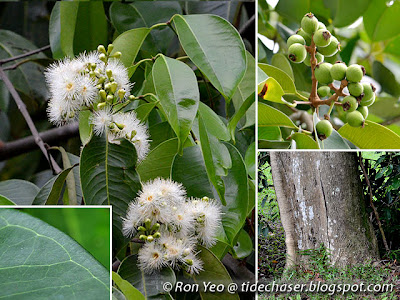
At the landward side of the back mangrove, the Sea Apple (Syzygium grande) also occurs naturally. It is commonly planted as a roadside tree for its shade, and previously it is also planted as fire breaks as it is quite fire-resistant (being a coastal plant, it has adapted to survive in the dry environment by retaining water in its trunk and leathery leaves). The wood is used for building boat and houses.
Pong Pong (Cerbera odollam)
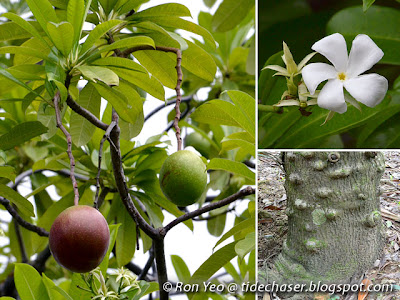
The Pong Pong (Cerbera odollam) occurs more on the landward side of the back mangrove as well. has pretty white flowers with a yellow centre, while the fruit is round, turning red to dark purple with age. The fruits are dispersed by water. The seed, sap and leaf are very poisonous. It is sometimes planted as a wayside tree, and the dried fibre mesh of the fruit is sometimes used in flower arrangement.
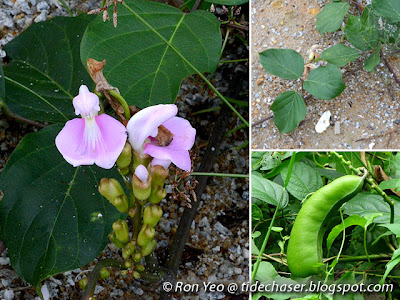
Maunaloa (Canavalia cathartica)
The Maunaloa (Canavalia cathartica), a common seashore creeper/climber, is also found here. Studies shown the beans to be highly nutritional, and scientists are exploring the possibility of exploiting it as a solution for food scarcity in developing countries. However, it is mildly toxic, and hence for it to be safely consumed, they are usually soaked overnight to support microbial fermentation to break down the toxins, and then boiled or roasted.

Senduduk (Melastoma malabathricum)
The Senduduk (Melastoma malabathricum) is a very common shrub in our forests and open areas, and they can be found on the landward side of the back mangrove too. The ripe fruits can be eaten but stain the mouth black, hence the genus name Melastoma, which means "black mouth". The young leaves are edible as well, and are used to treat stomach complains.

Sea Daisy (Melanthera biflora)
The Sea Daisy (Melanthera biflora) is a straggling to climbing herb with lovely yellow composite flowers, and usually occurs on sandy beaches, mangrove edge and sometimes inland open area. The leaves have lots of medicinal properties, and are used to treat cuts, stings and ulcer. It can be consumed to treat stomach pains and to improve healing after childbirth.

Red Jungle Fowls (Gallus gallus)
It is around here at the edge of the back mangrove on the landward side, families of Red Jungle Fowls (Gallus gallus) can be regularly seen. This species of wild chicken is believed to be the ancestor of the domestic chicken. The former, however, can be differentiated from the latter by the white cheek, white rump, grey legs, and the calls of the male which have an abrupt ending. They are usually found in wooded areas, forest edges and open areas near forests.
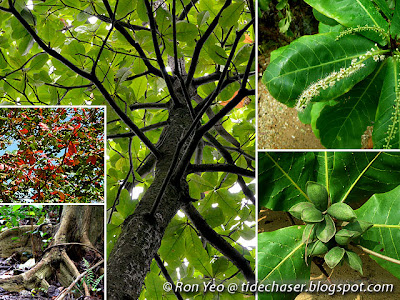
Sea Almond (Terminalia catappa)
The Sea Almond (Terminalia catappa) is commonly found along beaches and at the back mangrove. It is deciduous, shedding its leaves twice a year, and the leaves turn orange or red before they are shed. The branching is somewhat layered horizontally, and hence they are also called pagoda tree. The kernel of the fruit is edible, and taste somewhat like almond, hence the common name.

Plantain Squirrel (Callosciurus notatus)
Plantain Squirrels (Callosciurus notatus) can be seen feeding on the Sea Almond or Sea Apple fruits sometimes, or jumping from branch to branch, or even tree to tree! They eat mainly fruit and nuts, but are also known to feed on small insects.

Kacang Kayu Laut (Pongamia pinnata)
The Kacang Kayu Laut (Pongamia pinnata) is a common seashore tree with pretty pinkish-white to purplish flowers and thick leathery seed pods. The oil from the seeds are used for illumination and for medicinal purposes. Recently, there were suggestions to use the oil as biofuel as well. The seeds and roots are used to make fish poison.

Bird's-nest Fern (Asplenium nidus)
Sometimes, you can find Bird's-nest Ferns (Asplenium nidus) growing on some of the trees, which got its common name from its resemblance to bird's nest (with some imagination). The rosette of leaves traps dead leaves, resulting in a spongy humus that traps rain water, useful for the plant especially in the dry coastal environment.

Sea Hibiscus (Talipariti tiliaceum)
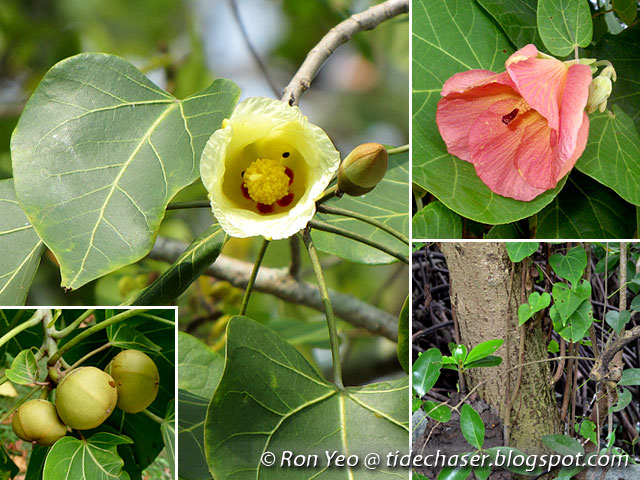
Occuring nearer to the true mangrove area, the Sea Hibiscus (Talipariti tiliaceum), with its pretty heart-shaped leaves, is also commonly seen in Singapore. Interestingly, the flowers are yellow in the morning, but turn orange or red towards the end of the day, and will be shed usually by the next day. The fibre from the bark is used to make ropes and caulk boats.

Cotton Stainer Bugs (Dysdercus decussatus)
And when there are Sea Hibiscus trees, you will often find Cotton Stainer Bugs (Dysdercus decussatus) which feed on the seeds. They got their common name from a related species which feeds on cotton seeds, and introduce a fungus which stains the cotton.

Portia Tree (Thespesia populnea)
Appearing rather similar to the Sea Hibiscus, the Portia Tree (Thespesia populnea) has narrowly heart-shaped leaves.

Thespesia Firebug (Dysdercus simon)
And the Portia Tree is also the host for a closely related but much rarer cotton stainer species, the Thespesia Firebug (Dysdercus simon). They can be differentiated from the Sea Hibiscus' Cotton Stainer Bug by the black head.

Sea Holly (Acanthus spp.)
Various species of Sea Holly (Acanthus spp.) can also be seen here. They got their common name from their resemblance with the Christmas holly. These plants can be found growing in saline conditions, and they are able to excrete the excess salt through glands on the top surface of their leaves.

Mangrove Derris (Derris trifoliata)
The Mangrove Derris (Derris trifoliata) is a very common woody climber in the mangroves. This plant is poisonous, and pounded leaves and roots are used to stun fish, and also as an insecticide. The poison will be broken down after cooking. This fishing method, however, is not encouraged as it harms not just the fish the fishermen want, but other animals in the area as well.

Sea Rubber Vine (Gymnanthera oblonga)
Pasir Ris houses a few critically endangered mangrove climbers, and the Sea Rubber Vine (Gymnanthera oblonga) is one of them. The fruits of this plant usually occur in pairs, and are eaten in Papua New Guinea.

Kalak Kambing (Finlaysonia obovata)
The Kalak Kambing (Finlaysonia obovata) is another critically endangered climber found here. The fruits appear like a pair of horns, and hence the common name "kalak kambing", which means goat's horn. The young leaves are apparently eaten by some as a vegetable.

At the Front Mangrove

True mangrove species refer to those that grow only in mangrove environment. They are adapted to survive in waterlogged and anaerobic conditions. The substrate they are growing on are usually muddy and unstable as well. That is why many of the trees have roots exposed to the air to take in more oxygen, and the roots often spread over a wide area to allow the trees to stabilise themselves on the soft mud. The roots also have to be adapted to survive in the saline conditions. Here are some of the animals and true mangrove species found at the front mangrove area:

Nyireh
The Nyireh Batu (Xylocarpus moluccensis), a rarer relative of the more commonly seen Nyireh Bunga (Xylocarpus granatum) which is also found here, is doing surprisingly well along the boardwalk. The various Xylocarpus species are usually called Mangrove Cannonball for their round fruits, which break upon drying or when they hit the ground, and the seeds are dispersed by water.

Atlas Moth (Attacus atlas)
The Atlas Moth (Attacus atlas) appear to like feeding on the leaves of the Niyreh Batu (and various other true and back mangrove plant species). This moth is the biggest moth in the world in terms of total wing surface area, and its wingspan is also one of the widest, up to 30cm.

Buta-buta (Excoecaria agallocha)
The Buta-buta (Excoecaria agallocha) usually occurs towards the landward side of the true mangrove habitat. It is also called "Blind-your-eyes", has poisonous white sap which can cause blistering and blindness. The tree is also deciduous, and the leaves turn yellow, orange or even reddish before they are shed.

Mud Lobsters (Thalassina sp.)
The blind-your-eyes tree can often be found growing on mud lobster mounds, which appears like little volcanoes among the mud. Mud Lobsters (Thalassina sp.) eat tiny organic particles in the mud, and as they process the huge amounts of mud and sand to seek food, the processed mud is piled around their burrows, forming the little "volcano-like" structures. Mud lobsters play an important role of bringing nutrient-rich soil to the surface. Many other plants and animals live in or on mud lobster mounds too, attracted by the nutrients, and also, higher ground and free lodging (burrow made by the mud lobster) to get away from the sea water.
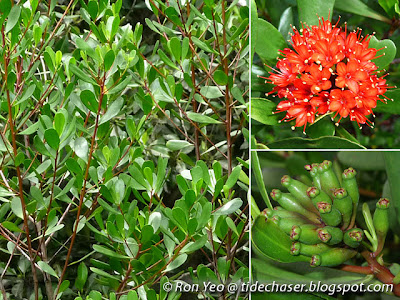
Teruntum Merah (Lumnitzera littorea)
The Teruntum Merah (Lumnitzera littorea) also occurs here. It has pretty red flowers, and even the young branches are reddish in colour. The wood is hard and extremely durable, and is used for the building of bridges, wharves, cart axles, flooring and sleepers. It has a rose-like scent, making it popular as a cabinet timber.

Tree-climbing Crab (Episesarma sp.)
An animal commonly seen on mud lobster mounds is the Tree-climbing Crab (Episesarma sp.), which usually dig burrows into the mounds or at the base of trees. During high tide, you may encounter many of them climbing up to trees to avoid the predatory fishes in the water. Tree-climbing crabs are primarily leaf-eaters. They are also called vinegar crabs, because the Teochews are known to pickle this crab in black sauce with vinegar.

Mangrove Pitta (Pitta megarhyncha)
The Mangrove Pitta (Pitta megarhyncha) can occasionally be seen foraging among the mud lobster mounds, in both the true and back mangrove habitats. It has been observed to feed on slugs, snails and small crabs. It is a rare resident in Singapore, and globally near-threatened due to loss of habitat.

Nipah Palm (Nypa fruticans)
Moving seaward, the Nipah Palm (Nypa fruticans) is the only true mangrove palm in Singapore. Also called the Attap Palm, its seed (called "attap chee") is edible is added to several local desserts, such as the ice kacang. The leaves are used for thatching. A sweet syrup can be extracted from the flower stalk in large quantities and made into palm sugar, or used in the production of alcohol (including ‘toddy’), sugar and vinegar.

Bakau Minyak (Rhizophora apiculata)
The Bakau Minyak (Rhizophora apiculata), like other Rhizophora species, has prop roots and stilt roots at the lower part of the tree. The wood is hard and heavy, and is used for making scaffolding and furniture. It is widely used for making charcoal. This tree is often planted along fish ponds to protect the bunds. It can occur quite close to the sea.

Orange Mud Crab (Scylla olivacea)
Among the roots and in the mud, the Orange Mud Crab (Scylla olivacea), which is the mud crab often used in the popular "Chilli Crab" dish. These crabs usually feed on clams which they crush with their powerful claws. They are very valuable in the local market, and are used in various popular local dishes.

Lenggadai (Bruguiera parviflora)
The Lenggadai (Bruguiera parviflora) is rather uncommon in other mangroves, but there is a good population at Pasir Ris along the boardwalk. The wood from this tree produces good charcoal and pulp. It is usually used as firewood or for mining and making fishing-stakes. The germinating seedling is sometimes eaten as a vegetable.

Perepat (Sonneratia alba)
Another common mangrove tree here nearer to the seaward side is the Perepat (Sonneratia alba). Like other Sonneratia species, it has conical roots protruding from the ground. The fruits and leaves are edible, while the wood is used for various construction purposes, such as the construction of buildings, bridges, boats, wooden tools and furniture.

Grey Heron (Ardea cinerea)
There is a nesting colony of Grey Herons (Ardea cinerea) on some of the Perepat trees along Sungei Tampines. One of the biggest bird in Singapore, it can reach heights of about 1m, and has a light grey plumage. The long legs enable it to wade in shallow water or among tall grasses to hunt small animals, such as fishes, amphibians, reptiles, insects, crustaceans and even small mammals and birds.
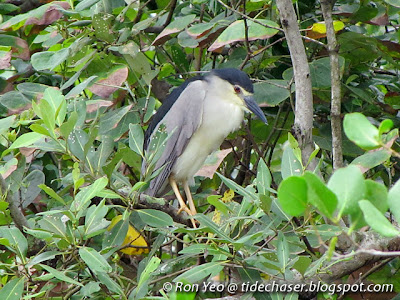
Black-crowned Night Heron (Nycticorax nycticorax)
The Black-crowned Night Heron (Nycticorax nycticorax) is often seen here too. This is a nocturnal bird, and usually roost in trees in the day. It has gotten its common name from its black crown. This heron lacks the long neck of the previous species (though the neck can stretch quite far out), but is still fairly tall (about 65cm). Like the other herons, it feeds on small animals.

Ceriops zippeliana
Another rather common mangrove tree here is the Ceriops zippeliana, which was only discovered to be a new species in recent studies. The Ceriops, Rhizophora and Bruguiera mangrove trees demonstrate vivipary, a condition whereby the young plant within the seed grows first to break through the seed coat then out of the fruit wall while still attached to the parent plant. Since the mangrove habitat is a very harsh environment, these plants have adapted such that the parent plants prepare their young as much as possible to increase their chances of survival. The seedlings are dispersed by water. They float horizontally for a few weeks, during which the root (lower part) will absorb water and become heavier, eventually causing the seedlings to tip and float vertically. As the tide goes down, the vertically-oriented seedling will sink into the mud or other suitable substrates. Most of the seedlings, however, end up being washed ashore or eaten by animals.

The Rhizophora, Bruguiera and Ceriops, together with the Perepet also deal with the saline conditions in a similar manner. They can selectively absorb only certain ions from the sea water through a process called ultrafiltration. But this process is not 100% effective, and some salt still gets into the trees, and will be removed by transpiration of the leaf surfaces or accumulated in old leaves.
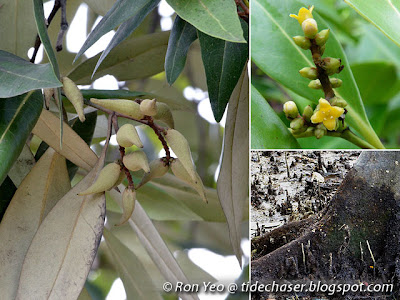
Api-api Putih (Avicennia alba)
The Api-api Putih (Avicennia alba) and other Avicennia species, on the other hand, not only exclude salt from entering the plant, but has salt glands on the leaves to excrete part of the remaining quantity of salt. "Api-api" means "fire-fire" or "firefly" in Malay, as some Avicennia species are noted to attract fireflies.

Chut-chut (Cerithidea obtusa) and Articulated Nerites (Nerita articulata)
On the trunks of these mangrove trees, various snails, such as the conical Chut-chut (Cerithidea spp.) and the round Articulate Nerites (Nerita articulata) above. The Chut-chut got its name from the way the cooked snails are eaten - by sucking the content out from the shell, making a "chut-chut" sound. The Articulate Nerites got their names from their shells' appearance - the shell looks as if it consists of sections united by joints (meaning of articulate in anatomy). Both feed on algae.
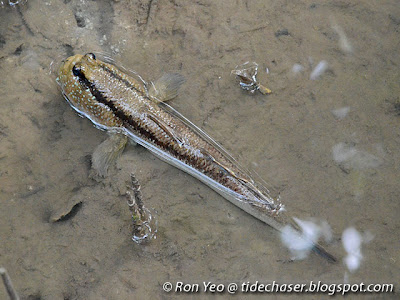
Giant Mudskipper (Periophthalmodon schlosseri)
Many fishes occurs in the mangroves, and the Giant Mudskipper (Periophthalmodon schlosseri) is one of them. This is the largest mudskipper species in Singapore. It is able to survive out of water by holding water in its mouth and gill chambers. It can breathe through its skin when it is wet too. Being a rather aggressive fish, it feeds on other small animals, such as crabs or worms.

Spotted Archerfish (Toxotes chatareus)
The Spotted Archerfish (Toxotes chatareus) is yet another fish that can be seen here. This fish feeds on insects by shooting them down with water. They may also jump out of the water to get their prey if they are near enough.

Collared Kingfisher (Todiramphus chloris)
And if there are fishes, there will be kingfishers! The Collared Kingfisher (Todiramphus chloris) is one of the commonest kingfisher in Singapore. Most of the time, they could be well-hidden among the foliage, but you could often still hear the distinctive cackling call. They do not just feed on fish though, but insects as well.

Whimbrels (Numenius phaeopus)
Towards the end and beginning of the year, migratory waders can also be seen here. The photo above shows two Whimbrels (Numenius phaeopus). They feed on worms in the mud by digging them out with their long beaks.

Dog-faced Water Snake (Cerberus rynchops)
Pasir Ris Mangrove is perhaps also one of the most convenient place on mainland Singapore to see the Dog-faced Water Snake (Cerberus rynchops). This snake is mildly venomous and feed on small fishes. It sometimes hunt other small animals too. It is usually easier to see them at night, in the early morning or late afternoon when it is cooler and darker.


Conserving Pasir Ris Mangrove Forest

The entire Pasir Ris Park is currently managed by NParks, but it is still very vulnerable to possible development plans in future. There are also problems of poachers who collect plants and animals without an NParks permit, and anglers not disposing disused fishing lines properly. The latter is especially an issue and many animals got entangled in the lines and either starve to death or get badly wounded. There is also the rubbish issue, as the park users may not have disposed their waste properly and animals may end up eating or getting trapped in them.

As such, it is important that Singaporeans visiting this park should behave in a more responsible manner. It is important for Singaporeans to learn more about our various nature spots, the issues they face, so that we can better protect what is left. Hence, I always encourage those who visit my blog to read up more about our natural heritage from books or online resources.

It is also important that nature lovers do share your experience with their friends so that more people get to know and visit Chek Jawa. And if time permits, become a volunteer to help with conducting guided walks here!

At the end of the day, we also hope that more Singaporeans can feedback to the government if they enjoy visiting our nature spots and hope to preserve them as they are, so that the authorities will know that we do value our natural heritage and these nature spots will be protected.