
I was back on Big Sisters Island today for a picnic organised by a friend. As the main focus wasn't on the shore life, I only managed to sneak out to check out the shore for like an hour or so. Tide wasn't that low by then, but fortunately I still managed to find a number of stuff :)
I was most excited to find this Fluted Giant Clam (Tridacna squamosa) in the lagoon - had not been able to find it for my past few trips here! The metal stick on the right probably indicated that Mei Ling, who worked on giant clams, was studying it. This one is about 30cm wide.
Most of the people on the island were more excited about the Long-tailed Macaques (Macaca fascicularis) though. There were more than 10 of them and they were really rather daring. We were kept busy for quite a while keeping them away from the food.
The smaller lagoon, as usual, had many Sand-sifting Sea Stars (Archaster typicus). These sea stars sift among the sand for tiny decaying matter (detritus) to feed on.
There were quite a few moon snail trails. I dug one out and it was a Pear-shaped Moon Snail (Polinices mammilla).
At the mouth of the small lagoon, there were a few Haddon's Carpet Anemone (Stichodactyla haddoni), and I found some Anemone Shrimps (Periclimenes brevicarpalis) on them! These shrimps had a layer of mucus on their body to prevent the anemone from stinging them, while being protected from predators by the stinging tentacles.
I found a few tiny Ocellaris Clownfish (Amphiprion ocellaris) in some of the Giant Carpet Anemones (Stichodactyla gigantea) near the mouth of the lagoon too!
Branched Sea Anemones (Phymanthus sp.) were as abundant as ever. They looked like little flowers of the sea...
Leaf Slugs (Elysia ornata) were in season, and I saw many of them among the seaweed. These sea slugs sucked the sap of the seaweed and retained the chloroplast in their body for photosynthesis. And so they were somewhat "solar-powered", like plants!
At the rocky areas, I saw many Black Sea Cucumbers (Holothuria leucospilota) among the rocks and coral rubble.
There were many snails on the sea wall, but the limpets caught my eye, as I suddenly remembered a friend who was studying them for her honours project.
I only saw one nudibranch, a Discodoris boholiensis. "Nudibranch" means "naked gills", refering to the flower-like gills on the back of most species.
Fanworms (Sabellastarte sp.) were also rather common at the coral rubble area.
The Red Maiden's Fan (Oceanapia sagittaria) is probably my favourite sea sponge - the bulk of the sponge is actually hidden in the ground.
Sisters Island has a very nice and dense intertidal coral reef. All the brown boulders above were hard corals! They are mostly brown due to this golden-brown algae (called zooxanthellae) that live inside them. The algae photosynthesize and provide nutrients for the corals, while getting shelter in return.
Some corals, such as the Turban Coral (Turbinaria peltata) above, have their own colour pigments that act as sun block, and hence they may appear greenish, bluish or even purplish.
Coral reefs can get rather colourful sometimes - the above shows some corallimorphs among some sponges.
Algae, like the red algae above, can be brightly coloured too!
So are the colonial ascidians.
Some of the areas had lots of Zoanthids (Palythoa mutuki), which looked like little flowers carpeting the area.
Even smaller are the tiny polyps of the Toadstool Leather Coral (Sarcophyton sp.).
The tide came back rather quickly, and I had to stop my exploration. As we were leaving the island, I noticed that the trash bin were really not very monkey-proof... Hopefully Sentosa will do something about this, since they are managing the island!
Thursday, October 27, 2011
Quick Look at Sisters Island on 26 Oct 2011

Sunday, June 05, 2011
Little Sister Island on 20 May 2011
Yet another rather late post. I have not visited the Little Sister Island for several years, and hence was really glad that we managed to organise a trip there this time round. Although it's quite a bit smaller than the Big Sister Island, there are still quite a number of things to see on the island.
The heart urchin, likely to be Lovenia elongata, appeared to be in season, and we saw quite a number of them! This one was walking over a rock using the spines on its underside. Looks really cute!
Here's another heart urchin burrowing into the sand.
Flipping over the rocks, I saw this little sea star, probably an asterinid among the encrusting bryozoan and red algae. This was only my third time seeing this sea star - the other times at Raffles Lighthouse and Big Sister Island.
Under the jetty were several red feather stars.
I also saw this black and white feather star in a shallow pool.
A stonefish sea cucumber (Actinopyga lecanora) was trapped high and dry during the low tide.
Not too far away from the sea cucumber was the resident fluted giant clam (Tridacna squamosa).
Another "giant" we saw was the giant top shell (Trochus niloticus), hiding among the rocks.
The creeper shell, Cerithium trailli, is supposed to be an endangered species in Singapore. I have been seeing a number of them on our southern shores though.
Another shell I saw was the dolphin shell (Angaria delphinus). Been seeing many of them these days too.
Only a few slugs were spotted though, including the pustulose phyllid nudibranch (Phyllidiella pustulosa).
A few leaf slugs, Elysia ornata, were also spotted. These slugs feed on algae, and are able to retain the chloroplast for photosynthesis!
The hairy leaf slug, Placida daguilarensis, was also in season, but since they were so small, it was rather hard to spot them unless you look closely.
This octopus moved around so gracefully, and almost looked like it was gliding over the corals and rocks.
The brown egg crab (Atergatis floridus) is commonly seen among corals and algae on our reefs.
The sponge, Rhabdastrella globostellata, was rather common here.
There are good populations of hard corals on the island too. The above is a small colony of turban coral (Turbinaria sp.).
At the sides of rocks and areas shaded from the sun, a few patches of cave corals were seen.
There are soft corals too, including several huge colonies of the Cladiella corals.
Some parts of the reef were covered with zoanthids, such as the two species of Palythoa above.
Corallimorphs of various colours were seen. Unfortunately, the species we have in Singapore remains a mystery.
Branching sea anemones (Phymanthus spp.) were very common on our shores. Recent studies shown that although they may exhibit various colours and appear different, most of them are probably of the same species.
Several giant carpet anemones (Stichodactyla gigantea) were seen, though I did not really spend time to check if there were any anemonefish inside.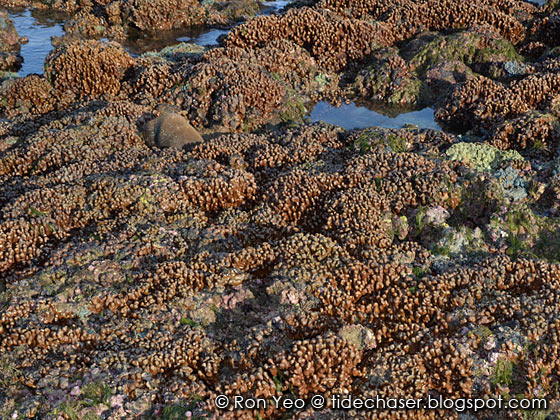
And before I left the reef, I took one last look at the densely covered coral reef - a sight most Singaporeans do not know exist in Singapore...
Monday, May 31, 2010
Sisters Island Walk on 30 May 2010
We finally conducted our very first public intertidal walk on Big Sister Island! Compared to the other walks that we have conducted, we have much fewer participants for this walk - only 30! This is because the Big Sister Island is much smaller than the other islands that we have conducted intertidal walks so far, and hence we had a smaller group that is more manageable to minimise impact to the environment.
We started off at the rocky shore, and at the edge of the shore, we found several feather stars (Class Crinoidea). These animals use their feather-like tentacles to collect plankton to feed on.
There were a number of Leaf Slugs (Elysia ornata) too. These slugs feed on the sap of algae, and are able to retain the chloroplast in the sap for photosynthesis to provide them with additional nutrients.
We soon reached a nice fringing reef with lots of hard corals and other reef organisms.
A few Striped Ribbon Worms (Baseodiscus quinquelineatus) were stranded on the rocks.
I noticed a few partially bleach coral colonies, but the situation was certainly not as bad as what we saw at Semakau.
There were a few Fireband Murex (Chicoreus torrefactus) among the corals. According to sources I found from the Web, the bright orange colour comes from a layer of skin (called the periostracum) which covers the shell.
There was also an Adhesive Sea Anemone (Cryptodendrum adhaesivum). Unlike most other sea anemones, this one has very short tentacles which it uses to sting its prey.
When we reached the small sandy lagoon, we saw many Moon Snails (Polinices mammilla) moving around just below the sand.
When we reached the big lagoon, I found a White-spotted Reef Hermit Crab (Dardanus megistos)! This hermit crab is seldom spotted on our shores. It was very shy though, and refused to come out for a nice photo :P
In the big lagoon, we also found a few Spider Conches (Lambis lambis). They were really well-camouflaged and it was quite hard to spot them when they were in the right environment.
A few nudibranchs were also spotted, including this Bohol's Nudibranch (Discodoris boholiensis).
Towards the end of the walk, the sky turned dark rather suddenly, but it fortunately did not rain and the participants managed to have a little picnic before we board the boat.
The boat ride back was mostly a rather peaceful one, until we reached Marina South Pier. One of the smaller boat accidentally crashed into our boat, and the impact smashed one of the windows! Fortunately, no one was hurt in this accident.
