Friday, March 23, 2012

Sea Urchins (Phylum Echinodermata: Class Echinoidea) of Singapore

Sea urchins (class Echinoidea) are animals with a round, rigid skeleton (test) made of interlocking calcite plates. The test is hollow inside, containing its various organs, and covered with lots of spines on the outside. They belong to a bigger group of animals called the spiny-skinned animals (phylum Echinodermata - "echino" roughly means "spiny"; "derma" roughly means "skin"). Examples of other echinoderms include sea stars, sea cucumbers, and feather stars.

long-spined sea urchin (Diadema setosum)
The spines can come in various forms - long or short, smooth or rough, sharp or blunt. They not only help the sea urchin to move, but deter predators as well. Some sea urchins are venomous, and hence it's a good habit not to pick up any of them. The venom may be delivered by the spines or tiny stalk-like structures with biting jaws called "pedicellariae".

Like other echinoderms, sea urchins generally have a five-part body plan with radial symmetry (i.e. pentaradial symmetry), at least in some stage of life. In other words, you can divide a sea urchin into 5 equal parts. Also, they are able to regenerate lost body parts - such as spines lost to predators. Echinoderms are brainless, but despite that, they can still perform their daily functions - they can move, they can eat, they can shit, and they can reproduce - all these without a brain! Also, instead of blood vessels, echinoderms have a water vascular system. This system is essentially a network of water-filled vessels used for internal transportation of oxygen, food and waste.
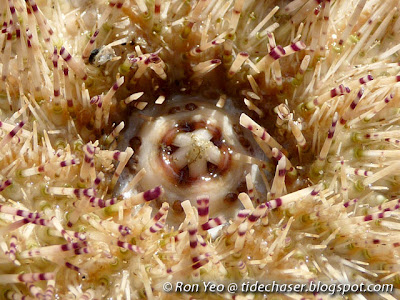
Salmacis
The mouth of a sea urchin is on its underside, comprising five elongated vertical jaws held together in a structure known as the Aristotle’s lantern. Sea urchins generally feed on algae and seagrasses, though some may scavenge. The anus is on the top side. They have separate sexes, and usually reproduce by broadcasting their eggs and sperms into the water.

There are two main groups of sea urchins: the regular sea urchins with spherical tests; and irregular sea urchins with more flattened tests that are bilaterally symmetrical. The latter generally lacks the Aristotle’s lantern as well. Interestingly, the regular sea urchins are usually found in seagrass meadows and coral reefs, while the irregular sea urchins are typically burrowers in sandy substrates. In Singapore, more than 20 species of sea urchins have been recorded.

Here are the sea urchins found in Singapore that I managed to photograph.

Order Diadematoida

Members of this order are regular sea urchins with hollow spines, many of which contains venom. Many have long spines.

long-spined sea urchin (Diadema setosum)
The Long-spined Sea Urchin (Diadema setosum) is a regular sea urchin commonly seen on our reefs. It has long, needle-like spines which break easily upon contact. These spines are hollow, containing a mild venom, and broken spines are very difficult to remove when they penetrate the victim's skin of the victim, causing pain and discomfort. This sea urchin has an orange anal cone and five equally spaced white spots on the upper side. The test can be up to 8cm wide.

Order Camarodonta

Members of this order are regular sea urchins, mostly with shorter spines. Their lanterns come with keeled teeth, and they usually have enlarged plates.
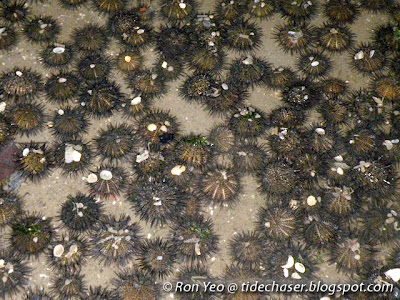
black sea urchin (Temnopleurus toreumaticus
The Black Sea Urchin (Temnopleurus toreumaticus) is seasonally abundant on Singapore's northern shores, and at times hundreds, if not thousands, can be found along a shore among seagrasses.

black sea urchin (Temnopleurus toreumaticus)
In Latin, "toreuma" means "carved or embossed work", possibly refering to the numerous intricately arranged bumps (where the spines and tube feet extend from) on the small test (up to 4cm wide).

white sea urchin (Salmacis sp.)
The White Sea Urchin (Salmacis sphaeroides), also seasonally abundant, usually occurs in seagrass meadows. They are often found camouflaged with dead shells, rock fragments, seaweed or seagrass. While it can occur in similar habitats as the previous sea urchin, it is usually much larger, with the test reaching almost 10cm wide.

white sea urchin (Salmacis sp.)
While Salmacis species are mostly whitish in colour, individuals with brown, purple or pink spines have been seen too. This is the Purple-spined Sea Urchin (Salmacis virgulata). In the water, translucent tube feet can be seen extending out, which sticks to surface and hence help the sea urchin to move around and camouflage.

Order Cidaroida

Members of this order have thick, blunt spines on their tests. They somewhat resemble pencil-holders with "pencils" poking out, and hence the common name pencil sea urchins.

pencil sea urchins (Prionocidaris sp.)
The Thorny Pencil Sea Urchins (Prionocidaris spp.) are seasonally abundant. Their thick spines often come with darker bands. Bits and pieces of seaweed and seagrass are often found entangled among the spines.

pencil sea urchins (Prionocidaris sp.)
Two species have been seen in Singapore: one with thicker and shorter spines, and another with thinner, longer and sharper spines. One of the species also has purple or pinkish spots at the base of the main spines. The two sea urchins above should be Prionocidaris bispinosa, since they lack the spots. Some of the bigger specimens may have tests reaching width of more than 8cm.

Order Spatangoida

The sea urchins from this order are usually called heart urchins. They are irregular sea urchins with oval or heart-shaped tests. Unlike other sea urchins, they have a definite front and rear end. They often burrows in the sand and hence, they are not often spotted - there could be many of them under the sand that you are standing on! They feed on tiny organic particles (detritus).

Heart urchin (Lovenia elongata)
Occasionally, they can be seen on the sand surface or on pebbles near sand, moving around with their short spines on the underside. Three species have been recorded from Singapore.

Heart urchin (Lovenia elongata)
The Elongate Heart Urchin (Lovenia elongata) is heart-shaped, usually reddish or pinkish in colour, and about 3-5cm long. It usually comes with a few longer spines pointing backwards.

Heart urchin (Maretia ovata)
The Agassi’s Heart Urchin (Brissus agassizii) is larger, about 5-8cm long, and whitish in colour. It appears more oval than heart-shaped, and lacks the special longer spines found in the former species.

Heart urchin (Maretia planulata)
The Longspine Heart Urchin (Maretia planulata) is the smallest heart urchin recorded from Singapore. It is about 2-3cm long with brownish or reddish flower-like pattern on the top side. It has many long spines pointing backwards.

Order Clypeasteroida

Sea urchins from this order are often called sand dollars. They are also irregular sea urchins, and as their name suggests, they are mostly round shaped like coins, and live in the sand bank! They have a flat test covered with short, hair-like spines which helps them to move around and burrow. On the top side of sand dollars are five rows of pores in a flower-like pattern, and it is through these patterns that their tube feet poke out to breathe. These animals probably feed on algae and detritus.

sand dollar (Arachnoides placenta)
The Placenta Sand Dollar (Arachnoides placenta) is the commonest sand dollar, and can occur in the hundreds in some areas. It is usually found on sandy shores with very fine sand. it can grow to about 10cm across.

Keyhole Sand Dollar (Echinodiscus truncatus)
More rarely seen is the Keyhole Sand Dollar (Echinodiscus truncatus) which has 2 distinctive slots (lunules) on the test. The exact function is still not fully understood, though scientist believe that they probably allow water to flow through and help prevent the sand dollar from being flipped over by strong currents. It can also grow to about 10cm across.

pink sand dollar (Peronella lesueuri)
The Lesueur's Sand Dollar (Peronella lesueuri) is sometimes seen on Singapore's northern shores. It is pink in colour, and is usually found among seagrasses, sometimes just beneath the sand surface. The biggest I have seen is about 8cm across.

brown sand dollar (Laganum depressum)
The Depressed Sand Dollar (Jacksonaster depressum) is sometimes seen, and usually several to many of them are seen together. They are usually light brown or pinkish brown in colour. I noticed it is often found in areas with some freshwater runoffs though. It is about 3-4cm across.

Like most other marine organisms, the sea urchins in Singapore are threatened by loss of habitats and collection.


References
  • Castro, P & M. E. Huber, 2003. Marine biology. McGraw-Hill, US.
  • Coleman, N., 2007. Sea stars: echinoderms of Asia/Indo-Pacific. Neville Coleman’s Underwater Geographic Pty Ltd, Australia.
  • Davison, G.W. H., P. K. L. Ng & H. C. Ho, 2008. The Singapore red data book: threatened plants and animals of Singapore. Nature Society (Singapore).
  • ETI BioInformatics. 2012. Marine species identification portal. Retrieved Oct 3, 2012, from http://species-identification.org.
  • Lane, D. J.W. & D. Vandenspiegel, 2003. A Guide to sea stars and other echinoderms of Singapore. Singapore Science Centre.
  • Lane, D.J.W., L.M. Marsh, D.VandenSpiegel, & F.W.E. Rowe. 2000. Echinoderm fauna of the South China Sea: an inventory and analysis of distribution patterns. The Raffles Bulletin of Zoology, Suppl.8: 459-493.
  • Liao, Y. & A. M. Clark, 1995. The Echinoderms of Southern China. Science Press, China.
  • World Register of Marine Species. 2012.  Retrieved Oct 3, 2012, from http://www.marinespecies.org.

Thursday, March 22, 2012

Sea Stars (Phylum Echinodermata: Class Asteroidea) of Singapore

knobbly sea star (Protoreaster nodosus)
Sea stars (class Asteroidea) are animals with a somewhat star-shaped body, made up of several arms extending from a central disc. They belong to a bigger group of animals called the spiny-skinned animals (phylum Echinodermata - "echino" roughly means "spiny"; "derma" roughly means "skin"). Examples of other echinoderms include sea urhins (possibly where the term "spiny-skinned" come from?), sea cucumbers, and feather stars.

Anthenea aspera
Like other echinoderms, sea stars generally have a five-part body plan with radial symmetry (i.e. pentaradial symmetry), at least in some stage of life. In other words, you can divide a sea star into 5 equal parts (imagine a star-shaped pizza...). Also, any keen follower of "SpongeBob SquarePants" will probably know that echinoderms are brainless (like Patrick Star). But despite that, they can still perform their daily functions - they can move, they can eat, they can shit, and they can reproduce - all these without a brain!


One other characteristic that makes the echinoderms so different from us, is that instead of blood vessels, they have a water vascular system. This system is essentially a network of water-filled vessels used for internal transportation of oxygen, food and waste. The sea star can also move by changing the water pressure, which extends or contracts the tube feet on its underside. The tube feet may also be used for breathing, sticking to hard surfaces, and feeding - they work like a conveyor belt by transporting food from the tip of an arm to the mouth in the middle.


Sea stars are also known for their amazing ability to regenerate lost body parts - such as an arm bitten off by a predator. Still, it would take lots of energy and resources to regrow lost body parts, and in the meantime, the sea star will be moving slower, making it more vulnerable to predation and less efficient in finding food.

More than 30 species of sea stars have been recorded from Singapore, but unfortunately, many are threatened by loss of habitats due to reclamation and coastal development, and some are collected by poachers.

Family Oreasteridae

Members of this family are usually rather flat below, but convex on the top side, with tapering arms. The arms' marginal plates are well-developed but may or may not be conspicuous looking from the top, and may be concealed by thickened skin.


They also have cylindrical tube feet with a terminal disc. They are usually rather massive - adults are usually more than 10cm wide - with a massive central disc.

knobbly sea star (Protoreaster nodosus)
The Knobbly Sea Star (Protoreaster nodosus) from this family is one of the bigger sea stars found in Singapore, and some can be more than 35 cm wide! This is perhaps also one of the prettier sea stars, as they occur in various colours, ranging from bright red, orange and pink to dull colours such as brown and beige. They have a hard, calcified body with large nodules on the top surface, which protects them from most predators except fish with sharp and powerful teeth, such as pufferfish and triggerfish. Indeed, every now and then I will see individuals with broken nodules or arms.

knobbly sea star (Protoreaster nodosus)
Despite the big size, this sea star feeds mainly on microorganisms, although it has also been observed to feed on snails, clams, soft corals and sponges. Like most other sea stars, they feed by everting their stomach over their food and digestion takes place externally.

cushion star (Culcita novaeguineae)
The Cushion Star (Culcita novaeguineae) is another member of this family, and is possibly the heaviest sea star in local waters, weighing to more than 5kg! Mature ones are more pentagonal in shape and appear somewhat bloated - like a cushion!

cushion star (Culcita novaeguineae)
Juvenile Cushion Stars appear very different from the mature ones though. They are a lot thinner with more obvious arms. Juvenile cushion stars usually feed on encrusting algae, while mature ones preys on corals, other small organisms and tiny decaying particles (detritus). They usually feed at night, and in order to maintain its huge body mass, they are continuously moving in search for food. It can grow to about 40cm across.

mammillated sea star (Pentaceraster mammilatus)
The Mammillated Sea Star (Pentaceraster mammilatus) is another of the bigger sea star that can be found here. It's about the same size as the closely related knobbly sea star, and is usually found in the same habitats. "Mammillated" means "having nipple-like projections", and is certainly a rather appropriate description of this sea star. It was first recorded from Singapore only in 2008, and is likely an introduced species, possibly from ballast water.


Since then, we have been seeing sea stars that suspiciously appeared like hybrids between this sea star and the knobbly sea star. It's probably too early to determine the ecological implications though.

Anthenea aspera
The Cake Sea Star (Anthenea aspera) can grow to more than 20cm across, making it one of the bigger sea stars too. "Aspera" means "rough" in Latin. Indeed, if you run your fingers over the surface of this sea star, it feels rough, despite the "smooth" appearance, due to the numerous tiny spinelets on the top surface.

Anthenea aspera
This sea star certainly comes in many colour variations - pink, red, orange, green, brown, black, and not to forget the many different patterns on its top side. Indeed, it also may not be easy to spot them among the seagrass or coral rubble if the colours happen to be just right and blend into the surroundings. This sea star has many tiny clip-like structures on its underside, and some on its topside called pedicellariae. Exact functions of these structures are poorly understood, but they are generally thought to keep the sea star's body surface clear of unwanted stuff, such as dirt, algae or encrusting organisms.

Gymnanthenea laevis
Juvenile Rough Sea Stars are often confused with the Spiny Sea Star (Gymnanthenea laevis), a closely related sea star. Unlike the former which feels rough to the touch, G. laevis is covered with a smooth, thick skin on the top side. The marginal plates also form a smooth margin. Hence, the species was named "laevis", which means "smooth". Large groups of small protruding structures (or papillae) can be found on the top side, while big, conspicuous pedicellariae (clip-like structures, as shown in the previous species) can be found both on top and below.

Goniodiscaster scaber
The Biscuit Sea Star (Goniodiscaster scaber) has a regular star shape and look as if it's cut out using a cookie cutter. Smaller specimens are more commonly seen, but bigger ones can grow to more than 15 cm wide. The species name "scaber" means "scabby" or "rough", possibly refering to the rough and broad scab-like marginal plates.

Family Asterinidae

Members of this family are usually small-sized or moderate, covered with granules on the top side. The arms are usually flat below, and flattened or rounded above. The marginal plates are inconspicuous. The tube feet are cylindrical with a terminal disc.

Rock star (Asterina Aquilonastra)
The Rock Star (Aquilonastra coronata), also called the crown sea star, which grows to about 2cm wide. This sea star usually hides among crevices or under rocks in the day - and that's why we called it the rock star! It has numerous crown-like spinelets, and hence the species name "coronata", which means "crown". It emerges at night to feed, possibly on algae or detritus, sometimes on the adjacent seagrass meadows. Most of them have dull colours, but we often see brightly coloured ones as well!

cryptic rock star (Cryptasterina sp.
Another small sea star found in rocky areas is the Cryptic Rock Star (Cryptasterina pentagona). This sea star blends in very well into the surrounding rocks with its mottled patterns, and this certainly helps it to avoid predation. The ones I have seen are not more than 3cm across. So far I have only seen them on some of the Southern Islands. During low tide, it clamps itself tightly against the rocks to prevent desiccation. It feeds on algae on the rocks.

Nepanthia
In some of of our seagrass meadows, a few Nepanthia spp. can be found. The arms are finger-like, usually flat below, but somewhat cylindrical above. The top surface has a mottled or blotchy pattern, and can be red or brown. It is not sure if they are of the same species or different species. The red one could be Nepanthia belcheri, but it lacks some of the features description in some of the identification keys, so I am not too sure as well.

Asterinidae
The smallest and lightest sea star I have seen is a tiny unidentified one from the family Asterinidae. It is less than a centimetre wide, but we still have not been able to confirm what species it is. I am sure there are even smaller species in our waters though, just that I have not seen them.

Family Archasteridae

This family is represented by just one member in Singapore. Members are of a moderate size, and the top surface is generally quite flattened. They have spines lining the margins of the body. The arms taper to a pointed tip. The tube feet are cylindrical with a terminal disc.

sand-sifting star (Archaster typicus)
The Sand-sifting Star (Archaster typicus) from this family is possibly the commonest sea star in Singapore, and hence many nature guides also call it the common sea star. It has many common names though, but I personally prefer to call it the Sand-sifting Star, as I thought the name itself tells the story of how the sea star behaves - it sifts among the sand to avoid predation and to forage for detritus to feed on.

sand-sifting star (Archaster typicus)
Unlike most other sea stars, the Sand-sifting Stars have a rather interesting reproduction behaviour - males are often found stacked on top of the females, and the pairing may last for up to 2 months before the eggs and sperm are released into the water. The reproductive organs do not meet, and hence this behaviour is termed "pseudocopulation" - in other words, "fake sex". This behaviour apparently increases the chance of fertilisation though.

Family Astropectinidae

Members of this family superficially resemble those of the previous family - with the margins lined with spines. However, they have tube feet tapering to a knob with no terminal disc.


Also, the marginal plates with the spines are larger than the paxillae (the round, scale-like patterns on the top surface).

Sand stars (Astropecten spp.)
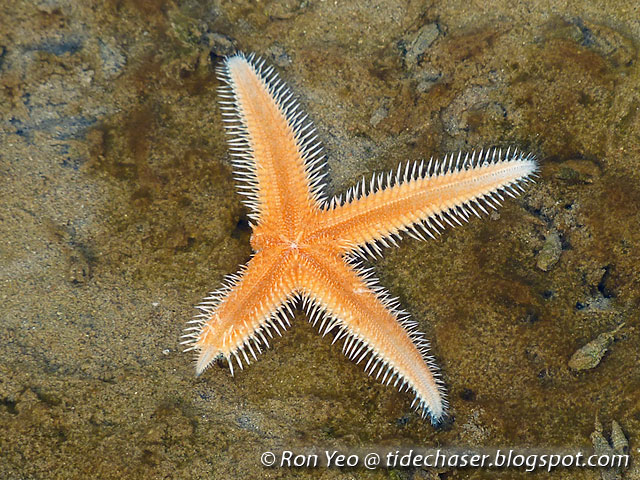
Sand Stars (Astropecten spp.) are rather common in Singapore. They usually hide in the sand in the day, and emerge when it's cooler and darker to hunt small prey such as clams and snails. The above features the Indian Sand Star (Astropecten indicus). It can be recognised by the orange lines running from the centre of the animal's upper side to the tip of each arm, and by the dark V-shaped markings around the centre of the animal and the dark bands cutting across the middle of each arm. The sides of each arm are lined with sharp whitish or orange spines. This sea star has colourless tube feet and feeds on small clams and snails.

Sand star (Astropecten sp.)
This is the New Guinea Sand Star (Astropecten novaeguineae). It has a greyish-brown colouration and usually inhabits intertidal and subtidal sandy bottoms. Its arms are lined with orange or whitish marginal spines, and its tube feet are colourless. It feeds on clams and snails.


Sand star (Astropecten sp.)
Most Sand Stars have whitish undersides, as seen in the above photo, featuring one feeding on some button snails. Unlike most sea stars, which digest their food externally, sand stars swallow their prey whole and digest it internally.

Sand star (Astropecten sp.)
One particular Sand Star, however, has an orange underside instead. This species, the Brown Spotted Sand Star (Astropecten polyacanthus),  has a brownish-orange upper side with a bluish-green margin. Some individuals may have black markings similar to those on A. indicus. It has orange tube feet. This sand star inhabits sandy seabeds and feeds on other small marine invertebrates.

Sand star (Astropecten sp.)
This is how the Brown Spotted Sand Star with the orange underside looks like with the right side up.

Family Luidiidae

Members of this family are very similar in appearance to those of the previous family, with their marginal spines and tapering tube feet. And similarly, they swallow their food whole and digest them internally.


To differentiate the two families, look at the marginal plates of the luidiids from the top - they are not distinguishable from the paxillae, unlike the broad and conspicuous marginal plates found in the previous family.

maculated sand star (Luidia maculata)
The biggest sea star I have seen in Singapore, based on body width, is from this family - the Maculated Sand Star (Luidia maculata). The biggest I had seen was 60 cm wide! Anyway, I used to call this the eight-armed sand star, until I started seeing a number of them that had 9 arms. This huge sea star burrows in soft sand and feeds on other echinoderms and molluscs. "Maculata" or "maculated" means "marked with spots or blotches", refering to the darker patches on the surface.

Luidia sp.
This sea star, Luidia difficilis, was only described as a new species in 2006. Its upper side is light brown with dark brown blotches, appearing very similar to Luidia maculata, but it can be differentiated from the latter by its six tapering arms with distinctively short marginal spines. The tube feet are mostly colourless. This species is not very well studied. It inhabits sandy seabeds and feeds on other small marine invertebrates.

Penang sand star (Luidia penangensis)
The Penang Sand Star (Luidia penangensis) usually comes with 6 arms, and of a dark grey colour.


The madreporite of this sea star is very large and conspicuous. And each paxilla on the top surface has an enlarged wart-like central spinelet.


Penang Sand Stars have orange tube feet, distinguishing them from other similar-looking Luidia sea stars in Singapore.


The above is most probably a Hardwick's Sea Star (Luidia hardwickii). It typically has 5 arms.


The tube feet are slight brownish to white.

Family Goniasteridae

Members of this family have large marginal plates, forming a conspicuous side-wall to the body. The top side is usually quite flat. The arc between adjacent arms appears rounded. The tube feet are cylindrical and with a terminal disc.

galloping sand star (Stellaster equestris)
The Galloping Sand Star (Stellaster childreni) from this family is occasionally seen on sand banks near coral reefs. As the name suggests, it can indeed "gallop" by moving on the tips of its arms. There is a row of spines lining the margins.The underside has obvious blotchy patterns.

icon star (Iconaster longimanus)
In the coral reef, divers often come across the Icon Star (Iconaster longimanus) of the same family on lower reef slopes and seabeds. They feed on algae. While most sea stars which broadcast lots of eggs, icon stars produce small numbers of large eggs. The eggs are orange in colour and apparently contain chemicals that deter fish predators.

Lots of other sea stars can be found in Singapore, but unfortunately I do not have photos of them. Here are a few other interesting facts about sea stars:

1. They have an internal skeleton (endoskeleton) made up of calcium carbonate (ossicles), somewhat like us.

2. Most sea stars have an anus on the upperside, but not the Astropecten and Luidia species.

3. Sea stars have light-sensitive eyespots at the tips of their arms, and they often keep the tips slightly tilted upwards so that they can sense their surroundings better.

4. Like most other marine organisms, the sea stars in Singapore are threatened by loss of habitats and collection.

Afternote:

Quoting from Romeo & Juliet: "A rose by any other name would smell as sweet."

As such, unlike many other local nature guides, I never insist that my participants stop calling the asteroids "starfish", and switch to calling them "sea stars". I guess that's as good as asking them to call a cuttlefish "sea cuttle", a horseshoe crab "sea horseshoe", a jellyfish "sea jelly", a hermit crab "sea hermit", or even a feather star "sea feathers" (and in fact some people do call them as such).

To me, these are just common names, and so it's a matter of personal preference or habit. In my case, ironically though, I personally prefer to call the asteroids "sea stars", not for any scientific reasons, but more because I think it sounds nicer. Haha...

As long as the guide explains clearly that a starfish is not a fish, and a horseshoe crab is not a crab etc, I think it is sufficient. If anyone is so anal about getting it scientifically correct, then they might as well go and lead a scientific group and use scientific names - common names are for the general public and they were never meant to be scientific in the first place.


References
  • Bos, A. R. , G. S. Gumanao, J. C. E. Alipoyo & L. T. Cardona (2008). Population dynamics, reproduction and growth of the Indo-Pacific horned sea star, Protoreaster nodosus (Echinodermata; Asteroidea). Marine Biology 156: 55-63.
  • Castro, P & M. E. Huber, 2003. Marine biology. McGraw-Hill, US.
  • Clark, A. M. & F. W. E. Rowe. (1971). Monograph of Shallow-water Indo-West Pacific Echinoderms. Trustees of the British Museum (Natural History). London, viim + 238 pp, 31 pls.
  • Clark, H. L. 1938. Echinoderms from Australia. Memoirs of the Museum of Comparative Zoology of the Harvard College 55: 1-596
  • Coleman, N., 2007. Sea stars: echinoderms of Asia/Indo-Pacific. Neville Coleman’s Underwater Geographic Pty Ltd, Australia.
  • Davison, G.W. H., P. K. L. Ng & H. C. Ho, 2008. The Singapore red data book: threatened plants and animals of Singapore. Nature Society (Singapore).
  • ETI BioInformatics. 2012. Marine species identification portal. Retrieved Oct 3, 2012, from http://species-identification.org.
  • Lane, D. J.W. & D. Vandenspiegel, 2003. A Guide to sea stars and other echinoderms of Singapore. Singapore Science Centre.
  • Lane, D. J. W., L. M. Marsh, D.VandenSpiegel, & F.W.E. Rowe. 2000. Echinoderm fauna of the South China Sea: an inventory and analysis of distribution patterns. The Raffles Bulletin of Zoology, Suppl.8: 459-493.
  • Liao, Y. & A. M. Clark, 1995. The Echinoderms of Southern China. Science Press, China.
  • Pawson, D. L. 2007. Phylum Echinodermata. Zootaxa, 1668: 749-764.
  • Run, J. Q., C. P. Chen, K. H. Chang, & F. S. Chia, 1988. Mating behavior and reproductive cycle of Archaster typicus (Echinodermata: Asteroidea). Marine biology 99: 247-253.
  • VandenSpiegel, D., D. J. W. Lane, S. Stampanato, & M. Jangoux. 1999. The asteroid fauna (Echinodermata) of Singapore, with a distribution table and an illustrated identification to the species. The Raffles Bulletin of Zoology, 46(2): 431-470. 
  • World Register of Marine Species. 2012.  Retrieved Oct 3, 2012, from http://www.marinespecies.org.