Wednesday, January 09, 2013

Zoanthids or Colonial Anemones (Phylum Cnidaria: Order Zoantharia) of Singapore

Zoanthids (phylum Cnidaria, class Anthozoa, subclass Hexacorallia, order Zoantharia) are colonial animals with radially symmetrical bodies, resembling sea anemones clustering together in a colony, and hence they are also called colonial anemones. Each animal (or polyp) is made up of a stomach (coelenteron) housed in a cylindrical body column, and at the tip of the column is a mouth on a disc-like structure (oral disc) surrounded by tentacles. The tentacles occur in multiples of six, and hence they are in the subclass Hexacorallia.

Zoanthids (Zoanthus spp.)
These colonial animals are connected at the base by a common fleshy tissue, and there are channels within the common tissue linking the stomachs of the individual polyps. Zoanthids do not have an anus, and hence the mouth performs both functions of ingesting food and removing waste. To feed, they usually capture plankton and tiny decaying matter with their stinging tentacles - like other cnidarians, they possess explosive, harpoon-like cells (called cnidocytes). Each cnidocyte contains a secretory organelle (cnidae), which can be a nematocyst that discharges a harpoon-like stinger carrying toxins, a ptychocyst that discharges sticky substances, or a spirocyst that discharges lasso-like threads. Hence while cnidocytes are often called "stinging cells", they do perform other functions apart from stinging.
Zoanthids (Zoanthus spp.)
The stings of zoanthids are, however, usually too weak to deter predators. Hence, they usually retract their tentacles in the body column when disturbed to protect themselves from predators. The tentacles are also retracted during low tide to prevent desiccation. Many zoanthids are also poisonous, though some predators have adapted such that they can still consume the zoanthids safely.

IMPORTANT: Zoanthids should never be handled with bare hands - you just need a tiny wound on your hand, or accidentally rub your eyes or mouth after touching them for the toxin to get into your body. For the most toxic zoanthids, it is suggested that just 64 microgram [one millionth (1/1,000,000) of a gram] of the toxic chemical entering a human's blood vessels is enough to kill.

Bleached Zoanthids
Sometimes, bleached zoanthids that are white in colour can be seen. This happens because the base colour of the zoanthids usually come from the unicellular algae, zooxanthellae (Symbiodinium spp.), living inside their tissues. Due to environmental stress, the zoanthids may expel their zooxanthellae or the latter may leave their host, thus resulting in the whitish appearance. The zooxanthellae play an important role by producing food through photosynthesis and share the food with the host zoanthids, and in return get shelter and nutrients (waste products of the corals). If the situation does not improve and the zoanthids cannot recruit new zooxanthellae to replace the lost ones, they may die. One of the main causes of coral bleaching is the rise in water temperatures.
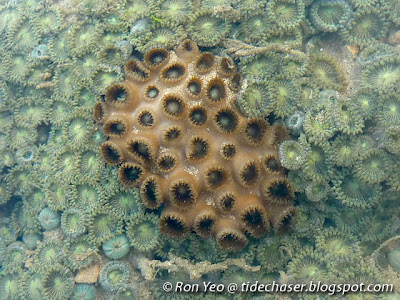
Zoanthids
Sometimes, more than one species of zoanthids can be found over the same area.

Zoanthids
Here is another example of more than one species of zoanthids growing together.

A study by Dr James D. Reimer in 2009 recorded four species of previously known zoanthids and one possible new species in Singapore. The identification of the following zoanthids is hence based on the paper he published with Dr Peter A. Todd.

Family Sphenopidae

Zoanthids from this family generally incorporate sand and other marine debris into their tissues. Many members also contain palytoxin, one of the most toxic chemical found in nature. It is believed that the toxin is not produced by the zoanthids, but by symbiotic bacteria living inside them. The toxin destroys protein (hence body cells), and studies suggest that 64 microgram [one millionth (1/1,000,000) of a gram] is enough to kill a human. There was even a Hawaiian legend related to palytoxin. Here is a summary of the legend from Wikipedia:

According to an ancient Hawaiian legend, on the island of Maui near the harbour of Hana there was a village of fishermen haunted by a curse. Upon their return from the sea one of the fishermen went missing. One day, enraged by another loss, the fishermen assaulted a hunchbacked hermit deemed culprit of the town's misery. While ripping off the cloak from the hermit the villagers were shocked because they uncovered rows of sharp and triangular teeth within huge jaws. A shark god had been caught. It was clear that the missing villagers had been eaten by the god on their journeys to the sea. The men mercilessly tore the shark god into pieces, burned him and threw the ashes into a tide pool near the harbour of Hana. Shortly after, a thick brown moss started to grow on the walls of the tide pool causing instant death to victims hit by spears smeared with the moss. Thus was the evil of the demon. The moss growing in the cursed tide pool became known as "limu-make-o-Hana" which literally means "seaweed of death from Hana." The Hawaiians believed that an ill curse came over them if they tried to collect the deadly seaweed.

It was only in 1971 when palytoxin was isolated from a zoanthid, Palythoa sp., that scientist assessed that the limu-make-o-Hana was not a seaweed but a zoanthid.
Palythoa tuberculosa, commonly called the Carpet Colonial Anemones or Sea Mat Zoanthids
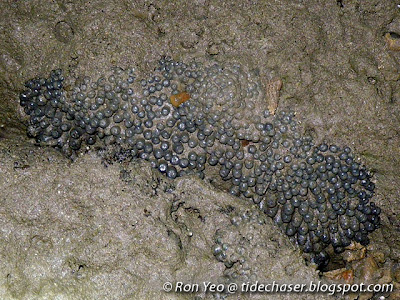
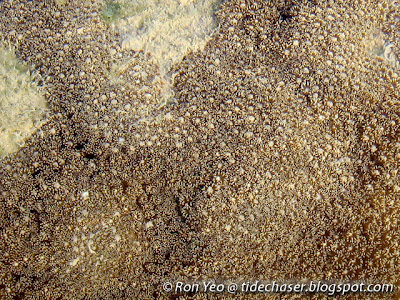
Palythoa tuberculosa, commonly called the Carpet Colonial Anemones or Sea Mat Zoanthids in the diving or aquarium trade, got its common names from the carpet-like appearance when the tentacles are extended. 

Palythoa tuberculosa, commonly called the Carpet Colonial Anemones or Sea Mat Zoanthids
When exposed during low tide, the polyps of this highly toxic zoanthid retract completely into the body tissue, giving the colony a lumpy, rubber-like appearance. The colony feels rough (remember not to touch with bare hands) as it incorporates the sediment to build the tissue mass. The polyps retract completely into the body tissue, and hence no protruding body columns will be seen.

Palythoa tuberculosa, commonly called the Carpet Colonial Anemones or Sea Mat Zoanthids
The colour of the colony can be light to dark brown, or yellow to orange.

Palythoa tuberculosa, commonly called the Carpet Colonial Anemones or Sea Mat Zoanthids
According to Dr Reimer, obvious radiating gill-like structures (septae) can be seen on the oral disc, but unfortunately my photos are not close-up enough to see that. The oral disc is about 6-16mm wide.

Palythoa mutuki, or the Mutuki Colonial Anemone
Palythoa mutuki, or the Mutuki Colonial Anemone, forms a network of fleshy branches (stolons) connecting the polyps instead of the massive encrusting body tissue seen in the previous species. The body columns of the polyps do not retract completely into the stolons, and can be seen obviously when they are exposed during low tide. The oral discs and the tentacles can retract completely into the body column though. The body also incorporates sand and other marine debris.

Palythoa mutuki, or the Mutuki Colonial Anemone
The colour of the body column ranges from pinkish brown to light brown. The oral disc may be bright to dark green, or sometimes, brownish.

Palythoa mutuki, or the Mutuki Colonial Anemone
The oral disc is rather broad - between 10-18mm wide, and obvious septae (gill-like radiating structures) can be seen. The tentacles taper to pointed tips.

Palythoa spp.
Dr Reimer reported in his paper that another species of Palythoa which has dark-brown oral disc with barely visible septae, which he tentatively named as Palythoa sp. "singapura". Interestingly, this zoanthid harbours the same type of zooxanthellae previously only found in Zoanthus species, but more specimens need to be studied before it can be confirmed to be a new species. I have seen a brown Palythoa sp. growing among some Palythoa mutuki which are dark brown with less obvious septae. Not sure if that could be the same as this unknown species?

On a separate note, one species of  Palythoa, Palythoa singaporensis, was discovered in and named after Singapore. It is still regarded as a valid species, but has not been seen in recent surveys.

Family Zoanthidae

Zoanthids from this family generally do not incorporate sand and marine debris into their body tissue, and the polyps do not retract completely. According to Dr Reimer's paper, two species have been found among Singapore's Southern Islands. It is possible that there are more species waiting to be uncovered, especially in the areas no surveyed.

Zoanthids (Zoanthus vietnamensis)
Zoanthus vietnamensis, or the Vietnamese Zoanthid, usually form mats over soft substrates, or occur as a thin encrusting layer over rocks. There are a few colour variations, and the ones with the pinkish tips are most easily recognised.

Zoanthids (Zoanthus vietnamensis)
So are the specimens with pink oral discs.

Zoanthids (Zoanthus vietnamensis)
Specimens of other colour variations can be hard to differentiate from other Zoanthus species. They generally have obvious septae on their oral discs though.

Zoanthids (Zoanthus vietnamensis)
The size of the oral disc can range from 4-14mm, according to Dr Reimer's paper. The oral disc can be green, but that can be confused with other Zoanthus species with similar colours.

Zoanthids (Zoanthus sansibaricus)
Zoanthus sansibaricus is the other Zoanthus species recorded during the 2009 survey. It tends to have smaller polyps, with the oral disc between 4-8mm, and the tentacles are relatively longer when fully extended. The oral disc can come in a variety of colours, including brown, red, orange, blue, green etc, but the septae is not obvious.

Zoanthids (Zoanthus sp.)
But I often wonder if there could be more variations or species, as the one above has somewhat obvious septae, relatively long tentacles, and small polyps. Could it be a variation of Zoanthus sansibaricus or another species altogether? Identifying Zoanthus species in the field is thus very difficult and rather confusing.

More studies definitely need to be done on the zoanthids of Singapore.


References
  • Burnett, W. J., J. A. H. Benzie, J. A. Beardmore, & J. S. Ryland. 1997. Zoanthids (Anthozoa, Hexacorallia) from the Great Barrier Reef and Torres Strait, Australia: systematics, evolution and a key to species. Coral Reefs 16(1): 55-68.
  • Erhardt, H. & D. Knop. 2005. Corals: Indo-Pacific Field Guide. IKAN-Unterwasserachiv, Frankfurt. 305 pp.
  • Fautin, D. G. 2011. Hexacorallians of the World. Retrieved Jan 8, 2013, from http://geoportal.kgs.ku.edu/hexacoral/anemone2/index.cfm
  • Forino, M. et al. 2010. Palytoxins: A still haunting Hawaiian curse. Phytochemistry Reviews 9 (4): 491–500.
  • Moore, R. E. & P. J. Scheuer. 1971. Palytoxin - New Marine Toxin from a Coelenterate. Science 172 (3982): 495–498.
  • Reimer, J.D. & P. A. Todd. 2009. Preliminary molecular examination of zooxanthellate zoanthids (Hexacorallia: Zoantharia) and associated zooxanthellae (Symbiodinium spp.) diversity in Singapore. Raffles Bulletin of Zoology Suppl. 22: 103-120.
  • Rhodes, L., R. Munday, L. Briggs. 2008. Ostreopsis siamensis and palytoxin-related compounds in New Zealand: a risk to human health? In: Moestrup, Ø. (Ed.), Proceedings of the 12th International Conference on Harmful Algae. ISSHA and Intergovernmental Oceanographic Commission of UNESCO. Copenhagen, Denmark. pp. 326–329
  • Ruppert, E.E. and R.D. Barnes. 1991. Invertebrate Zoology (International Edition). Saunders College Publishing. U.S.A. 1056 pp.
  • Palytoxin. Wikipedia. Retrieved Jan 9, 2013, from http://en.wikipedia.org/wiki/Palytoxin
  • World Register of Marine Species. 2012. Retrieved Jan 8, 2013, from http://www.marinespecies.org.

Saturday, January 05, 2013

Sea Anemones (Phylum Cnidaria: Order Actiniaria) of Singapore

Sea anemones (phylum Cnidaria, class Anthozoa, subclass Hexacorallia, order Actiniaria) are solitary animals with radially symmetrical bodies. They are named after a terrestrial flower, the anemone, due to their flower-like appearance. Like other cnidarians, they possess explosive, harpoon-like cells called cnidocytes. Each cnidocyte contains a secretory organelle (cnidae), which can be a nematocyst that discharges a harpoon-like stinger carrying toxins, a ptychocyst that discharges sticky substances, or a spirocyst that discharges lasso-like threads. Hence while cnidocytes are often called "stinging cells", they do perform other functions apart from stinging.


Sea anemones have a simple body comprising a stomach (coelenteron) and an oral disc with a mouth surrounded by tentacles (where most of the cnidocytes are located). The tentacles occur in multiples of six, and hence they are in the subclass Hexacorallia. They do not have an anus, and hence the mouth performs both functions of ingesting food and removing waste. A sea anemone has a cylindrical body column, and most species have a specialised foot called a pedal disc to attach themselves to hard surfaces or to anchor themselves into soft substrates.


Many are able retract their tentacles either partially or completely.


Sea anemones are carnivorous, as seen in the above unidentified sea anemone feeding on a segmented worm. They use their tentacles to sting and paralyse small animals, and move them to the mouth to be consumed. The mouth also excretes undigested matter. Most sea anemones are sessile and remain in the same location, unless there are changes in temperature, salinity, food sources or other conditions. They will then detach from the substrate to seek for a better location, either by drifting along with the current or swimming by flexing the body column. Some sea anemones can also detach quickly and swim away to escape predation.

Some sea anemones harbour the unicellular algae, zooxanthellae, which produce food through photosynthesis and share with the host sea anemones, and in return for shelter and nutrients (waste products of the sea anemones).


Sometimes, the sea anemones may expel their zooxanthellae or the latter may leave the coral due to environmental stress, resulting in a phenomenon known as bleaching. Without the zooxanthellae giving the sea anemones their base colour, they turn white and appear bleached. One of the main causes of bleaching is the rise in water temperatures. If the situation does not improve and the sea anemones cannot recruit new zooxanthellae to replace the lost ones, they may die.


Sea anemones occur on a variety of substrates. Sometimes, they may be attached to hard substrates such as rocks or dead corals.


Some species may be found on sandy substrates, with their body column buried in the sand.


Others may be found in muddy areas, such as in mangroves and mudflats.


Some sea anemones may attach themselves to other organisms. The small sea anemone above usually attaches itself to seaweed and seagrass.


Some sea anemones attach themselves to snails, such as the dog whelk above. Being a scavenger, the whelk will bring the sea anemone with it to the dead animal, and the sea anemone will benefit from the tiny bits and pieces of meat drifting around. Others are known to attach to shells with hermit crabs.

I have seen many species of sea anemones in Singapore, but unfortunately, most of them, have not been identified. Apart from the ones with easy-to-recognise physical characteristics which I got the identity from reference books, many of the sea anemones below were identified with help from Dr Daphne G. Fautin when she visited the Raffles Museum of Biodiversity Research, though some were also identified by Dr Tan Swee Hee when we use the photos for our publications. Thanks both!

Family Boloceroididae


Swimming Anemones (Boloceroides mcmurrichi) are very commonly seen on our shores, though at times they can be more abundant. They are often seen stuck to seagrass or seaweed, or swimming around by pulsation and lashing their tentacles. They are able to cast off tentacles by autotomy when disturbed, and the individual tentacle can regenerate the other body parts and grow to become a whole sea anemone. The animal is usually brownish in colour, sometimes with darker patches or bands on the tentacles. The mouth is on a short, protruding, cylindrical structure. The body column is short, whitish and translucent. They harbour zooxanthellae.

Family Phymantidae


Sunburst Sea Anemones (Phymanthus pinnulatus) are very commonly seen on Singapore's reef flats, especially in tidal pools. They are usually attached to hard substrates, such as rocks or coral rubble. The body column has numerous spots of a lighter colour, and the tentacles can range from unbranched to branched. Genetic works in recent years suggest that despite the variety of colours and tentacle-types, most of the Phymanthus Anemones in Singapore are of the same species, Phymanthus pinnulatus. They have zooxanthellae, and bleached ones are sometimes seen. They can grow to about 20cm wide, including the tentacles.

Family Thalassianthidae


Adhesive Anemones (Cryptodendrum adhaesivum) have a broad oral disc that is irregularly folded. They have two types of tentacles - short branching ones and small rounded ones, both just a few millimetres long. There is a row of branching tentacles at the margin, followed by a broad band of rounded tentacles, while the inner part of the oral disc is densely covered with short branching tentacles. The tentacles are extremely sticky, and hence the common name. The two types of tentacles may come in different colours. The body column may be brightly coloured, such as purple, orange, yellow or pink. They harbour symbiotic algae (zooxanthellae), and I have seen bleached ones before. They grow to about 30cm across in local waters. They are usually found near or in coral reefs, attached to hard substrates.

Family Stichodactylidae


Miniature Carpet Anemones (Stichodactyla tapetum) are much smaller than the other carpet anemones found in Singapore, reaching widths of about 10cm. The oral disc is flat (not undulating) with short and bulb-like tentacles that are radially arranged in rows, especially in the middle of the oral disc, appearing like spokes of a wheel with spaces in between the "spokes". Miniature Carpet Anemones host zooxanthellae. They usually occur on sandy or slight muddy substrates, often among seagrass.


Haddon's Carpet Anemones (Stichodactyla haddoni) grow to much larger sizes - the largest I have personally seen in local waters is about 60cm across. They have short tentacles with rounded tips, and hence the smaller individuals may be mistaken for the previous species. Haddon's Carpet Anemones lack the radially arranged tentacles in the middle of the oral disc though, and two types of tentacles can be found at the margin - short bulb-like ones and longer ones with rounded tips, though they can be hard to see sometimes for specimens which have contracted. In rare cases, stripes of a lighter colour can be seen towards the edge of the oral disc (as in the main picture above). The tentacles are sticky. The upper part of the body column has small, non-adhesive bumps (verrucae), usually of the same colour as the body column or of some light colours. They host zooxanthellae, and usually occur on sandy or muddy substrate, often among seagrass.


Merten's Carpet Anemones (Stichodactyla mertensii) are rather uncommon in Singapore, and can grow to huge sizes of more than 1m wide. They have rows of bright red, purple or orange verrucae (bump-like structures) on the upper body column, and while there are no verrucae on the lower part, the brightly-coloured botches continue all the way down. The tentacles can be club-shaped to finger-like, and are not sticky. They may be all short (shorter than 2cm), or there may be a few patches of very long ones (5cm or more). Merten's Carpet Anemones harbour zooxanthellae, and in Singapore, host the Ocellaris Clownfish (Amphiprion ocellaris). They are usually attached to hard substrates, either near or among coral reefs.


Gigantic Carpet Anemones (Stichodactyla gigantea) appear very similar to the above species, but a lot more commonly seen. They may or may not have brightly-coloured verrucae on their body columns, but if they do, the coloured blotches diminish towards the lower part. The oral disc is deeply folded, covered with short (about 1cm), extremely sticky tentacles that are usually moving constantly. The middle of the oral disc around the mouth is usually rather bare. The Gigantic Carpet Anemones I have seen in Singapore do not exceed 50cm in width. They harbour zooxanthellae, and in Singapore, host the Ocellaris Clownfish (Amphiprion ocellaris). They are usually attached to hard structures that may be exposed or buried in the sand. They occur on reef flats or coral reefs, though sometimes they have been seen on rocky areas near mangrove as well.


Magnificent Anemones (Radianthus magnifica) can usually be recognised by the uniform colours of their body column, which may be purple, blue, red, white or brown. There are rows of translucent verrucae, either of the same colour as the body column, or slightly lighter or darker. The oral disc can get to 1m wide, and is usually flat or slightly folded. The dense tentacles are long (to 7.5cm) finger-like, with a blunt or slightly swollen tip. They may irritate human skin and cause swellings. The tentacles can almost contract completely into the body column, such that only a few tentacles can be seen. Sometimes, several to many individuals of the same colour can be seen occuring in clusters, and it is believed that they can reproduce by cloning themselves asexually. Magnificent Anemones harbour zooxanthellae, and in Singapore, host the Ocellaris Clownfish (Amphiprion ocellaris). They are usually attached to hard substrates, and found near or in coral reefs.


Leathery Sea Anemones (Radianthus crispa) are uncommonly seen in Singapore. The oral disc may have big folds, and reaches widths of about 50cm. It is densely covered with extremely numerous long tentacles long (to 10cm), evenly tapered to purple or blue tips. The body column is usually grey or whitish, have a leathery feel with prominent adhesive verrucae, often stuck with small rocks or coral fragments. Leathery Sea Anemones also harbour zooxanthellae. They are usually attached to hard substrates that are either exposed or buried in the sediment, and found near or in coral reefs.


Corkscrew Tentacle Anemones (Radianthus doreensis) have long tentacles (to 17cm) that evenly taper to a point. Some to many of the tentacles may twist and turn, appearing corkscrew-like. The oral disc can get to about 50cm wide, with the margin densely lined with tentacles, but the inner part sparsely covered - it is easy to find big, bare spaces between the tentacles. There may be white or lighter-coloured radial lines on the oral disc, in some cases extending onto the tentacles. The upper part of the body column has lots of prominent, non-adhesive verrucae. Corkscrew Tentacle Anemones can retract completely into the sediment, and harbour zooxanthellae. They usually occur on sandy or muddy substrates.

Family Actiniidae


Bulb-tentacled Anemones (Entacmaea quadricolor) have long (to 10cm) brown tentacles, with or without bulb-like tips. Observations suggest that the bulb may be related to the presence of fish, and tentacles without a bulb may have a white ring near the blunt-ended tips. Bulb-tentacled Anemones are often found attached deeply in holes, and only the long tentacles can be seen. The body column is usually brown or whitish (rarely reddish or greenish), and lacks verrucae. They harbour zooxanthellae, and host the Tomato Clownfish (Amphiprion frenatus). They can be found in coral reefs, or sometimes on sea walls.


Goa Sea Anemones (Bunodosoma goanense) are usually dark red or maroon in colour, reaching widths of about 10cm. The tentacles taper to sharp tips, and the body column is covered with small verrucae. They are usually attached to hard structures.


This Dofleinia armata can be recognised by the transparent body covered with tiny white dots. The tentacles are longer than the diameter of the oral disc (about 5-8cm wide), and there is a black ring at the base of the tentacles. Similar species from Australia are known to give painful stings that take months to heal, though we are not sure about the ones in Singapore (doubt anyone will want to test that). They are usually found on sandy to muddy substrates.


Paracondylactis sinensis is usually found on sandy or muddy substrates. The body is somewhat translucent, and is either brownish or slight orange in colour. The margin of the oral disc is lined with tapering tentacles, but the inner part is sparsely covered. The oral disc can grow to over 7cm wide. They can be mistaken to be the Swimming Anemone, but unlike the latter, they have a long body column buried in the sand.


Banded Bead Anemones (Anthopleura spp.) are commonly found on high shores, usually attached to rocks, often in rock pools or in cracks and crevices. When they are exposed during low tide, the tentacles retract and they appear like black, jelly-like beads a few cm wide. When they are submerged, the banded tentacles extend. Several species occur in Singapore, and they can be quite hard to identify in the field.

Family Aiptasiidae


Whelk Anemones ( Paraiptasia radiata) are small sea anemones, usually found growing on small snails living on muddy or sandy substrates. The oral disc is about 1cm wide. The body column is marked with very prominent vertical white stripes (if the stripes are not prominent, it could be a different, yet to be identified species). When the tentacles retract, the streaks exhibit a radiating pattern from the mouth of the animal.

Family Hormathiidae


Hermit Crab Anemones (Calliactis spp.) are often found attached on hermit crabs, such as the Pale Anemone Hermit Crab (Dardanus deformis). Research suggests that the hermit crab attaches the sea anemones on the shell for protection, as the stinging tentacles of the sea anemone deter predators from feeding on the hermit crabs. Meanwhile, the sea anemone gets to feed on the leftover scraps of food from the hermit crab.

Family Diadumenidae


Lineated Anemones (Diadumene lineata) are easily recognised by their obvious patterns of white, yellow, orange or even red lines on the greenish body column. They are commonly found attached to various hard structures along the seashore, such as jetties, pillars, rocks and ships, especially in empty oyster and barnacle shells. At present, this species is known to be the most widespread sea anemone in the world. It can reproduce asexually by splitting.

Family Actinodendronidae


Hell's Fire Anemones (Actinodendron aboreum) have bushy, branching tentacles, and are often found on sandy substrates. The oral disc can get to about 30cm wide, and there are often several pairs of white stripes radiate from the mouth to the edge of the oral disc. The body column is smooth with many small dark splotches. Hell's Fire Anemones can give very painful stings, and hence the common name. When disturbed, they will retract quickly into the sand. They harbour zooxanthellae. Some smaller specimens may be mistaken for Phymanthus Anemones, but while the latter may have branched tentacles, they lack the thick "stalks" (lower part of the tentacles) and bushy appearance.


Haeckel's Sea Anemones (Actinostephanus haeckeli) usually have tapering tentacles of uneven lengths, with the longest a few times longer than the width of the oral disc. The tentacles are covered with numerous small bumps. The black variety is more commonly seen in local waters, while the green ones are only occasionally seen. Like the previous species, they give very painful stings. The oral disc can get to about 10cm wide. They are usually found on sandy or muddy substrates. They are mostly active when it gets dark, and retract into the sand in the day.

Family Aliciidae


Stinging Wandering Anemones (Alicia spp.) are seldom encountered on our shores. They occur over a variety of substrates, ranging from sandy or muddy soft bottoms, to hard coral rubble and coral reef. In the day, the tentacles are retracted and they appear like a lump with irregular bumps (tubercles). As night falls, they extend their long and numerous tentacles, stretch the body to reveal a whitish column with clumps of tubercles, and start sliding over the substrate in search of small prey like a dancing lady in a long dress. It gives very painful stings when touched, not only the tentacles, but the body column as well. The column can stretch up to over 15cm tall.

Family Edwardsiidae


Edwardsiid anemones (Family Edwardsiidae) are commonly seen on our shores, but unfortunately I do not have friends who can identify them as yet. They are generally small, with the oral disc about 1cm and the tentacles a few cm long. The tentacles taper to a sharp point, and may be marked with stripes and/or blotches of other colours. They are usually found on sandy substrates, ranging from reef flats to higher shores. They can be greenish, bluish, reddish or brownish in colour. They retract very quickly into the sand when disturbed.

Family Haloclavidae


Striped Peachia Anemones (Metapeachia tropica) are usually found on sandy substrates, sometimes on relatively high shores compared with other sea anemones. They have a whitish body column, and sometimes the entire animal may be out of the sand (can be mistaken for a sea cucumber). The few tentacles are translucent and banded, with some V-shaped patterns nearer to the mouth. The oral disc is about 2-3cm wide, and the tentacles about 2-3cm long.


References
  • Chou, L. M. 1998. A Guide to the Coral Reef Life of Singapore. Singapore Science Centre. 128 pp.
  • Erhardt, H. and D. Knop. 2005. Corals: Indo-Pacific Field Guide. IKAN-Unterwasserachiv, Frankfurt. 305 pp. 
  • ETI BioInformatics. 2012. Marine Species Identification Portal. Retrieved Jan 3, 2013, from http://species-identification.org. 
  • Fautin, D. G. 2011. Hexacorallians of the World. Retrieved Jan 3, 2013, from http://geoportal.kgs.ku.edu/hexacoral/anemone2/index.cfm 
  • Fautin, D. G. and G. R. Allen. 1992. Field guide to anemone fishes and their host sea anemones. Western Australian Museum. Retrieved Jan 3, 2013, from http://www.nhm.ku.edu/inverts/ebooks/intro.html. 
  • Fautin, D. G., S. H. Tan and R. Tan. 2009. Sea anemones (Cnidaria: Actiniaria) of Singapore: abundant and well-known shallow-water species. Raffles Bulletin of Zoology Supplement No. 22: 121-143. 
  • Josephson, R. K. and S. C. March. 1966. The Swimming performance of the sea-anemone Boloceroides. Journal of Experimental Biology, 44: 493-506.
  • Ruppert, E.E. and R.D. Barnes. 1991. Invertebrate Zoology (International Edition). Saunders College Publishing. U.S.A. 1056 pp.
  • Tan, L. W. H. and P. K. L. Ng. 1988. A Guide to Seashore Life. The Singapore Science Centre. Singapore. 160 pp.
  • World Register of Marine Species. 2012. Retrieved Jan 3, 2013, from http://www.marinespecies.org.