
Velvet worms (phylum Onychophora, sometimes known as Protracheata) are segmented, centipede-like organisms with numerous pairs of legs.
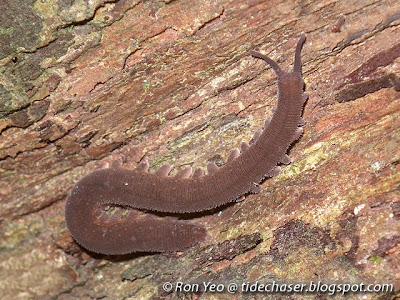
Depending on the species, they may have between 13-43 pairs of walking legs. For some, the number of legs may even vary between members of the same species. Each leg has a pair of claws, and hence the name Onychophora, which means "claw-bearers" in Greek ("onychos" means "claw", while "phoros" means "bearer").
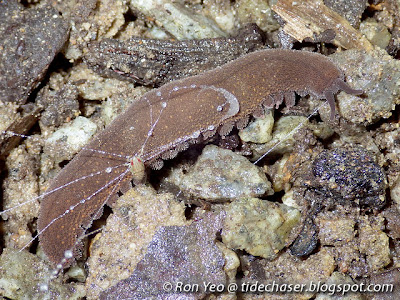
They mostly hunt at night, feeding on small invertebrates such as insects, spiders, centipedes and snails which they ambush and capture with a glue-like slime. The slime is expelled via a pair of modified limbs or finger-like structures (papillae), one on each side of the head. The slime is also used to confuse predators.
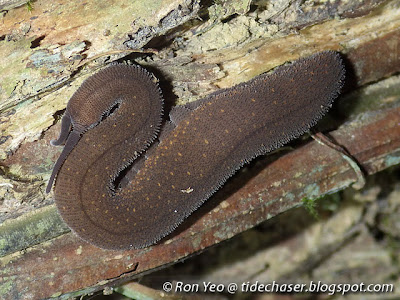
The brains of velvet worms are surprisingly complex despite the small size, and they are able to perform complex social interactions - some species live and hunt together in small closely-related groups dominated by one female. They usually live in dark and moist habitats, such as the forest leaf litter, in the soil or in rotten logs.

Most species have a pair of simple, tiny eyes (some may lack eyes) located behind a pair of antennae, unlike arthropods which is the opposite. Also, they lack a rigid exoskeleton. Instead, the body cavity is filled with a fluid to make the animal firm.
Depending on the species, velvet worms may lay eggs (oviparous), bear live young (viviparous), or bear live young from eggs brood within the body (ovoviviparous).

According to the Singapore Red Data Book, the species Eoperipatus sumatranus is found in Singapore. Most of the species collected were seen during heavy rain. However, I am not sure if the one I have seen in our forest are of the same species, as an introduced species was recorded from the Singapore Botanic Gardens.
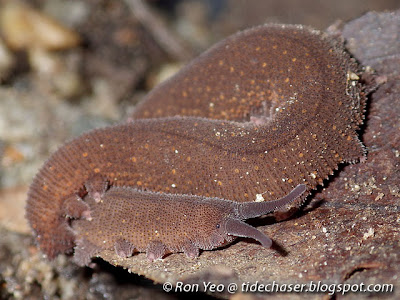
Recent studies have also regarded Eoperipatus sumatranus as a nomen dubium (doubtful species) since neither the holotype nor the type locality is known, which makes a revision difficult. Hence, more studies on our local species need to be done to revise the species.
References

Depending on the species, they may have between 13-43 pairs of walking legs. For some, the number of legs may even vary between members of the same species. Each leg has a pair of claws, and hence the name Onychophora, which means "claw-bearers" in Greek ("onychos" means "claw", while "phoros" means "bearer").

They mostly hunt at night, feeding on small invertebrates such as insects, spiders, centipedes and snails which they ambush and capture with a glue-like slime. The slime is expelled via a pair of modified limbs or finger-like structures (papillae), one on each side of the head. The slime is also used to confuse predators.

The brains of velvet worms are surprisingly complex despite the small size, and they are able to perform complex social interactions - some species live and hunt together in small closely-related groups dominated by one female. They usually live in dark and moist habitats, such as the forest leaf litter, in the soil or in rotten logs.

Most species have a pair of simple, tiny eyes (some may lack eyes) located behind a pair of antennae, unlike arthropods which is the opposite. Also, they lack a rigid exoskeleton. Instead, the body cavity is filled with a fluid to make the animal firm.
Depending on the species, velvet worms may lay eggs (oviparous), bear live young (viviparous), or bear live young from eggs brood within the body (ovoviviparous).

According to the Singapore Red Data Book, the species Eoperipatus sumatranus is found in Singapore. Most of the species collected were seen during heavy rain. However, I am not sure if the one I have seen in our forest are of the same species, as an introduced species was recorded from the Singapore Botanic Gardens.

Recent studies have also regarded Eoperipatus sumatranus as a nomen dubium (doubtful species) since neither the holotype nor the type locality is known, which makes a revision difficult. Hence, more studies on our local species need to be done to revise the species.
References
- Davison, G.W.H., P.K.L. Ng & H.C. Ho, (eds.), 2008. The Singapore Red Data Book: Threatened Plants and Animals of Singapore. Second edition. Nature Society (Singapore).
- Mayer, G. 2006. Onychophora Website. Retrieved Feb 4, 2013, from http://www.onychophora.com.
- Monge-Najera, J. 1995. Phylogeny, Biogeography and Reproductive Trends in the Onychophora. Zoological Journal of the Linnean Society 114 (1): 21–60.
- Oliveira, I. S., V. M. S. J. Read, & G. Mayer. 2012. A world checklist of Onychophora (velvet worms), with notes on nomenclature and status of names. ZooKeys, 211, 1–70.
- Ruppert, E.E. and R.D. Barnes. 1991. Invertebrate Zoology (International Edition). Saunders College Publishing. U.S.A. 1056 pp.
- Van der Lande, Virginia, and L. B. Holthuis. 1986. The type locality of Eoperipatus sumatranus (Sedgwick, 1888), with geographical notes on its collector W. J. E. Hekmeijer. Zoologische Bijdragen, no. 33. 1-22.
- Vanderlande, V. M. 1991. Native and introduced Onychophora in Singapore. Zoological Journal of the Linnean Society 102:101-114.
- Yeo, D. C. J & C. S. W Chia. 2010. Introduced species in Singapore: an overview. Cosmos 6(1): 23-37


