
The acoels, or acoel worms (phylum Xenacoelomorpha), are flat, bilaterally symmetric, soft-bodied unsegmented worms typically found in the marine environment.
They do not have a gut cavity, and hence the name "acoel", which means "no cavity" in Latin. Depending on the species, the mouth can be anywhere on the body, though for most species it is located in the middle of the underside. The ingested food is encompassed and digested by special digestive tissues. Some acoels feed on algae and detritus (i.e. tiny decaying organic particles), while others form symbiotic relationships with cnidarians and feed on any tiny organic matter trapped in the mucus produced by the latter, or harbour symbiotic algae which are able to photosynthesise and share food with the host acoels.
Acoels do not have excretory organs, and waste is usually excreted by some of the cells.
As they are mostly very flat, they were previously classified as flatworms (phylum Platyhelminthes). Studies have shown that they are more primitive than flatworms though, and can be distinguished from the latter by having a distinctive balance sensory receptor (or statocyst) at the front end. This statocyst is made up of a large cell bearing one calcareous body (or statolith) within a capsule formed by two cells. Sometimes, those that have been reproduced asexually may not have the statocyst though.
Despite the fact that they are very simple animals, acoels possess a very simple brain which may be shaped like a ring, a barrel or a two-lobed structure.
Acoels can reproduce sexually or asexually. They are simultaneous hermaphrodites (with both male and female reproductive parts), and in sexual reproduction, some may exchange sperms, while in other cases one may perform the role of a male while another the female. Some species have a specific opening for the female reproductive part, and for these species, the male reproductive part tends to be soft and muscular to be inserted into the female opening for sperm transffer. Other species may have female reproductive parts scattered around the body, and possess needle-like male reproductive parts to penetrate the skin of another acoel to inject the sperm. The fertilised eggs will then be laid. In asexual reproduction, they may split into two, or grow a new acoel from the body (this process is known as budding), which eventually detaches and develops into a separate animal.
Like many other simple animals, acoels are able to regenerate lost body parts.

The only acoel I have personally seen in Singapore are those that infest cnidarians. They are tentatively identified as Waminoa Acoels (Waminoa sp.). They are typically less than 0.5cm long.

Waminoa Acoels are known to harbour symbiotic algae which photosynthesise and contribute to the host acoel's nutritional needs. Their brownish coloration is probably due to the colour of the symbiotic algae. It is suggested that Waminoa Acoels feed on the organic particles trapped in the mucus produced by the host cnidarian to supplement their nutritional needs as well.
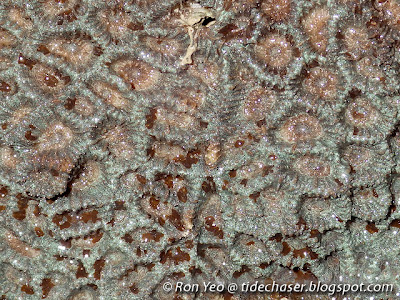
The Waminoa Acoels have been observed to infest many hard coral species, such as the favid coral (family Faviidae, probably Goniastrea spp.) above.
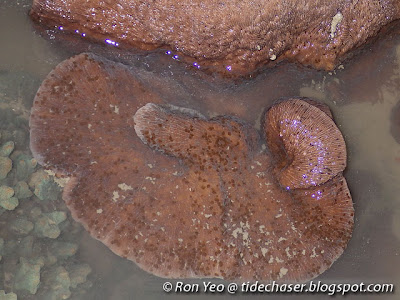
They also infest mushroom corals (family Fungiidae), such as the Podabacia sp. above.

While the acoels may not feed on the corals directly, it has been observed that some corals infested by them appear less healthy, such as the Sunflower Mushroom Coral (Heliofungia actiniformis) featured above. This coral appears sickly compared to the time when it was not yet infested.

Acoel worms have been observed to infest corallimorphs (order Corallimorpharia) as well.
References
They do not have a gut cavity, and hence the name "acoel", which means "no cavity" in Latin. Depending on the species, the mouth can be anywhere on the body, though for most species it is located in the middle of the underside. The ingested food is encompassed and digested by special digestive tissues. Some acoels feed on algae and detritus (i.e. tiny decaying organic particles), while others form symbiotic relationships with cnidarians and feed on any tiny organic matter trapped in the mucus produced by the latter, or harbour symbiotic algae which are able to photosynthesise and share food with the host acoels.
Acoels do not have excretory organs, and waste is usually excreted by some of the cells.
As they are mostly very flat, they were previously classified as flatworms (phylum Platyhelminthes). Studies have shown that they are more primitive than flatworms though, and can be distinguished from the latter by having a distinctive balance sensory receptor (or statocyst) at the front end. This statocyst is made up of a large cell bearing one calcareous body (or statolith) within a capsule formed by two cells. Sometimes, those that have been reproduced asexually may not have the statocyst though.
Despite the fact that they are very simple animals, acoels possess a very simple brain which may be shaped like a ring, a barrel or a two-lobed structure.
Acoels can reproduce sexually or asexually. They are simultaneous hermaphrodites (with both male and female reproductive parts), and in sexual reproduction, some may exchange sperms, while in other cases one may perform the role of a male while another the female. Some species have a specific opening for the female reproductive part, and for these species, the male reproductive part tends to be soft and muscular to be inserted into the female opening for sperm transffer. Other species may have female reproductive parts scattered around the body, and possess needle-like male reproductive parts to penetrate the skin of another acoel to inject the sperm. The fertilised eggs will then be laid. In asexual reproduction, they may split into two, or grow a new acoel from the body (this process is known as budding), which eventually detaches and develops into a separate animal.
Like many other simple animals, acoels are able to regenerate lost body parts.

The only acoel I have personally seen in Singapore are those that infest cnidarians. They are tentatively identified as Waminoa Acoels (Waminoa sp.). They are typically less than 0.5cm long.

Waminoa Acoels are known to harbour symbiotic algae which photosynthesise and contribute to the host acoel's nutritional needs. Their brownish coloration is probably due to the colour of the symbiotic algae. It is suggested that Waminoa Acoels feed on the organic particles trapped in the mucus produced by the host cnidarian to supplement their nutritional needs as well.

The Waminoa Acoels have been observed to infest many hard coral species, such as the favid coral (family Faviidae, probably Goniastrea spp.) above.

They also infest mushroom corals (family Fungiidae), such as the Podabacia sp. above.

While the acoels may not feed on the corals directly, it has been observed that some corals infested by them appear less healthy, such as the Sunflower Mushroom Coral (Heliofungia actiniformis) featured above. This coral appears sickly compared to the time when it was not yet infested.

Acoel worms have been observed to infest corallimorphs (order Corallimorpharia) as well.
References
- Achatz, J.G., M. Chiodin, W. Salvenmoser, S. Tyler & P. Martinez. 2012. The Acoela: on their kind and kinships, especially with nemertodermatids and xenoturbellids (Bilateria incertae sedis). Organisms Diversity & Evolution.
- Burnie, D. 2001. Animal. London: Dorling Kindersley. 624 pp.
- Hikosaka-Katayama T, Koike K, Yamashita H, Hikosaka A, Koike K. (2012) Mechanisms of Maternal Inheritance of Dinoflagellate Symbionts in the Acoelomorph Worm Waminoa litus. Zool. Sci. 29:559-567.
- Mwinyi, A., X. Bailly, S J. Bourlat, U. Jondelius, D. T. J. Littlewood & L. Podsiadlowski. 2010. The phylogenetic position of Acoela as revealed by the complete mitochondrial genome of Symsagittifera roscoffensis. BMC Evolutionary Biology 10: 309.
- Ng, P. K .L., R.T. Corlett & H.T.W. Tan (eds.). 2011. Singapore Biodiversity: An Encyclopedia of the Natural Environment and Sustainable Development. Singapore: Editions Didier Millet. 552 pp.
- Philippe, H., H. Brinkmann, R. R. Copley, L. L. Moroz, H. Nakano, A. Poustka, A. Wallberg, K. J. Peterson & M. J. Telford. 2011. Acoelomorph flatworms are deuterostomes related to Xenoturbella. Nature, 470, 255–260.
- Ruppert, E.E. and R.D. Barnes. 1991. Invertebrate Zoology (International Edition). Saunders College Publishing. U.S.A. 1056 pp.


