
Flatworms (Phylum Platyhelminthes) are unsegmented worms with soft and bilaterally symmetrical bodies. They are generally rather flat, and hence the common name "flatworm". The name "Platyhelminthes" originated from the Greek words "platy" (meaning "flat") while "helmins" (meaning "worm").

The flat body allows internal transportation of oxygen and nutrients by diffusion, since most of them do not have a body cavity, circulatory organ and respiratory organ (except for some larger species). They still possess a simple brain though at their front end, and lateral nerve chords. Hence, some scientists are studying their simple brains, so as to understand our more complex brains better.
Flatworms have an incomplete digestive system, and the mouth is used for both ingestion and excretion. Most of them are hermaphrodites, meaning that each flatworm possesses both male and female reproductive organs. When they mate, one flatworm may play the male's role, while the other the female's role, though in some cases they may fertilise each other.

Flatworms also have an amazing ability to regenerate loss body parts. It is not uncommon to see those with part of their flat body bitten off by predators and still surviving well. Many species hence can also reproduce asexually by fission – splitting into two and regenerating the missing parts. Many flatworms are parasites of other animals, either infesting them internally or attached to them externally. Examples of parasitic flatworms include tapeworms, flukes and monogeneans. But apart from them, there are many free-living species too, and these beautiful worms can be seen sometimes in our forests and seashores.
Singapore has several species of terrestrial flatworms that are mostly found in damp areas, as most of them are unable to retain water in their body. These terrestrial flatworms are voracious predators of earthworms, possessing a reversible muscular structure called a pharynx, which they use to grab their prey. They will then secrete enzymes to digest the prey externally, before eating the processed meal. Like other flatworms, terrestrial flatworms can reproduce sexually or asexually. Scientifically, the terrestrial flatworms found in Singapore are from the class Turbellaria and order Tricladida. These are some of the terrestrial flatworms that I have seen:
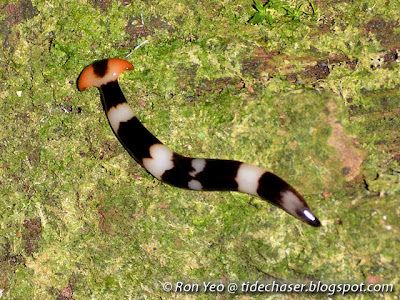
This Diversibipalium sp. is often seen in our forests or even scrublands.

This is also a Diversibipalium sp. It has an orange head, somewhat like the previous species, but has a black line running on its back. The body is relatively longer compared to the head also.
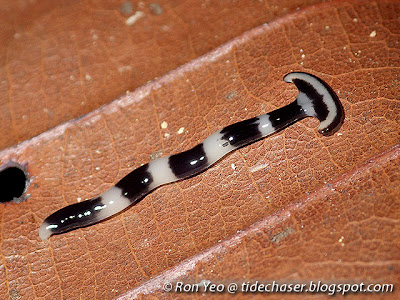
This Diversibipalium sp. has black and white bands on its body, but lacks the orange coloration found in the previous species on its head.

This Diversibipalium sp. has a few cream-coloured patches on its body.
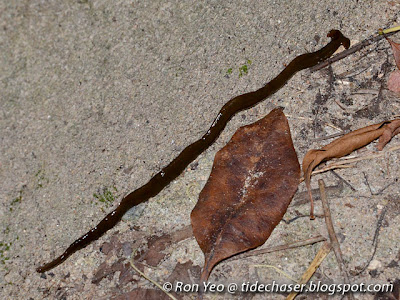
This Diversibipalium sp. is all brown in colour.

This non-native species, commonly called the New Guinea Flatworm (Platydemus manokwari) was probably introduced with imported plants. It is found in secondary forests and shrublands. The body is black, with a brown line running down its back.

The flat body allows internal transportation of oxygen and nutrients by diffusion, since most of them do not have a body cavity, circulatory organ and respiratory organ (except for some larger species). They still possess a simple brain though at their front end, and lateral nerve chords. Hence, some scientists are studying their simple brains, so as to understand our more complex brains better.
Flatworms have an incomplete digestive system, and the mouth is used for both ingestion and excretion. Most of them are hermaphrodites, meaning that each flatworm possesses both male and female reproductive organs. When they mate, one flatworm may play the male's role, while the other the female's role, though in some cases they may fertilise each other.

Flatworms also have an amazing ability to regenerate loss body parts. It is not uncommon to see those with part of their flat body bitten off by predators and still surviving well. Many species hence can also reproduce asexually by fission – splitting into two and regenerating the missing parts. Many flatworms are parasites of other animals, either infesting them internally or attached to them externally. Examples of parasitic flatworms include tapeworms, flukes and monogeneans. But apart from them, there are many free-living species too, and these beautiful worms can be seen sometimes in our forests and seashores.
Singapore has several species of terrestrial flatworms that are mostly found in damp areas, as most of them are unable to retain water in their body. These terrestrial flatworms are voracious predators of earthworms, possessing a reversible muscular structure called a pharynx, which they use to grab their prey. They will then secrete enzymes to digest the prey externally, before eating the processed meal. Like other flatworms, terrestrial flatworms can reproduce sexually or asexually. Scientifically, the terrestrial flatworms found in Singapore are from the class Turbellaria and order Tricladida. These are some of the terrestrial flatworms that I have seen:

This Diversibipalium sp. is often seen in our forests or even scrublands.

This is also a Diversibipalium sp. It has an orange head, somewhat like the previous species, but has a black line running on its back. The body is relatively longer compared to the head also.

This Diversibipalium sp. has black and white bands on its body, but lacks the orange coloration found in the previous species on its head.

This Diversibipalium sp. has a few cream-coloured patches on its body.

This Diversibipalium sp. is all brown in colour.

This non-native species, commonly called the New Guinea Flatworm (Platydemus manokwari) was probably introduced with imported plants. It is found in secondary forests and shrublands. The body is black, with a brown line running down its back.

This is an unknown species of terrestrial flatworm that is sometimes seen on trees.

This yellowish species with stripes, commonly called the Three-striped Land Flatworm (Anisorhynchodemus varians) can be found both on the ground and on the leaves of low shrubs. It has a pair of small eyes.

This one is seen constricting a small insect.

This brownish one was found on moist ground. It is the about the same size as the previous one.

It has a pair of eyes too. The eyes are believed to be very simple - able to detect light and darkness but probably cannot form clear images.
Free-living flatworms are also found in the marine environment. They are also called "polyclads", which means "any branches", referring to the highly branched guts radiating from their mouths. Scientifically, marine flatworms are placed in the class Turbellaria, and order Polycladida. As marine flatworms are usually very flat, they are very fragile and get torn easily. But been flat also allows them to slide into narrow cracks and crevices to seek prey and escape predation. Like other flatworms, they are mostly carnivorous, and usually feed on sessile organisms such as tunicates and bryozoans. Some may feed on motile organisms too, such as some worms and crustaceans, while others may scavenge. Only a few are herbivorous, feeding on algae. The mouth is on the underside, and may be located near the front end, in the middle or even near the rear end, depending on the species. Like the terrestrial flatworms, they have a pharynx for feeding.

Many bigger polyclads can swim by flapping the sides of their bodies.

Others can glide upside-down on the surface of the water.
Marine flatworms have brilliant colours to advertise their toxicity to predators. Studies have shown that many species contain powerful nerve toxins in their tissues, making them poisonous to most animals.
Like other flatworms, they are hermaphrodites, and some polyclads indulge in what is termed 'penis fencing'. Each flatworm extends its male reproductive organ to attempt fertilising the other party while avoiding getting itself fertilised by the latter, as egg production consumes more energy and resources. This results in a fierce fight between the two flatworms, and the "winner" just need to pierce the "loser's" skin with its penis, and the sperm will be absorbed through pores of the other party.
As the flatworms in Singapore are generally not well-studied, the identities are usually derived by comparing with identification guides and hence are rather tentative. Many of them, are in fact, not even tentatively identified. Some of the marine flatworms which I have seen and photographed include:

This flatworm is sometimes found sliding over the rocks on rocky shores during low tide. It is likely that it hides in trapped pockets of air among cracks and crevices during high tide, or even in crevices above the high tide line, since it does not appear to like water. I still could not determine what species it is from the guide books and online resources though.

This Mangrove Flatworm (Limnostylochus sp.) appears to be seasonally abundant, as there are times when literally hundreds of them can be seen, while at other times, none can be seen at all. They usually occur in mangroves, especially nearer to the back mangroves in brackish water. It is usually dark red with a thin orange line on its back.

This unknown flatworm is also found in the mangroves. It is pink in colour, and lacks the thin line found on the back of the previous species.

The Acanthozoon Flatworm (Acanthozoon sp.) is one of the most commonly seen flatworm in Singapore. It can grow to more than 10cm long, and is certainly one of the biggest flatworms found here. Despite being a commonly seen species in the region, it has not been described scientifically and hence still does not have a species name. This flatworm has numerous small yellow spots and a few bigger white spots on a black background with a narrow white margin.

The Thysanozoon Flatworm (Thysanozoon sp.) is usually found in deeper waters, and hence are seldom encountered in the intertidal zones. They are sometimes seen while diving in local waters. Like the previous flatworm, it has numerous yellow spots on a black background with white borders, but the yellow spots are bigger and it does not have the bigger white spots.

The Red-lined Flatworm (Maritigrella virgulata) has an orange to red line running down the middle of its back and numerous black stripes running perpendicular to the edge of its body. The black stripes are bordered by grey outlines and are of unequal lengths. This species is usually found on coral reefs.

The Darkspotted Flatworm (Maritigrella fuscapunctata) also has numerous black blurry lines on the sides, but lacks the red line found on the back of the previous species. The numerous black lines are formed by dark spots along the edge of its body. Its back is cream-coloured, with white, net-like patterns. Its species name, "fuscopunctata", means "dark-spotted". This species mostly inhabits coral reefs.

Phrikoceros baibaiye is red or bright orange in colour, dotted with numerous tiny white spots. There is a short white line, formed by tiny white dots, near its front end. This species can be found in seagrass meadows and on coral reefs.

The Orsak's Flatworm (Maiazoon orsaki) is sometimes seen in the intertidal area on Singapore's southern islands on coral reefs and coral rubble flats. Its body is light brown or orange, with a black outer margin and an orange inner margin. There is a white line bordered by a brownish-orange smudge running down the middle of its back.

A rather similar-looking species is the Bayer’s Flatworm (Nymphozoon bayeri), which usually flatworm is grey or brownish-grey, with a black stripe bordered by a thin white margin running along the middle of its back. The edge of its body has a black outer marginal stripe and a white inner stripe running alongside it. This species has been seen in seagrass meadows and on coral reefs.

The Bedford's Flatworm (Pseudobiceros bedfordi) is a very pretty flatworm that is sometimes seen in local seagrass meadows and on coral reefs. It has orange or pink and black bands forming complex branching patterns on its back. The black patterns are covered in tiny white spots. This species is also called the Persian carpet flatworm, due to the intricate patterns on its body.

The Stella’s Flatworm (Pseudobiceros stellae) is named after a person, Mrs Stella Laycock. It is seasonally abundant and is usually seen in seagrass meadows or on coral reefs. This species can be brown or dark brown, with numerous white speckles of different sizes distributed over its entire surface. The pseudotentacles have white tips.

Here is another one of a slightly darker colour tone.
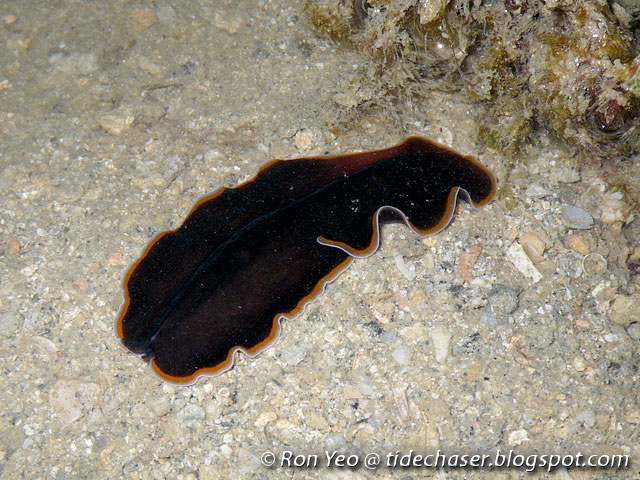
The Hancock’s Flatworm (Pseudobiceros hancockanus) another often seen flatworm. This flatworm has a dark brown to black body with three marginal bands. There is a thin white band at the edge, followed by a translucent grey band and then an orange inner border within the grey band. This species inhabits coral reefs.

A similar-looking flatworm is this one, which is also black, but has a white border followed by an orange border right at the edges. This flatworm is still unidentified.

This flatworm is white with blue edges, and has three black-bordered yellow stripes running along its back. Its identity is currently still under investigation.

This flatworm is commonly called the Purple-spotted Flatworm (Pseudoceros laingensis). This flatworm can be recognised by the purple spots on its cream-coloured body and the irregular blue or purple spots forming a margin around it. It is usually found on coral reefs and adjacent areas. This species feeds on colonial ascidians.

The Blue-frilled Flatworm (Pseudoceros indicus) has a white body with irregular blue or purplish-blue spots forming a margin. It is often found on coral reefs and rocky shores. This species displays parental care, in which the adult covers the eggs with its body until they hatch. The intensity and frequency of this behaviour decrease over time.

This is another variation which the blue dots are more closely-packed.

This small flatworm is sometimes seen on our shores. It resembles Pseudoceros bifurcus, but the latter has a white line with a red tip on its back, while this individual has a yellow line with a somewhat orange tip, both on a blue background. No sure if they are of the same species, but more obvious specimens of Pseudoceros bifurcus do occur in local waters, though I do not have the photos.

This is another similar-looking one, but is more whitish in colour with blue edges. There are numerous small white patches on the back as well.

A similar-looking one will be the Blue-lined Flatworm(Pseudoceros concinnus) which has a blue line running along its back in the middle, and a blue border on a whitish background. It is commonly seen on rocky shores and coral reefs. This species exhibits long-term parental care, where the adult stays with its egg mass, covering it directly with its body.

This one comes with pale white patches on the body. It is not known whether it is a variation of the previous species or something different.

The Black Flatworm (Pseudobiceros bajae), when closely examined, has numerous tiny, if not microscopic, white spots densely covering the back of its body. It is mostly found on coral reefs.

This flatworm is commonly called the Lizard Island Flatworm (Tytthosoceros lizardensis). This species is usually olive green or brown, with numerous tiny white spots either densely arranged to form fine streaks extending laterally towards the margin or clustered to form mottled patterns. The body has a thin black inner marginal band, sometimes interrupted by white dots, and a thin white outer margin. This flatworm is usually found on coral reefs and adjacent areas.

This is possibly a colour variation of the same species. It is somewhat brownish-yellow, but similarly the colour darkens toward the edges and has the black followed by white border at the edges.

I have only seen this unidentified translucent flatworm once. It has numerous brown dots on it.

The Lightning Flatworm (Pseudobiceros fulgor) has numerous fine white lines forming lightning-like patterns on its mainly reddish-brown back. Random, blurry white or yellow blotches may be present along some of the lines. This species is found in seagrass meadows and on coral reefs. "fulgor" means "lightning" in Latin.
References
- Newman, L & L. Cannon. 2003. Marine Flatworms: The World of Polyclads. CSIRO Publishing.
- Ruppert, E.E. & R.D. Barnes, 1991. Invertebrate Zoology International Edition. Saunders College Publishing, U.S.A. 1056 pp.
- Seifarth W. (2003) Marine Flatworms of the World. Retrieved August 1, 2012, from http://www.rzuser.uni-heidelberg.de/~bu6/index.html


1 comment:
Thanks for the information. Useful for the preparation of a lesson plan for Cambridge marine Science.
Post a Comment